Showing posts with label EDGE. Show all posts

Sunday, 7 May 2017

Terry Harknett

I generally drop western legend, Terry Harknett AKA George G. Gilman, writer of among others, the classic Edge series of westerns, an email every so often and usually get a prompt reply. However my last few emails went unanswered and I was dismayed to find that Terry, now 80 years of age, is living in a care home in Dorset. He celebrated his 80th Birthday at the home just before Christmas last. He marked the occasion with a special white chocolate birthday cake, golden balloon and a party which he shared with his friends and staff at the 29 bedroomed, Grade II listed Victorian manor house.

Terry's work, especially his Edge series is still widely read and I am honoured to have been involved in getting the first Edge novel into digital print, before fellow western fan Malcolm Davy took over the digital transition of the ancient texts. Terry and I would pass emails back and forth and Terry often read the Archive, several times sending me private messages on articles that graced these digital pages.

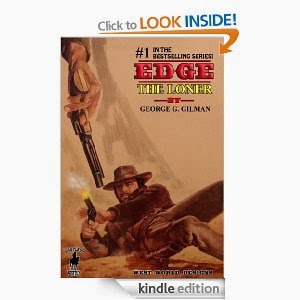
The first time Edge ever saw digital print with an introcution by myself
I, and I'm sure all fans, would like to send their very best wishes to Mr Harknett...a true legend of western literature.

Below I have reposted an interview with the great man which was originally published on the Archive back in 2008 -

The US publisher called the Edge series, "The most violent westerns in the world."

And they were but it was stylised violence, Grand-Guignol violence, written by an author who didn't much like violence but managed to tune into what the western reading public wanted.

"I was worried about the amount of graphic violence I was asked to put in the Gilman books and it was a cold blooded decision (pun intended) by me to counter-balence this with humour. Fortunately my publishers and later the reading public didn't seem to mind even though some of the jokes were very anachronistic that tended to ruin whatever degree of realism I had manged to convey in the narrative."


The humour certainly became a big part of the series. And perhaps that's what made them stand out from the other Oater-Nasties in the bookshops, maybe it was this often surreal humor that makes the series so evergreen. The series ended in 1989 and the books are not in print but there is still an huge demand. At the time of writing there is a copy of Edge no 60 on Ebay and it's currently been bid upto £31. Not bad for a cheap paperback.

Besides the Edge books George G. Gilman, real name Terry Harknett, created Adam Steele (there are 49 books featuring this character) as well as other lesser series characters and was responsible for the Fistful of Dollars novelisation under the name Frank Chandler.


"My first published books were hardback mysteries for Robert Hale featuring a London private eye called Stephen Wayne. And later I wrote several crime novels for a handful of paperback and hardback publishers. But it was Edge that eventually allowed me to become a full time writer."


Terry was born in Essex in 1936 to a working class background. He went to a secondary modern school and was a very practical boy, developing an interest in mechanics.

"After my initial boyhood ambition to become a motor mechanic was dashed by a school career visit to the Ford Motor Company factory in Dagenham - I was born only a few miles away. I decided I wanted to be a mystery writer instead."

Motor mechanics to mystery hack is quite a radical turn around. Can't quite see the connection there somehow but for Terry it made perfect sense. The motor industry's loss is the reading publics gain.


"I was always painfully shy as a kid, still am in many ways. In fact I still have a phobia about being the centre of attention. I wanted to be rich and, as a fifteen year old, it seemed to me that only those born with a silver spoon in their mouths or famous people in the public eye got to be rich. There was once exception - writers, who could beaver away in their lonely studies writing books that would bring them wealth - some of them, anyway. And since my favourite reading matter was American hard boiled crime fiction this was the genre I would make my fortune working in."


Only in life, as I'm sure Edge pointed out somewhere in his laconic drawl, things never quite work out as planned. Terry's first job was as a copy boy with The Reuters News Agency. He stuck at this for nine months and then he went across to Fleet Street and got a post in a features syndicate agency. Here his duties was buying articles, crossword and strip cartoons and then flogging them onto various markets. It was here that Terry started writing short stories and he saw several syndicated via Newspaper Services.

National Service came next and saw Terry serve with the RAF. He chose to be a typist which gave him access to a typewriter and a good amount of free time. He started writing books, actually writing two unpublished novels on RAF headed notepaper. Terry says that these books were basically Raymond Chandler copies but not anywhere near as good as the master who was his favourite author.

After finishing his duty to his country Terry went back to Reuters but soon he left and got a job at the Twentieth Century Fox publicity department. He was based in Soho Square and not Hollywood which rankled somewhat. Eventually Terry went back to work for Newspaper Features again but the company was in trouble and would soon go down the pan. Eventually Terry came into contact with the late Peter Haining when he went up before a board for a job with The National Newsagents Society.

Someone there thought Terry was unsuitable for the job but meeting Peter Haining was the start towards becoming a bestselling writer. By this time Terry was churning out Chandleresque crime novels for Robert Hale, present day publishers of the Black Horse Western series. Terry was a Chandler buff and read everything the great man published but he felt he could never aspire to his greatness. Didn't stop him trying, though.

Eventually Terry ended up with New English Library where Peter Haining was in charge of the paperback division. Terry's first novel for the imprint was The Weekend Game and he followed that up with W.I.T.C.H. The latter book, about militant bra burning feminists, was written under the name Jane Harman which was Terry's wife's maiden name. The title stood for - we intend to create havoc.

Terry took whatever commission he could find (although he did turn down an offer of £1000 a book for writing hard core porn) and this led to him penning the novelisation of the Clint Eastwood movie, A Fistful of Dollars and then several other spaghetti western based novels. He was asked to create a new western series for New English Library - all action, violent in the style of the Italian westerns which were taking so much money at the box office and Edge came from that.


"I had never read a western novel when I did my first and I consider that fact was a cornerstone to the success of George G Gilman.. For Edge had to be an original concept since having no idea what a western book should be like I had to create the series almost out of thin air. Of course I was aware of Hollywood's version of the Western locale and what the stock characters that peopled it looked like since I grew up in an era when the cinema and television were awash with oaters."


Gilman's Edge was a hit - not initially but it gradually gained a large audience which continued to expand, making the Edge series the benchmark by which all other westerns of the period were judged.

In total the series went on for 61 books, spawned a series of Italian comic book adaptions and the pen name George G. Gilman even had his own fan club.

" I think a good western needs a fast moving story, believable characters and some violent action with a seasoning of gallows humour."

The Edge character certainly delivered those ingredients in spades. Edge would always emerge from seemingly desperate situations, often cheat almost certain death. In many ways the character was a superhero - where Batman had his utility belt, Edge had his cut-throat razor. Where Superman had his cape, Edge had his Winchester. The Edge books provided sheer enjoyable escapist fiction, never taking itself too seriously so that although westerns, the books seem to be lodged in a sub-genre of their own.


I wondered if Terry had ever been to the American West.

"Jane (my wife) and I took one of those bus tours of the South-western US many years ago - Los Angeles-Grand Canyon-Las Vegas-San Francisco and many points between. All this really gave me in terms of research for the Gilman books was a sense of "the big sky" and vast distances spread out beneath it. And I must admit the most significant part of the trip for me was walking the streets of downtown Los Angeles where my all-time favourite fictional hero Philip Marlowe plied his trade."

And so I've spoken to a literary hero of mine and I'm as excited as the kid I was when I first read the Edge novels. To my mind the Edge series is the perfect example of the British pulp tradition and the books, although very violent, are never downbeat and the narrative is so slick your eyes slide smoothly from page to page. Pick one up and before you know it your hooked which is part of the reason the books fetch so much on Ebay. Terry though, forever modest, has a theory on that.


"It never ceases to amaze me that that my ancient scribblings continue to interest readers. Although I take little notice of how they come and go on e-bay. For I think most people who acquire them in this area are collectors hopeful of making a bob or two profit in the future, rather than readers seeking to enjoy my deathless prose!"


We'll have to agree to disagree on that point as I know many people who love the Edge series as well as a lot of Terry's other Gilman stuff. Adam Steele is always worth a read but Edge is something special - these are great books that I believe will one day see a resurgence. All it takes is an enterprising publisher to start issuing the classic westerns, much in the way Hard Case Crime are doing for mysteries and a new legion of fans will be found.


Terry's top ten western movies
In no particular order:
Leon's Eastwood Dollar Trilogy
Once upon a time in the west
The Shootist
The Searchers
Soldier Blue
Rio Bravo
High Noon
Terror in a Texas Town

George G. Gilman on the web:

A man called George G. Gilman

Gilman Forum


Known Pen-names
George G Gilman, Adam Hardy (with Kenneth Bulmer), Jane Harmon, Joseph Hedges, William M James (with John Harvey and Laurence James), Charles R Pike (with Kenneth Bulmer and Angus Wells), William Pine, Thomas H Stone, William Terry

Tuesday, 21 January 2014

Keeping the Edge

Now available as eBook
No one could reasonably deny that Leone’s best work was not as defining and important to the western genre, as the best of John Ford or Anthony Mann. Leone’s westerns were spawned from imitation and yet became vastly imitated themselves.Inhabiting the West of the American movies Leone gave the genre a much needed kick, created a heightened reality, both surreal and stylized. He gave the stock gunslingers and cliched bounty hunters a coolness that appealed to the counter culture. Much the same argument can be used with the Edge novels of George G. Gilman – they too were born out of imitation, influenced by the films of Leone and other European directors who were themselves indebted to the Americans. And they too were widely imitated and like Leone they too redefined the western. For where Leone started out as an imitator he ended up creating a sub-genre of his own, as did George G. Gilman. It was the tremendous success of the Edge series that kicked off the boom in Adult western novels.

They are without doubt the most important of the British westerns – true J T Edson was more prolific but, although highly readable, he took his influences first hand from the great American westerns, while Edge drew from a well polluted by the excesses of Leone, Corbucci and others. This resulted in Edge proving popular with a younger, more hip readership than was usual for the western genre.

A man without fear
A man without remorse
A man who survives because he has … the Edge
Edge comes to eBook


#1: The Loner
#2: Ten Grand
aka Ten Thousand Dollar American
#3: Apache Death
#4: Killer’s Breed
#5: Blood on Silver
#6: The Blue, the Grey and the Red
aka Red River
#7: California Killing
#8: Hell’s 7
aka Seven Out of Hell
#9: Bloody Summer
#10: Vengeance Is Black
#11: Sioux Uprising
#12: Death’s Bounty
aka Biggest Bounty
#13: A Town Called Hate
aka The Hated
#14: Big Gold
aka Tiger’s Gold
#15: Blood Run
aka Paradise Loses
#16: The Final Shot
#17: Vengeance Valley
#18: Ten Tombstones to Texas
#19: Ashes and Dust
#20: Sullivan’s Law
#21: Rhapsody in Red
#22: Slaughter Road
#23: Echoes of War
#24: The Day Democracy Died
aka Slaughterday
#25: Violence Trail
#26: Savage Dawn
#27: Death Drive
#28: Eve of Evil
#29: The Living, the Dying and the Dead
#30: Waiting for a Train
aka Towering Nightmare
#31: The Guilty Ones
#32: The Frightened Gun
#33: Red Fury
#34: A Ride in the Sun
#35: Death Deal
#36: Town on Trial
#37: Vengeance at Ventura
#38: Massacre Mission
#39: The Prisoners
#40: Montana Melodrama
#41: The Killing Claim
#42: Bloody Sunrise
#43: Arapaho Revenge
#44: The Blind Side
#45: House On the Ranged
#46. The Godforsaken
#47: The Moving Cage
#48: School for Slaughter
#49: Revenge Ride
#50: Shadow of the Gallows
#51: A Time for Killing
#52: Brutal Border
#53: Hitting Paydirt
#54: Backshot
#55: Uneasy Riders
#56: Doomtown
#57: Dying is for Ever
#58: The Desperadoes
#59: Terror Town
#60: The Breed Woman
#61: The Rifle
For more than twenty years the Edge books dominated the western scene, equally successful in the UK and US and in fact translated into ten different languages. Many of the Edge titles are available in eBook

Sunday, 23 December 2012

The Western is dead - well, that's fighting talk.

One of the most eagerly awaited movies of the holiday period is, Django Unchained - a western and recent years have seen several excellent westerns coming from Hollywood - True Grit and Blackthorn to name but two. On the fiction front genre writers such as Larry McMurtry and Cormac MacCarthy have entered the mainstream and brought the genre many new fans and the eBook revolution is seeing a lot of classic western material coming back into print - Check out Piccadilly Publishing - an outfit that are fast becoming my favorite publisher, well apart from Robert Hale but then I'm biased there since it is Hale's Black Horse imprint who publish my own novels. And of course many of the excellent George G. Gilman westerns are now available as eBooks which is reason enough to check out the genre.

That's a lot of activity for a so called dead genre.

 At the grass roots, where the fans hang out, there are scores of western blogs and web sites with new ones springing up all the time. There are some excellent western blogs - Western Fiction Review, Rope and Wire and Black Horse Express are just three of a list that could go on forever. Check out the recommended reads in the sidebar of this blog for some great western websites.


That's a lot of activity for a so called dead genre...so is the western entering a revival phase?

To my mind the western has never really gone away nor has it rolled over, turned a sickly green and been in need of reviving. Even during the Eighties when the genre seemed to vanish from bookshops there were still loyal fans.

So why now this surge of interest?

What surge? There is no surge? The only difference these days is that we've got the Internet and booksellers are able to get their books, whatever the genre, to a wider demographic than ever before. It was only the book sellers that claimed the western was dead in the first place but now that fans are able to come together via the Internet or as we call it here, The Wild West Web they can dictate what it is they want. Type in BOOK BLOGS into Google and it soon becomes obvious that genre fiction is still popular and not only westerns but horror, SF, crime, hardboiled. And yet go into any bookshop (if you can find one) and you'd swear only a handful of big name authors were ever read, but westerns are well supported in the electronic book store with new and classic books now available as eBooks.

Genre fiction is formulaic they say. And to some extent it is but then so are the blockbusters that line the bookshop shelves. These blockbusters are of a uniform building brick size and if that's not writing to a formula then I don't know what is. Over the last few years  I've gotten to know a lot of western writers and to a man (or woman, of course) they are all trying to push the envelope of what is acceptable in a western. If you want an example of diversity in the western genre then check out the  anthology A Fistful of Legends from Express Western. The book contains 21 western stories including one from myself.


My own westerns (self promotion warning) Tarnished Star, Arkansas Smith, The Ballad of Delta Rose and Wild Bill Williams  may stick closely to the classic style of western storytelling but I have tried to work in subtexts.

Tarnished Star in many ways questions what it is to be a man and the responsibilities we all share. And whilst Arkansas Smith travels a far darker trail there is, I hope, a story being told on more than one level. The Ballad of Delta Rose is a story of redemption  and Wild Bill Williams is something of a culture shock western. My next Black Horse western,  The Afterlife of Slim McCord pushes the boundaries to breaking point - at least, I hope it does..

That's why I love the western, both as a writer and a reader - the possibilities are endless and far from being straitjacketed into an endless routine of Cowboys and Indians or white hats and black, the genre can go anywhere it wants, can explore both the good and bad sides of human nature.

I can never stray too far from the deserts and plains, the mountains and the rivers - it's the landscape of adventure and great courage. For the past few months I've been working on another cozy crime novel set in my native South Wales - A world away from the Wild West and yet there are still western elements in everything I write; look hard enough and they are there.

Me as a cover star!
The point is that no matter what I do, where and when I set my stories, there will always be something of the western about them.

And recently I was thrilled to find that my image was used as the inspiration for the new cover art for the Ben Bridges western, Hangman's Noose - how cool is that to be immortalized as a character in a western! I do hope the book sells squillions because not only is Ben Bridges a fine western writer but that's such a good looking lead character.


So go on give a western a try...you'll be glad you did.

Wednesday, 19 October 2011

The Edge is back

He's back again!

Just goes to prove you can't keep a good man down!

Who am I talking about?

Why Edge of course - that no nonsense half breed who carried a series of westerns that became my all time  favorite western series. You may remember I, together with the original author, made attempts to bring the Edge series back into print as eBooks and the first volume,Edge The Loner was published by Solstice Westerns. I was over the moon and am still mighty proud of my association with the Edge books. However sales weren't great and I became tied up with other projects, not to mention several months filming in Africa, the sale of the film rights for my own first novel, and a little project with that madman Vincent Stark.

Eventually it was decided to pull the plug. There was a film/TV project for the Edge character bubbling away in the background and when the gentleman responsible for the film pitch started looking at eBooks it was felt that given the low sales my Edge eBook project should be pulled to avoid stepping on the toes of any tentative multi media possibilities for the character. I still think things would have changed with several more volumes on the eMarket, but in all fairness I couldn't find the time that the project required. And so reluctantly, feeling that I was turning my back on the half breed, the Edge eSeries was pulled.

Now though thanks to western writer and friend of the Archive, Cody Wells, Edge is once again riding towards digital print...find all the exciting details HERE


Monday, 3 January 2011

Wild West eMonday - Edge and George G Gilman

If there is one western series more than any other that is responsible for my lifelong love of the genre it is the Edge series by George G. Gilman. The widely violent and satirical series of westerns were published from the early Seventies until the late Eighties and earlier this year the first in the series, Edge The Loner returned as an eBook. I had more than a little to do with this and indeed the new edition features an introduction from myself.

There aren't many western series that can boast the strong cult following of the George G. Gilman Edge series. The first in the series is available in eBook now and to celebrate Wild West eMonday we are reposting an earlier interview I did with the author. And so settle around the virtual campfire for a chat with Mr George G. Gilman.


Come on and sit down besides the virtual campfire. Take the weight off your feet and grab a cup of java. This time we’re sharing the virtual campfire with Mr. Terry Harknett, otherwise known as George G. Gilman, author of many fine westerns and creator of that evergreen loner, Edge.
And so with the Edge series about to make its explosive debut in eBook format, I thought it was a good time to chew the fat with Terry. We both invite you to share in our conversation.


Cowboys and 'injuns - not likely!
GD: Before you decided on the name Edge were there any other choices you considered?

TH: As I vaguely recall from the dark and muddy depths of my memory, the first name I came up with for the main character in my first ever Western was... Hell, I can’t remember! Because I was so immersed in American private eye fiction rather than riders of the range it was probably a variation on Hammer or Marlowe or Shayne etc. Whatever it was, Laurence James who was the commissioning editor at New English Library told me in no uncertain terms that it would not do and to come up with something more ‘Western’.
And over one of many alcohol fuelled lunches that took place in the creating of Edge, the hero’s name and most famous weapon were decided upon. Although, on second thoughts, I now seem to recall that in the initial synopsis I wrote for the first book in the series the character was called something along the lines of The Tornado Kid! Remember, a great deal of my Western knowledge came from the serials I watched as an ABC Minor at the Saturday morning picture shows

God, thank you Laurence!!!


GD: Thank you Laurence indeed!  The Tornado Kid: The Loner - doesn’t really scan.
From my understanding when the series was decided upon you outlined four Edge books at a time. Do you think this pre-plotting gave you some advantage in developing the character book from book? Even though you were only working on one book at a time in the actual writing - during the initial outlining you were working on a much bigger canvas. I imagine you must have set stages of character development you wanted to reach with each book?


TH: At the outset NEL commissioned just two books and of course nobody who was involved at the time envisaged what was to happen down the line. So the first two titles were written with no idea about developing the characters beyond how they shaped up in each of this pair of stories.
When the books were published and became instant successes the next and subsequent contracts specified four books. But even then I looked no further ahead than the end of each book in terms of where Edge was going and what he was going to do to get there! The stories just kind of built themselves up out of the bare bones of the five or six pages of each synopsis. I cannot bring myself to be so pretentious as to claim that Edge and other major characters took over the narrative and I simply reported their exploits and conversations.
So maybe I was just lucky and possessed a natural flair for storytelling that flowed from my brain with little effort on my part. I certainly never came up against what some authors term ‘writer’s block’.  Until the creative juices ran dry and I realised I had to call a halt. 


GD: That’s interesting - because there is a very definite character development with Edge from book to book, something that stopped him feeling stale. Even today the books read fresh. I would say you do indeed have a natural flair for storytelling and obviously book buyers must have felt the same. You say the stories came from your brain with little effort - maybe great work is often created in this way. It like’s when Paul McCartney dreampt the song Yesterday; it was written with no effort or work at all and yet it is as beautiful as any slaved over piece of music. And Conan Doyle often claimed to just bash out the Holmes stories. And in the field of pulp style adult westerns, George G. Gilman is the undisputed king. And, I suspect, always will be - when taken as a whole it’s an impressive body of work, and as worthy of the tag,  “literature” as any of the pulp classics.

The Edge books sold in phenomenal numbers and influenced many imitators - thankfully The Tornado Kid was not among them. Indeed you even became something of an imitator yourself with your own Adam Steele series. I’m not saying Steele was the same as Edge, he wasn’t and is an entertaining series in its own right. But the books were ploughing the same furrow pioneered by Edge. In fact in many ways Steele is a more rounded character and although successful, he never quite reached the heights of Edge. Who did you prefer writing - Steele or Edge? And don’t say Jubal Cade!


TH: I have often told fans, not entirely with my tongue lodged firmly in my cheek, something along the lines of I was never sure if I had written over a hundred westerns or the same western more than a hundred times. For in writing book after book in double quick time to meet the publishing schedule I was always wary of the danger of sub-consciously repeating myself with certain scenes and using clichéd characters in what it seemed to me was a somewhat formula based genre. So I think I did make an effort to develop the characters of my protagonists as I related their adventures over the years in an attempt to ring the changes. This said, I certainly recall as the number of Edge books moved toward double figures abandoning the attempt to adhere to strict chronology as he aged against a backdrop of actual events and this is the reason that, apart from the Civil War stories I hardly ever incorporated such events in my books.
All of which brings me to putting forward the suggestion that maybe the character development readers are aware of is the reason for the fresh element they find in the stories. What I suppose I am saying is that this all came about naturally in the creative process without me having to think too hard about what I was writing – so lucky me, I guess! I did have to think more deeply and work harder on the Adam Steele and Jubal Cade series, always conscious of the dangers of cloning them out of the raw material provided by my experience of creating Edge. And maybe because of the blood, sweat and tears I was required to expend on the creative processes of producing these two series was the reason they lacked the magic ingredient that led to Edge being so phenomenally successful?
So, to answer the direct question you posed I always preferred working on the Edge books above all others since they were relatively easier to write. And when the spinning coin has an easy and a hard face a basically lazy feller like me has always called easy and hoped it was a winner! As I am sure you have discovered, Gary, ‘relatively’ is a word with something of an elastic meaning in terms of fiction writing.  


GD: Your wrote three team-up novels in which Adam Steele and Edge shared the limelight. Were these your idea or did the publisher suggest these? Personally I enjoyed the three books but never found them as successful as the stand-alone series featuring the characters. Do you think that with the team up’s you might have over-milked the pudding?
Even the birds dug Edge

TH: If anyone from NEL’s Editorial Department is still around and maybe paying attention to this area of cyberspace I guess they could argue the point. But I’m pretty certain the Edge-Steele team-up books was an idea that that emerged from a brainstorming session held at the publisher’s office. They had one and a half bestselling series on their hands and a tame writer ready to write anything (outside of science fiction, romance or porn) so why not lay this wheeze on him?  And it worked in terms of me signing the contract and crouching over the keyboard to provide what was required.
But my agreement was against my better judgement since I thought then (as I still do today) that ‘buddy’ stories featuring men – or women, I guess - who are supposed to be equal in prowess do not work. One of them has to be better at some skill or other. Of course, they can switch superior roles from time to time, but how can the writer divide the kudos? I never did discover how to do this with two characters so well established in their own series.
And since I have been asked this same question many times in the past, I have wracked my brain over the years trying to come up with a pairing by other writers that succeeded in being a ‘matching pair’ and have always failed. I am, of course open to suggestions that will prove me wrong!

GD:      You’ve said that you started off writing mystery fiction and that you maintained that ambition even after the westerns took over. Did you in any way resent the success of your westerns and feel that they stopped you working on your first love, the mystery novel? Did you ever think of Edge in the way Conan Doyle thought of Holmes - that he was diverting your attention from what you really wanted to write? Yes I know that’s the same question asked two different ways but you sure know what I mean...

TH: Here we return to my contention that I am a hack in the true definition of the word that implies somebody who writes for money – and I cannot accept that there are many writers who do not! Certainly I would have preferred to write private eye mystery fiction in the same style as Chandler. And I tried in ten books to do this. Probably halfway through this attempt I came to the conclusion that my ambition was for many reasons doomed to failure.
For starters, I did not attain his level of education and certainly did not have his  talent for prose writing. Also, I was not American and had little chance of living in the US. So I lowered my sights and reverted to simply wanting to be a professional writer in whatever genre (with certain exceptions) would make this possible. This genre turned out to be Westerns that on reflection was a fortunate turn of events since it meant I was able to the best of my ability to write in an American style against a US backdrop – albeit in a different century!
No, I never resented the success of my Westerns that provided me with a pretty decent living doing a job that I loved. Remember, I was a hack! But even when the success of Edge was demonstrating which side of my bread was spread with butter, I did once attempt to revert to the American mystery in the regrettably short-lived and unlamented Chester Fortune series!
It was not to be but no tears were spilled!

GD: Does it surprise you this continued interest in Edge? Are you ever shocked by the prices some of your books fetch on sites like Ebay?

TH: I’m one of those people who are very easily led and an American devotee who has been a fan of the series for many years directed me toward killing off Edge.  And I toyed with the idea of rounding off the series many times until I finally got around to stating to write the book, which had many working titles until I settled on ‘Detour to Destiny’. Maybe because I had not written any fiction since completing the six titles in the ‘Mini Series’ I became something of a dilettante as I worked on the book. And I only returned to the work in progress when the mood took me – a method of writing that was far removed from the professional attitude I had to adopt when I was tied in to contacts with their tight delivery dates.
And when I was getting close to the near 200 typescript pages that now exist - reading and re-reading them several times (a novelty for me!) I became increasingly dissatisfied with the material I was producing and it was easy to blame Edge for refusing to die while in my heart of hearts I knew the fault was mine because I had quite simply run out of creative juice. So the work I was doing was not up to the standard I had set myself and I thought it best to go out on whatever level I reached in ‘The Rifle’ and not push my luck any further. I am sorry if my fans – one in particular - feel let down because the series did not reach the conclusion I and my American fan had in mind for it, but that’s the way this cookie has crumbled I’m afraid. Sorry Trever.
When I see copies of ‘The Rifle’ selling for silly money on e-bay I am pleased for the lucky sellers and stunned by the enthusiasm of the buyers. Although I have a sneaking suspicion many of those involved are wheeler-dealers rather than fans seeking to complete their collections and the books that change hands are never read by their new owners. I also regret that I only have one copy of the final published book on my vanity shelf so am unable to make any extra loot myself!

GD: Ahh yes of course the six novels you wrote featuring an older Edge and then gave them away free online. I keep forgetting about those when I think of the Edge series – I’ve always been of a mind that only the 61 books in the regular series are really canon, but I suppose the six online books, given that they are written by yourself are very much a part of the story. Was there never any attempt to publish these later books conventionally?


TH: I had ‘retired’ from writing westerns (or so I thought!) and attempted to return to my first love in fiction. But after I struggled with total lack of success to come up with a half decent private eye mystery I had to face up to the fact that it was - as it always had been - not what destiny had marked me down for.
But at that time I still felt an urge to write and had the time to indulge the need so decided it would be an interesting exercise to continue writing about Edge as he aged and became even less of a violent character than he had developed into over the final few published books.
By this time the era of the Piccadilly Cowboys was over so I knew there was little or no chance of these books finding a publisher. But I thought, what the hell, I had a fan base of loyal readers who had stayed with me over many years, shelling out good money to read what I wrote. So as a thank you to all those people who had ensured there was always bread on my table and whisky in my glass over so many years, I decided to offer the ‘Mini Series’ for free on the Internet.  So that is what I did, without any sense of regret that no royalty cheques were going to roll in!
But I was rewarded in one way. For I was able to despatch Adam Steele in one of the final six books to neatly round off this Gilman series.  Which just leaves Edge to get his comeuppance (for did not Barnaby Gold go to a better place in the sixth book of The Undertaker series - or did he?)


GD: Somehow I think the day of Edge’s comeuppance will be a long time coming. The Edge mini-series is still available to read on the Internet – find them HERE. And now the first in the regular series, Edge: The Loner has burst back onto the western scene in all new eBook and print-on-demand paperbacks.
Edge is back – twice as mean!

Wednesday, 8 September 2010

Edge the eLoner

There's a great review by respected western author James Reasoner of Edge: The Loner - now out on eBook

Find the review HERE

Tuesday, 24 August 2010

STEVE M AND AMAZON ARE ALL ON EDGE

Check out Steve M's entertaining western news round-up HERE

The Edge will soon be travelling up the Amazon
And many of you are waiting for the Edge eBook to appear on Amazon - well sit tight because we've hit a little snag which will be remedied in a day or two. You see Amazon's servers are having trouble with the book because they are having clashes with the many second-hand copies of the old Pinnacle Edge books on offer from associate sellers on Amazon. The Amazon system is throwing this up as a copyright issue with Pinnacle. All Amazon needs is documentation of the ownership of copyright which is the original author, Terry Harknett as all rights reverted some considerable time ago. So the delay in the book being listed on Amazon, the biggest online marketplace is just a hitch that we are working to sort out at the moment. The new Edge eBook will be there very soon and The Archive will send you over. However anyone wanting to buy the book immediately can do so from the publisher's site HERE.

Edge is the western series too tough to die.

Friday, 13 August 2010

Living on the Edge - Guest blogger The Bish

Paul Bishop, The Bish to friends, is a long serving Police Officer with the Los Angeles Police Department - in his spare time he is a connoisseur of pulp and pulp-related fiction. So it was no surprise to find that he was a fan of the writings of George G. Gilman, Mr. Edge himself. And so we present Bish's take on another Gilman western series, The Undertaker:
Blacker than black


BROUGHT UP WITH DEATH, HE LEARNED TO KILL

With that epithet used as promo copy on the front of each book, the prolific writer of ultra-violent westerns, Terry Harknett, began a third series – after Edge and Adam Steele – to be written under his famous George G. Gilman pseudonym, The Undertaker.

This wasn’t Harknett’s third series by any stretch, he’d already started and contributed numerous titles to the Jubal Cain western series and the Apache saga, but under another pseudonym.   He’d also put out books under his own name in the Crown series set in ‘70s Hong Kong, the hardboiled London based police series featuring Chester Fortune under the name Thomas Strong, and an Executioner-style series, The Revenger, as Joseph Hedges.

It was with The Undertaker, however, Harknett would try to get more of the Gilmore gold to rub off.  Featuring humorless mortician Barnaby Gold, the series debuted in 1981 with Black As Death.

In the opening novel, Barnaby Gold goes from doing a mortician’s work to piling up a mortician’s victims when he kills the rancher who murdered his libidinous wife. The problem now arises, and the conceit of the series, as the dead rancher’s relatives pursue Gold and, in subsequent books, constantly frustrate his plans to leave the United States for Europe.
Gilman's characters were snappy dressers

While the series only lasted six books, it contained a certain amount of morbid humor that was different than the style of dry humor for which both the Edge and Adam Steele series were known.  This made them a refreshing change, as if Harknett was having a wink at the reader and including him in the nasty fun.  For that reason alone they are worth seeking out, along with the very cool uniform covers.

Barnaby Gold is rumored to have also made a fleeting appearance in the final, ultra-rare Edge novel, The Rifle (1989), but that one is missing from my collection and out of range of my pocketbook.


THE UNDERTAKER SERIES

BLACK AS DEATH
DESTINED TO DIE
FUNERAL BY THE SEA
THREE GRAVES TO A SHOWDOWN
BACK FROM THE DEAD
DEATH IN THE DESERT

Thursday, 12 August 2010

WHY EDGE MATTERS

A FRESH TAKE ON THE OLD WEST
No one could reasonably deny that Leone’s best work was not as defining and important to the western genre, as the best of John Ford or Anthony Mann. Leone’s westerns were spawned from imitation and yet became vastly imitated themselves, for in inhabiting the West of the American movies Leone gave the genre a much needed kick, created a heightened reality, both surreal and stylised. He gave the stock gunslingers and clichéd bounty hunters a coolness that appealed to the counter culture. Much the same argument can be used with the Edge novels of George G. Gilman – they too were born out of imitation, influenced by the films of Leone and other European directors who were themselves indebted to the Americans. And they too were widely imitated and like Leone they too redefined the western. For where Leone started out as an imitator he ended up creating a sub-genre of his own, as did George G. Gilman.

They are without doubt the most important of the British westerns – true J T Edson was more prolific but, although highly readable, he took his influences first hand from the great American westerns, while Edge drew from a well polluted by the excesses of Leone, Corbucci and others. This resulted in Edge proving popular with a younger, more hip readership than was usual for the western genre.

A man without fear
A man without remorse
A man who survives because he has … the Edge
Edge comes to eBook


#1: The Loner
#2: Ten Grand
aka Ten Thousand Dollar American
#3: Apache Death
#4: Killer’s Breed
#5: Blood on Silver
#6: The Blue, the Grey and the Red
aka Red River
#7: California Killing
#8: Hell’s 7
aka Seven Out of Hell
#9: Bloody Summer
#10: Vengeance Is Black
#11: Sioux Uprising
#12: Death’s Bounty
aka Biggest Bounty
#13: A Town Called Hate
aka The Hated
#14: Big Gold
aka Tiger’s Gold
#15: Blood Run
aka Paradise Loses
#16: The Final Shot
#17: Vengeance Valley
#18: Ten Tombstones to Texas
#19: Ashes and Dust
#20: Sullivan’s Law
#21: Rhapsody in Red
#22: Slaughter Road
#23: Echoes of War
#24: The Day Democracy Died
aka Slaughterday
#25: Violence Trail
#26: Savage Dawn
#27: Death Drive
#28: Eve of Evil
#29: The Living, the Dying and the Dead
#30: Waiting for a Train
aka Towering Nightmare
#31: The Guilty Ones
#32: The Frightened Gun
#33: Red Fury
#34: A Ride in the Sun
#35: Death Deal
#36: Town on Trial
#37: Vengeance at Ventura
#38: Massacre Mission
#39: The Prisoners
#40: Montana Melodrama
#41: The Killing Claim
#42: Bloody Sunrise
#43: Arapaho Revenge
#44: The Blind Side
#45: House On the Ranged
#46. The Godforsaken
#47: The Moving Cage
#48: School for Slaughter
#49: Revenge Ride
#50: Shadow of the Gallows
#51: A Time for Killing
#52: Brutal Border
#53: Hitting Paydirt
#54: Backshot
#55: Uneasy Riders
#56: Doomtown
#57: Dying is for Ever
#58: The Desperadoes
#59: Terror Town
#60: The Breed Woman
#61: The Rifle
For more than twenty years the Edge books dominated the western scene, equally successful in the UK and US and in fact translated into ten different languages. And if any western series deserves to be brought back into print it is the Edge series.

Let's be careful out there......

  The recipient of 26 Emmy awards, actually nominated 29 times and between 1981 and 1984 it had four consecutive wins of Best TV Series. It...