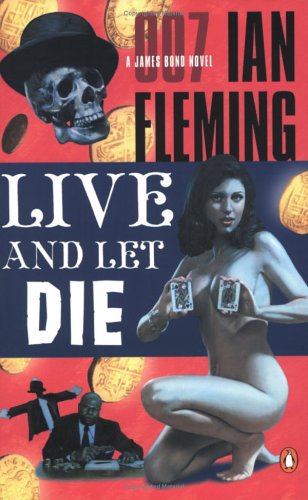
In a couple of months we will have a new James Bond movie, as the film franchise celebrates fifty years, but to get to the real 007 you must return to Ian Fleming's original canon.
“The scent and smoke and sweat of a casino are nauseating at three in
the morning. Then the soul-erosion produced by high gambling – a compost
of greed and fear and nervous tension – becomes unbearable and the
senses awake and revolt from it.”
They are the opening words from Ian
Fleming’s 1953 debut novel, Casino Royale – the book that introduced
James Bond 007 to the world. I know this book, so well, have read it so many times that I can write
the passage above from memory.
Raymond Benson noted, in his excellent James Bond Bedside Companion (1984) that Bond is entirely humourle

ss
in this first novel, and for the most part I would go along with that
but I wouldn’t say the character was entirely without humour. There is
much resigned wit over being partnered with a woman and Bond even laughs
at his own pretentiousness when ordering dinner. And in the latter
sections of the book Bond is overly romantic when falling in love with
Vesper, but for the most part Bond is a stiff no-nonsense type, which
perfectly suits the seriousness of the story. And it is a serious story –
Fleming set out to write the best spy thriller possible – and there is
no time for frivolity.
A highly ingenious plot
sees Bond trying to out gamble Russian agent, Le Chiffre who is trying
to win back the funds he has misappropriated from his paymasters in
order to finance a string of failed brothels. It is felt that if Le
Chiffre fails to recover the monies he has embezzled his ruination will
bring about the collapse of a Communist controlled trade union in
Alsace, something that would be highly desirable to the British,
Americans and French governments.
Fleming’s introduction
of Bond at the Casino is masterful and shows him to live the kind of
high life that was out of the grasp of most people. During the time the
book was written foreign travel was attainable to only the wealthiest
and the degree of description the author gives to the locales would have
seemed incredibly exotic to the average reader.

Fleming is heavy on detail –
offering the minutiae of food, car engines, locations
and weaponry. However the author manages to makes these passages
exciting and interesting – he even fills several chapters explaining the
rather complicated card game and yet the story moves like an express
train. Fleming would pull off similar tricks several times in the
series, most notably with the thrilling Golf duel in Goldfinger. Raymond
Benson, again in his James Bond Bedside Companion, called this
"the
Fleming Sweep" and it is a term we will adopt for this article.
“Three measures of Gordon’s, one of vodka, half a
measure of Kina Lillet. Shake it very well until it’s ice cold and then
add a large thin slice of lemon peel. Got it?”
Did
Fleming consider a series of books when he wrote this one? I feel he
did, several passages seem to suggest he is setting up character traits
in Bond that will be used later. At one point Bond decides to resign
from the service, telling Mathis while lying battered in a hospital bed:
“History is moving pretty quickly these days and the heroes and
villains keep on changing parts.”
To which Mathis replies, “Don’t let me down and become human yourself. We would loose such a wonderful machine.”

Bond,
by the point, has had enough – his body has been beaten almost to
destruction and his mind has taken a similar treatment. Le Chiffre is
dead, killed by a SMERSH assassin, and it all seems to have been so
useless to Bond. He contemplates marriage to Vesper and a normal life,
the kind of life the average person leads. But all this is not to be and
when Vesper is revealed to have been a double agent. His heart hardens
and he weeps real tears as he informs his people that she was a traitor –
“Yes, dammit, I said, ‘was’. The bitch is dead now.”
Casino
Royale is one of the best in the series (personally it’s my favorite)
and the book sets up the shadowy world in which James Bond operates. The
novel details the first meeting between Bond and Felix Leiter and we
are told that Bond uses a .38 Police Positive. With this book Fleming
provided wish fulfilment for many people including a soon to be
President Kennedy whom it later emerged was a huge fan of Mr Fleming.
Live and Let Die came next and is the most problematic of
the novels for the modern reader. I’ve heard people complain that it is
racist, largely because of the frequent use of the words, “Nigger”, (one
chapter is titled: Nigger Heaven) and, “Negro,” but such charges are
ludicrous. Neither word was considered a slur at the time the novel was
written and that is the key. The novel is of its time and as such
reflects that time. Yes it may read xenophobic by today’s standards but
then so would most fiction of this time period.
“It had
been a smart and decisive bit of driving, but what had startled Bond was
that it had been a negress at the wheel, a fine looking negress in a
chauffeur’s uniform.”

The book is set (and was written)
in the early 50’s – a time when there was still segregation,
particularly in the United States where the novel is set. So charging
Fleming with racism is absurd – he was writing fiction set in a
contemporary world – his contemporary world and as such he reflects the
attitudes and realities of the time.
Nuff said, - on the racism issue, I think, otherwise we are at risk of becoming bogged down with the issue - we will treat the book as an adventure story and not consider how truly dated it has become.
We
discover Bond is still driving the Bentley convertible, the grey 1933
four and a half litre with the Amherst-Villiers supercharger – such an
expensive car would have been out of the reach of most readers of the day, still is - and it
is details like this that add to Bond’s appeal. He lives a life
unattainable to mere mortals but one that we would all like to live if
we only had the chance. Bond’s cars are just that little bit larger than
life, as are his women, his clothes and his thrilling adventures.
Fleming
ties up the loose ends left over from the previous novel in this early
section – we learn that Bond has had new skin grafted over the scar on
his hand, the mark of a spy, carved there by a SMERSH assassin at the
climax of the previous book.
“Morning 007. Let’s have a look at that hand. Not a bad job.”
The
meeting between Bond and M doesn’t really flush out M’s character or
the relationship between the two men and as in Casino Royale. M’s brief
appearance is merely to outline the bones of the plot. Though there is a
feeling running between the lines that M holds Bond in high regard but
the overall impression of the chief of the service is that he is a cold,
aloof and very stern. He holds the utmost authority as suggested when
it is revealed Bond wouldn’t dream of smoking in M’s presence unless
invited to do so.
Fleming didn’t really describe Bond
physically in Casino Royale (a conscious decision to let the reader slip
into Bond’s shoes more easily). Other than that comma of hair and those
piercing blue-grey eyes we knew very little about 007’s appearance, but
this time out the author starts to flesh the character out. For the
first time Bond’s face is fully described.
There
is also a lot more humour in the writing – one early section takes some
good-humoured swipes at the American use of the English language. One
section where Bond is being advised on his cover as an American is
particularly good.
“He was reminded to ask for the check
rather than the bill, to say cab rather than taxi and (this from Leiter)
to avoid words of more than two syllables. (You can get through any
American conversation, advised
Leiter, with yeah, nope and sure.) The English word to be avoided at
all costs was, Ectually. Bond assured him it was not in his vocabulary.”
If
Fleming impressed with his descriptive powers in Casino Royale, then he
astounds with Live and Let Die. By the fourth chapter he has given us a
potted history of both Voodoo and piracy on the high seas, he has
described in great detail Bond’s clothing and his breakfast menu, and
yet the story zings along, not once does it slow down, not even when
explaining the background of chief villain, Mr Big – the Fleming sweep
is cranked up to full gear and runs like a well oiled machine. That many of Fleming's details are outlandish matters not because they have an air of authenticity even when they are complete inventions.
The
plot is suitably, “Boy’s Own”, - Gold coins, believed to be from a
seventeenth century pirate horde, have been turning up on the market.
The source is thought to be a treasure hidden in Jamaica by the English
pirate, Bloody Morgan (although Henry Morgan was in reality Welsh). M
believed the gold is being used to finance SMERSH operations on American
soil and that Mr Big, the man behind the smuggling, is an agent of the
Soviet terror organisation. Bond’s initial investigation takes place in
New York where he is re-teamed with Felix Leiter, the CIA operative who
had been such a help in Casino Royale, before moving onto Florida, where
Felix is mutilated by a shark (a scene used in the movie, Licence to
Kill). From there Bond travels onto Jamaica where Fleming pulls off an
extraordinary piece of writing – his description of the underwater world
in the chapter entitled, Valley of Shadows is so effective that the
reader has to come up for air.
“There were no big fish
about, but many lobsters were out of their holes looking huge and
prehistoric in the magnifying lens of the water. Their stalk like eyes
glared redly at him and their foot long spined antennae asked him for
the passport.”
Later Bond and heroine, Solitaire are tied
together and dragged behind a boat (a scene used in the movie, For Your
Eyes Only). It is an effective scene and by the time the story ends the
reader is left exhausted. Bond too it seems – he is given compassionate
leave which he, understandably spends with the lovely Solitaire. Where
sex was only touched on briefly in Casino Royale with Live and Let Die,
Fleming is firmly in wish fulfillment territory and the entire
text is dripping with more sexuality than a dozen Fifty Shades of Grey.
“Opposite
him, leaning forward with concern on her pretty face, was a sexy little
negress with a touch of white blood in her. Her jet-black hair, as
sleek as the best permanent wave, framed a sweet almond shaped face with
rather slanted eyes under perfectly drawn eyebrows. The deep purple of
her parted, sensual lips was thrilling against the bronze skin.”
Fleming
was of course inventing the Bond formula as he went along and with this
book many of the trademarks of the series were developing – exotic
locations, bizarre villains, beautiful women, fast cars, good living,
thrilling danger, are all present and correct. Bond is also humanised –
no longer the blunt instrument of the previous book and it seems like
snobbery is an inherent character trait. Though with Bond it comes
across as charmingly eccentric rather than boorish.
Live
and Let die, though not as tight as Casino Royale, is a fast and fun read. It’s more violent than most of the
other books in the series, but there are many light moments and the
suspense level is cranked up high in several sections. There is also
something of a supernatural feel to the voodoo scenes, which conjure up a
feeling of genuine unease in the reader. It’s no fluke
that James Bond is the massive franchise he is today. Sure the success
of the movies is most to do with the enduring appeal, but it all started
with Fleming’s pen. Those exotic images and fantastic plots that have
made the movies so successful come from the imagination of Ian Fleming
and there is only one place to find the real James Bond and that’s in
these books.
Moonraker came next and although an improvement on Live and Let Die, and an easier read today, it is further away from the formula that would eventually be set in stone than the previous book. It's still a spy thriller but the driving force is that of a detective story, with Bond cast in the role of investigator.
It’s a muc

h
slower, more thoughtful novel than the previous two and it’s nothing
at all to do with cool looking laser guns and bad guys in one piece
yellow suits. After two largely fantastical novels Fleming brings the
series down to earth (ironically given the movie this would become) with Moonraker – the reader learns more about Bond
in this novel that they did in the previous books and Fleming takes
great care to put meat on the bones and give Bond a reality that had
previously been lacking.
We learn a lot more about Bond in this novel - we discover his age as it is said that he's got eight years to go before he is retired as a 00 agent. Agents are retired at 45. We discover that he lives in a flat just off King's Road and that he has a beloved housekeeper named, May.
“He had a small but comfortable flat off King’s Road, an elderly
Scottish housekeeper – a treasure called May – and a 1930 supercharged
four and a half litre Bentley, which he expertly tuned so that he could
do a hundred when he wanted to."
 The following novel, With Diamonds are Forever, would see Fleming perfecting the formula
that would become so familiar, and for the first time we have what
could be called, “a teaser
scene.” – a vividly drawn section which places the reader as voyeur as
we witness a deadly scorpion emerge from its lair to kill and feast on
a beetle. Shortly afterwards the scorpion is in turn killed by a
dentist cum diamond smuggler with a large rock. There is a message
there that is not lost on the reader as we follow the man as he hands
his latest batch of smuggled diamonds to the pick-up man. He dares to
complain that things are getting harder and that next time he wants an
increase in his cut. The pick up man says he will pass on his message
but warns him there could be consequences. There is the sense that
whatever unseen organization is behind this they are big, ruthless and
all-powerful.
Mortality is a theme that runs through the entire narrative. For every
predator there is an even bigger predator and James Bond may be the
biggest predator of all.
The following novel, With Diamonds are Forever, would see Fleming perfecting the formula
that would become so familiar, and for the first time we have what
could be called, “a teaser
scene.” – a vividly drawn section which places the reader as voyeur as
we witness a deadly scorpion emerge from its lair to kill and feast on
a beetle. Shortly afterwards the scorpion is in turn killed by a
dentist cum diamond smuggler with a large rock. There is a message
there that is not lost on the reader as we follow the man as he hands
his latest batch of smuggled diamonds to the pick-up man. He dares to
complain that things are getting harder and that next time he wants an
increase in his cut. The pick up man says he will pass on his message
but warns him there could be consequences. There is the sense that
whatever unseen organization is behind this they are big, ruthless and
all-powerful.
Mortality is a theme that runs through the entire narrative. For every
predator there is an even bigger predator and James Bond may be the
biggest predator of all.
‘This day-dream of male prepotence is written in a most suave and civilized prose, carries not an ounce of conviction and is extremely readable.’ THE NEW STATESMAN
With
the previous novel Fleming began to develop the relationship between
007 and M and he further builds the relationship here – the scene with
Bond and M discussing the illicit diamond trade is very effective and
would provide a template used over and over throughout the series, both
in the book and the movies. Bond’s
task this time out is to impersonate a diamond smuggler carrying a
selection is smuggled stones from London to New York, once there Bond
must follow the diamond pipeline to the people at the very top. Fleming
again uses the American setting to their full advantage and even
though a high level of suspense is maintained throughout the book, the
scenes where Bond infiltrates the gangster network are great fun. Bond
looks on these people as comical though dangerous goons and the
elaborate way in which Bond is paid for his services are clever and give
the story a reason for jumping from location to location.
“You
will be paid in full, Mr Bond,” the high voice was precise and
businesslike. “And you may get more than $5000. But the method of
payment will be devised as much for your protection as ours. There will
be no direct payment.”
Fleming was highly skilled when describing cultures alien to his own – It’s as if the author’s outsider’s-eye picks out details that would otherwise go missed.
Raymond Chandler praised Fleming’s bringing to life of America and said
that the book rings true, better than most written by Americans. Maybe
we never really see what is around us and it is only the interloper who
can pick out interest in the commonplace. It also helps the Fleming
was deeply knowledgeable about Diamond Smuggling (read his non fiction,
The Diamond Smugglers) and this results in the plot reading true, even
the more outlandish elements come across with a certain authority.
The
gangsters are wonderfully drawn and although critics have pointed out
that they are too lightweight for true Bond villains, which is true in
the sense of these men work their evil solely for financial gain rather
than megalomania, but at the same time Fleming was innovating and
changing the formula in order to keep things interesting. Which to my
mind is an odd thing to criticise any writer for. The book may not be
as good as Moonraker, its immediate predecessor, but it is in no way a
weak entry in the series. The villains may not be as strongly realized
as some of the others but Ms. Tiffany Case was the best Bond girl up to
that point. She is a tough resourceful character and most definitely
no shrinking violet.

Diamonds
are Forever then is a great thriller and a welcome part of the canon –
it’s a different kind of adventure for 007 and that’s something to be
applauded. Ian Fleming can be accused of many things but not of writing
the same book over and over.
From Russia with Love was the book with which Fleming began to set the James Bond formula in stone -
previous to the publication of this one the series was sel

ling
reasonably well. However when President Kennedy listed it amongst his
favourite titles for holiday reading sales went into the stratosphere.
But before looking at the book I would like to point out that the film
version of this was the last of the Bond's movies Fleming would see
prior to his untimely death.
Back to the book - faced with a four
hour round trip I opted to listen to this one on audio-book, rather
than re-reading the book. It is one of my favorites of the Fleming
works and I've read it several times and sometimes it's nice to sit
back, avoid the numerous speed cameras up and down the British roads and
let the story wash over you.
Read by Robert Whitfield - it's an excellent reading that catches the nuances of what is a deeply detailed novel.
"The
naked man who lay by the pool might have been dead. He might have been
drowned and fished out of the pool and laid out on the grass to dry
while the police or the next of kin were notified. Even the little pile
of objects in the grass besides his head might have been his personal
effects, meticulously assembled in full view so that no one should think
that something had been stolen by his rescuers.'
That
first sentence introduces us to Red Grant, the chief executioner of
SMERSH, the murder apparent of the KGB, an organisation which Fleming
informs us in his foreword is very real and not just a figment of h

is
vivid imagination. The inner workings of the organisation are detailed
in meticulous fashion as we are introduced to other characters, chiefly
the harridan Rosa Klebb as the latest scheme against the west is
outlined. Fleming takes great care over this first quarter of the book
with Bond not coming into the story until chapter eleven. When we first
meet Bond we discover he is suffering from the effects of being
underemployed for far too long.
"The
blubbery arms of the soft life had Bond round the neck and they were
slowly strangling him. He was a man of war and when, for a long period,
there was no war, his spirits went into decline."
Thankfully
for the Bond's sanity he is soon sucked into a clever plot,
designed to both eliminate the agent and embarrass the organisation for
which he works. Of course both Bond and M realise that the plot which
offers the British a sought after Spektor Coding Machine is an obvious
trap. But both Bond and his superior feel it is worth the risk.
We
also learn much more about Bond's personal life this time out - we
discover that he performs twenty push ups immediately after waking each
morning . The scene between M and
Bond is the best yet to appear in a Bond novel with the old man of the
service as it irascible best. The book is also notable for introducing
gadgets into the mix when the armourer gives Bond an attache case with
some hidden ext

ras.
The introduction of the case is perfectly natural and it is a shame
that the gadgets would be overused, particularly in the films and in
some of the non-Fleming continuation novels.
For anyone new to
the Fleming novels, From Russia with Love is a good place to start -
out of all the early novels the character of Bond is more recognizable
here as the character of the movies, particularly those made before the
mid-70's. And it's also a thrilling espionage story in its own right.
There
is also a cliffhanger ending, the first time Fleming had used such a
device in the Bond novels.
SPOILER ALERT - in fact Bond is left
seemingly dead at the end of the novel. Had Fleming, I wonder grown
tired of his creation? Did he like Conan Doyle before him plan to kill
of the golden goose only to be forced to bring him back?
"Bond felt his knees begin to buckle. He said, or thought he said, 'I've already got the loveliest...' Bond pivoted slowly on his heel and crashed head-long to the wine red floor."
I
suspect that Fleming did intend for this to be the end - interviews he
gave at the time certainly suggest that he was eager to explore new
avenues but thankfully 007's demise, if that's what it was, was left
open ended and the author was able to resurrect the character for the
even better, Dr No.
However Bond is revived
for Dr No, the sixth book, in the series. The book starts in the by now
usual fashion with a teaser sequence that sets up the feel of the novel
to come. The first chapter sees the death of Strangways and this
immediately followed by the Bond/M scene.
"No stopping power, sir. But it' easy to operate. A bit fancy looking too. Appeals to the ladies."
The armourer is talking about Bond's beloved Beretta which is taken away
from him, to be replaced by the now iconic Walther PPK and a Smith and
Wesson. Bond is not happy with this but M points out that it is not
debatable and so Bond is kitted out with the new equipment for what is
seen as an easy mission, a bit of a rest.
Of course in the world of James Bond there is no such thing as an easy mission.
Bond is ordered to investigate the disappearance of Strangways, a agent working of the Jamaica branch of the service - and so
Bond he picks up on the trail that will
eventually lead him to Dr Julius No - the novel is far more action
orientated than From Russia with Love and the plot is also far more
fantastical, almost science fiction. The book can also boast one of the
most successful female leads in the child-like Honey Rider.

From Russia with Love's plot was relatively serious but Doctor No is the
complete opposite with a plot that foresakes credibility and goes all out
for thrills. Fleming's talents had
progressed by this period and for the time spent between the covers, Dr
No seems very real indeed. The violence is also cranked up considerably
and the author manages to create a true sensation of fear and revulsion
in the reader. Quarrel's death for instance is especially nasty and
described in nauseating detail. And later in the book we follow Bond
through an obstacle course that is truly thrilling with each blow 007
sustains felt by the reader.
Bond
stood and waited for his unspeakable end. He looked into the blue jaws
of death and saw the glowing red filament of the firer deep inside the
big tube. He thought of Quarrel's body - there was no time to think of
Quarrel - and imagined the blackened, smoking figure laying in the
melted sand. Soon he, too, would flame like a torch.
Dr No is a very effective thriller - M is at his most tyrannical in the
book and Bond is much more fatalistic and reflects on his own mortality
at several key points in the narrative. The last quarter of the book is
pure, "
Boy's Own"
Goldfinger, the seventh in Ian Fleming's series builds on the thread of fatalism running through the series. Bond is depressed at the start of the book, contemplating
his most recent case which left a nasty taste in his mouth and
death-watch beetle in his soul.
"What an extraordinary difference there was between a body full of
person and a body that was empty! Now there is someone, now there is no
one."
This first chapter goes into great detail to outline Bond's involvement
breaking a drug smuggling ring. Heroin has recently been made illegal in
Britain which results in a booming illicit trade. Prohibition, Fleming
points out, is the trigger of crime. Bond perks up slightly when he meets up with Junius Du Pont, a minor
character from Casino Royale, who remembers Bond as a superb card
player. Du Pont is convinced he is being cheated by a man called Auric
Goldfinger, but he can't for the life of him figure out how the man is
performing his slight of hand. Cards are, of course, a passion with Bond
and so the agent agrees to look into the matter. Fleming's ability to
turn something like a card game into a suspenseful tour de force is
amazing; later he will perform the same trick with a game of golf.
Like Moonraker before it, Goldfinger is something of a slower paced Bond
adventure but great care is taken over characterisation, which results
in a compelling read . Much more of Bond's little character traits
are brought out - for instance he hates tea and considers it partly
responsible for the decline of the British Empire. Bond refers to the
drink as a cup of mud and would much prefer coffee. It is little
inconsequential things like this that make Fleming such a joy to read.
Fleming's next Bond was a short story collection entitled, For Your Eyes Only.
The first story was A View to a Kill - The
title of this story was used for the 1985 James Bond movie, but other
than sharing a title there are no similarities between them.
Fleming's sweeping style is very much evident here and the author works
well with the brevity of a short story - From A view to a kill, opens
with a dispatch rider burning up the road on his BSA M20, but all is not
what it seems with the rider, for although he is dressed in the uniform
of The Royal Corps of Signals he has a Lugar strapped to his fuel
tank. He approaches another dispatch rider and coldly guns his down and
then vanished but not before stealing the dead man's wallet in order to
make this look like a robbery.
When we first come upon Bond he is in Paris, torturing himself with
alcohol and dark thoughts after a failed mission in Hungry - we learn
that he doesn't like to think of his childhood and dislikes Pernod
because its liquorice taste reminds him of those days.
"It had been a question of getting a certain Hungarian out. Bond had
been sent by London specifically to direct the operation over the head
of Station V. This had been unpopular with the Vienna Station. There had
been misunderstandings - wilful ones."
Bond doesn't like failure and he intends on getting drunk and finding himself a girl
- however this is not to be when Bond is called back to duty to investigate the death of the dispatch rider.
From a view to a kill is more a novella than a short story and it is
structured much the same as the full length novels. And zings along at
great speed - can be read in one sitting and leaves the reader
satisfied. And this is, I suppose, what it is intended to do.
The next James Bond novel, Thunderball came from an original idea for a
movie script which Fleming worked on with Kevin McClory and Jack
Whittingham prior to Dr No becoming the first Bond movie. When the
project fell through, Fleming retained the novelization rights to the
story and was thus able to develop Thunderball from the original
project.
As
such Thunderball is technically the first novelization of a screenplay
even if the resulting movie hadn't been produced when the book first saw
print. Ironic then that Fleming based the novel on a screenplay because
it is one of the most full and detailed novels in the entire series.
The book, often called the first in the Blofeld trilogy, also marks the
theme of mortality, particularly Bond's own, that runs through the later
novels.
"To begin with he (Bond) was ashamed of himself- a rare state of mind.
He had a hangover, a bad one, with an aching head and stiff joints. When
he coughed - smoking too much goes with drinking too much and doubles
the hangover - a cloud of small luminous black spots swam across his
mind like amoebae in pond water."
Bond is ordered by M to the Shrublands Health clinic because the agent's
fitness level has been sloppy of late. Bond is not happy with this but
if he wants to return to active service he has little choice but to
obey. However the clinic proves far from the restful experience expected
and whilst there Bond encounters one Count Lippe and starts unraveling
a series of clues that will lead the agent to the vast criminal
organisation led by Ernst Stavro Blofeld. And of course there is the
matter of a pair of stolen atomic bombs which sees Bond placed back onto
active service.
The book is terrifically well written and Fleming's journalistic eye for
detail is much evident, particularly in the underwater sequences in
which the author brings the almost alien landscape to life for the
reader. Felix Leiter is also used well in this novel and as much more to
do than usual and does not merely serve as a foil for James Bond, nor
merely as a plot device.
The growing sense of urgency is highlighted as Bond struggles to find
the stolen atomic bombs before the deadline. And the gambling motif is
continued throughout the book with all of Bond's successes resulting
from him playing hunches.
Thunderball may have started out as a collaborative effort but in the final analysis it is one hundred per-cent Ian Fleming.
Thunderball ranks among the best in the literary series.
And then came the Bond book that divides fans more than any other - some
consider it a brave attempt at working outside the formula, while others
see it as an abomination in the series, the result of a moment of
madness from Fleming. I must say that I belong to the former camp and
indeed I rate The Spy Who Loved Me very highly - it is known that
Fleming was a friend and admirer of Raymond Chandler and in places
Fleming seems to be reaching for Chandleresque moments in the first
person narrative from Vivienne Michael.
And it is very much Vivienne's story, her book and Bond becomes a
supporting player in his own series, indeed he doesn't even come into
the story until more or less the final quarter. Fleming shouldn't be
criticised for this experiment and by using a woman as the main
character and spinning the tale from her POV, the author has created his
most feminist work within the most male chauvinistic of series. But
panic not because Bond is his usual self and Vivienne certainly knows
her place when it comes to the bedroom.
Hey, this is 1960's male wish fulfilment so give Fleming a break here!
"I had no regrets or shame. There might be many consequences for me - not least that I may now be dissatisfied with other men." Vivienne Michael after sleeping with Mr Bonkbuster
A
benefit from Fleming's experiment here is that the reader gets a female
perspective of James Bond which adds much to our understanding of this
amazing fictional character. And from this female viewpoint Bond comes
across as a caring and warm man, a million miles away from the
cold-hearted assassin we have come to know and love.
The Spy Who Loved Me then is a great addition to the series - it's
certainly the odd one out and does not work as a first novel for someone
new to the series. But once readers have gotten a few of the more
conventional 007 thrillers under their belt, then TSWLM should prove an
enjoyable and refreshing change of pace and style.
Fleming deserved kudos for attempting something new from what was (is) a hugely successful and established formula.
And then Fleming took us back to basics for the second in the Blofeld trilogy. The book is one
of Fleming's most descriptive and epic in terms of storyline. It is also
one of the longest books and uses a split narrative technique to tell
two supposedly unrelated stories. However the author skilfully brings
both strands together at the end which leads us into one of the most
downbeat endings in the entire canon.
It seems that after the poor critical response to the experiment that
was, The Spy Who Loved me, that Fleming decided to get back to roots and
give the reader more of what made Bond so compelling a series in the
first place. It does all that and it does it well, but the book contains
an added dimension with Bond falling in love and the result is the most
rounded James Bond since Casino Royale.
Fleming's powers of momentum and description are at an all time high
here and the ski chase is thrillingly written - in prose Fleming somehow
manages to create more excitement and tension in this thrilling scene
than anything the movies ever managed. It is difficult to think of
another writer who could do this and the reader flies through almost two
chapters with their mouth hanging open. For most writers one such set
piece would be enough but Fleming also gives us the excellent bob-sleigh
sequence towards the end of the book.
And what an ending - Bond cradles his dead wife's head, telling her, 'We have all the time in the world.'
On Her Majesty's Secret Service may even be the best of the Bond books -
sometimes I certainly think of it as such, but then so many of
Fleming's original Bond novels are without peer, for whilst Fleming may
not have invented the espionage genre he certainly gave us a unique take
on the subject.
Next we had You Only Live Twice, the penultimate novel in the original Fleming canon and the last 007 novel published during his lifetime. The book, being the third in the Blofeld cycle, neatly bookends into the
events in the previous novel, OHMSS. It also marks another experimental
phase for the series with Fleming, bringing in allegory.
I like the book very much and feel that Fleming hadn't
taken as much care in creating mood in a long while. It is enticing to
look at the final few Bond books, discounting The Man with the Golden
Gun which was left unfinished when Fleming died, and speculate on where
the series might have gone had Fleming lived longer. All three of the
Blofeld books are excellent and Fleming's writing is cast iron solid in
his later books, he has also opened up to experimentation and the
character of Bond was becoming less of a cypher and more of a flesh and
blood man.
You Only Live Twice, starts with Bond depressed at the death of his wife
in the previous book. M is worried about him and decides to give Bond
an impossible assignment, something to snap him out of his maudlin
condition. M strips Bond of his 00 status and promotes him to the
diplomatic division.
"There's nothing the matter with you. You've been through a bad time.
You've had good reason to be a bit under the weather. As for the last
two assignments, anyone can make mistakes. But I can't have idle hands
around the place, so I'm taking you out of the Double-O section."

Bond
is sent to Japan with orders to persuade Tiger Tanaka, the head of the
Japanese secret service, to share the new ciphering method called Magic
44. However things do not go as planned and soon Bond find himself once
again on the trail of Blofeld, although the agent is initially ignorant
of the fact that it is his old enemy Blofeld who he is investigating.
You only live twice,
Once when you are born,
Once when you look death in the face
The
last section of the book sees Fleming do something he's never done
before - he depicts Bond as a St. George like figure while Blofeld is
depicted as the dragon. The analogy is brought to the fore and much of
the narrative is dreamlike, almost surreal. The author is clearly
thinking in the style of the old epics of literature and he does set
Bond an almost Herculean task. You Only Live Twice, is an excellent addition to the Bond canon - it's
bitter sweet, though...knowing that Fleming would never fully complete
another Bond novel, doubly so in that this book marks what might have
been an whole new avenue for the Bond adventures.
Ian Fleming, arguably the greatest pure-thriller writer the UK has ever
produced, died before completing his next novel. His creation James Bond had been left amnesic and
floundering in Russia. However there was still one more Bond novel to go but the problem was Fleming
had left it unfinished when he passed away. The book was apparently
mostly complete but had not been revised and polished to Fleming's high
standards. The executors brought in a ghost writer (still rumoured to
have been Kingsley Amis) to finish the book and it was eventually
published in 1965.
The novel is generally considered Fleming's weakest -
I'm not so sure of that though. Each time I've read it I've become
engrossed in the story and although it's not as detailed as some of the
books, I think that on time it makes the story move faster. I've always
thought of this book as the most pulpish in style of all Fleming's
books.
There
are several high points in the novel - Bond's attempted assassination
of M for one thing. And of course it does tie up all the plot points
left open after the previous novel. By the end of the book, Bond seems
to be his old self again.
"James Bond,in the full possession of his senses, with his eyes wide
open, his feet flat on the linoleum floor, stuck his head blithely
between the mink-lined jaws of the trap. He said, and meant it, 'You're
an Angel,'
At the same time he knew deep down that love from Mary Goodnight, or
from any other woman, was not enough for him. It would be like taking 'a
room with a view'. For James Bond, the same view would always pall."
Fleming went all out for boy's own style action, adventure with this
book - in one section he has Mary Goodnight tied, virtually naked, to a
railway track. There is a chilling moment when Scaramanga, Fleming
giving a nod to his childhood favourite Dr Fu Manchu, announces to everyone on the train that the woman up ahead is
Mary Goodnight.
Good,
bad or indifferent - make of this book what you will. I, myself, am of
the opinion that it is a damn good thriller and whilst not the best of
the series, I do not think it is the worse. In fact there's not a truly
bad book in the entire series, and I'd take Man with the Golden Gun over
any of the short stories Fleming wrote about Bond.
And so there we have it - a series of books that continue to be mined for gold by filmmakers and authors alike - Bond lives on in continuation novels, next year will see yet another Bond novel and later this year Daniel Craig will play the character for the third time in Skyfall. James Bond is now an iconic character, one who takes up a prominent place in pop culture, and it was in these books by Ian Fleming that it all started.
Ian Fleming's lasting legacy is well worth discovering, or indeed rediscovering.