
Showing posts with label the old west. Show all posts
Showing posts with label the old west. Show all posts
Monday, 7 October 2024


Saturday, 11 February 2023
Those deadly Cooks
History has not bestowed upon them the notoriety of The James Gang, nor are they as well known as The Daltons but in their day The Cook Gang were every bit as feared as any of the Old West's outlaws.
"They are a stench to the nostril of lawful men." Said one Indian Territory (now Oklahoma) newspaper in 1890. and during the height of their crimes they were pursued by a team of U. S. marshalls, the Army and even The Texas Rangers.
Their leader was William Tuttle Cook but their ranks changed so often that it is impossible to pin down all the names of the actual members.
The first recorded incident of Bill (William) Cook falling foul of the law was in 1892 when the half Cherokee, was charged with selling whisky in Indian Territory. Later Bill worked as a posseman for U.S. Marshall Will Smith. But when his kid brother Jim was charged with larceny and jumped bail in 1894 he moved over to the other side of the law and joined his brother on the lam. It was not too long before the t
 wo brothers met and joined up with Crawford Goldsby, an outlaw, better known to history as Cherokee Bill.
Together with other men, drifters mostly, including Jim French, Skeeter Baldwin and The Verdigris Kid (Sam Mcwilliams then only 17 years old), they started stealing horses whilst keeping one step ahead of the law.
In the Spring of 1894 the U.S. Government passed the law that became to be known as, 'Strip Money'. This was $7 million of compensation to be paid to the Cherokee Nation at Tahlequah. Now Cherokee Bill and the two Cook boys were entitled to payment under the scheme but being on the scout, as they called it, they didn't see how they could claim it. They eventually gave written persmission to one Effie Crittendon to collect their shares on their behalf.
When the law learned of this they sent a Cherokee posse out to Effie's home at Fourteen Mile Creek to capture the outlaws. The posse included Effie's husband, Dick Critterdon. There was a shoot out and Sequoyah Houston, a respected member of the Cherokee police, was killed. The two Cook brothers and Cherokee Bill managed to escape. Though Jim Cook was wounded by buckshot.

Following the incident the newspapers were calling the men 'The Cook Gang' and so began a trail of theft, murder and unspeakable violence that would turn The Cook Gang into household names across America.
Yet they are not remembered today in the way other Old West Badmen are -there was nothing romantic about the Cook gang, nothing to really mythologise though some did try - legend says that as Cherokee Bill was finally led to the hangman his last words were - "I came here to die and not make a speech. It is a good day to die." Though in fact documents record that he had no last words.
Bill Cook, leader of the gang, died in prison in 1901. His brother Jim had died the year earlier when he came second place in a gunfight over an argument about a steer.
If this brief article has prompted anyone to want to learn more about The Cook gang then I suggest getting hold of Black, Red and Deadly by Art Burton, or then again you can check out this video which was made by Samantha Ponce and tells the story using her children's toys. Or click HERE
Saturday, 22 September 2018
Buffalo Bill and the Myth of the Wild West

Queen Victoria attended twice and at the first performance, the Queen bowed when a cowboy rode into the ring holding an American flag - highly symbolic given that this was the first time since the War of Independence that a British ruler had honoured the stars and stripes.
 | |
| Sitting Bull and Buffalo Bill |
The highlight of the Wild West Show was a re-enactment of Custer's Last Stand, though some sources claim that Buffalo Bill played Custer in the show, others state that the part of Custer was played by various performers, while Cody would ride in to avenge the death of Custer - 'The first scalp for Custer.' He would yell from the back of his trademark white horse. This is partly based on truth for it was Cody who had killed and scalped the Indian, Yellow Hair and although it seems unlikely it was generally believed for many years that it had been Yellow Hair who had killed Custer at the Little Big Horn.
Though in truth no one knows who actually killed Custer, indeed the Indians would not have recognized him since he had been out of uniform, wearing buckskins at the battle and his famous flowing locks had been cropped short to hide encroaching baldness.
What is known that on 25th June 1876, General Custer led 210 men of America's elite 7th Calvary into battle near the Little Big Horn in what is present day Montana and confronted thousands of Sioux and Cheyenne warriors. The Calvary were wiped out, but Custer, realizing the situation was hopeless, may have even killed himself once he saw the battle was lost. He had suffered two bullet shots - one in the heart and one in the head.
Still, why let the truth get in the way of a good story....
Thursday, 14 June 2018
Wild West Town For Sale
Well if I win the lottery this weekend I know what I'll be buying.
a historic ghost town in Lone Pine, California, is for sale for just under $1 million.
 A 19th-century mining town, Cerro Gordo boasts more than 300 acres of land and 22 buildings, many of which are being restored — and maybe a ghost or two, considering the town's violent history dating back to the 19th century.
Established in 1865, Cerro Gordo was once the largest producer of silver and lead in California and helped spur economic growth in Los Angeles. The abandoned settlement is basically a history lover's dream.
"For those looking to acquire a piece of American West, Cerro Gordo is for you," reads the real estate listing, held by Jake Rasmuson of Bishop Real Estate
.
 Let's hope lady luck shines on me and those numbers come in, because I'd be moving in like shot.
a historic ghost town in Lone Pine, California, is for sale for just under $1 million.
 A 19th-century mining town, Cerro Gordo boasts more than 300 acres of land and 22 buildings, many of which are being restored — and maybe a ghost or two, considering the town's violent history dating back to the 19th century.
Established in 1865, Cerro Gordo was once the largest producer of silver and lead in California and helped spur economic growth in Los Angeles. The abandoned settlement is basically a history lover's dream.
"For those looking to acquire a piece of American West, Cerro Gordo is for you," reads the real estate listing, held by Jake Rasmuson of Bishop Real Estate
.

Wednesday, 13 June 2018
Custer's Scalp

On Saturday, a Heritage Auctions spokesperson declared that a lock of hair belonging to Lt. Col. George Armstrong Custer has been sold for $12,500. The auctions house refused to disclose the buyer’s name.
The lock of hair has quite an interesting study. According to the spokesperson, the item was bestowed by Glen Swanson, a Texan who spent the last three decades collecting memorabilia from the Battle of Little Bighorn.
The Swanson collection also included a rifle that the auction house said was used during the battle and other weapons.It also featured photographs and American Indian art.
Swanson says that he came across the perfectly preserved lock of hair while examining Custer’s war-time correspondence.

Apparently, before the Battle of Little Bighorn, Custer visited the regiment’s barber to get a haircut. Instead of disposing of the hair, Custer took a blonde lock, sealed it inside an envelope and sent it to Libbie. Swanson said that Libbie wanted her husband hair for her wig. The last owner of the lock of hair said there were about 50 pieces of hair in the envelope.
Friday, 3 October 2014
COOK...ing up a storm
 History
has not bestowed upon them the notoriety of The James Gang, nor are
they as well known as The Daltons but in their day The Cook Gang were
every bit as feared as any of the Old West's outlaws.
History
has not bestowed upon them the notoriety of The James Gang, nor are
they as well known as The Daltons but in their day The Cook Gang were
every bit as feared as any of the Old West's outlaws."They are a stench to the nostril of lawful men." Said one Indian Territory (now Oklahoma) newspaper in 1890. and during the height of their crimes they were pursued by a team of U. S. marshalls, the Army and even The Texas Rangers.
Their leader was William Tuttle Cook but their ranks changed so often that it is impossible to pin down all the names of the actual members.
The first recorded incident of Bill (William) Cook falling foul of the law was in 1892 when the half Cherokee, was charged with selling whisky in Indian Territory. Later Bill worked as a posseman for U.S. Marshall Will Smith. But when his kid brother Jim was charged with larceny and jumped bail in 1894 he moved over to the other side of the law and joined his brother on the lam. It was not too long before the t
wo brothers met and joined up with Crawford Goldsby, an outlaw, better known to history as Cherokee Bill.Together with other men, drifters mostly, including Jim French, Skeeter Baldwin and The Verdigris Kid (Sam Mcwilliams then only 17 years old), they started stealing horses whilst keeping one step ahead of the law.
In the Spring of 1894 the U.S. Government passed the law that became to be known as, 'Strip Money'. This was $7 million of compensation to be paid to the Cherokee Nation at Tahlequah. Now Cherokee Bill and the two Cook boys were entitled to payment under the scheme but being on the scout, as they called it, they didn't see how they could claim it. They eventually gave written persmission to one Effie Crittendon to collect their shares on their behalf.
When the law learned of this they sent a Cherokee posse out to Effie's home at Fourteen Mile Creek to capture the outlaws. The posse included Effie's husband, Dick Critterdon. There was a shoot out and Sequoyah Houston, a respected member of the Cherokee police, was killed. The two Cook brothers and Cherokee Bill managed to escape. Though Jim Cook was wounded by buckshot.
Following the incident the newspapers were calling the men 'The Cook Gang' and so began a trail of theft, murder and unspeakable violence that would turn The Cook Gang into household names across America.
Yet they are not remembered today in the way other Old West Badmen are -there was nothing romantic about the Cook gang, nothing to really mythologise though some did try - legend says that as Cherokee Bill was finally led to the hangman his last words were - "I came here to die and not make a speech. It is a good day to die." Though in fact documents record that he had no last words.
Bill Cook, leader of the gang, died in prison in 1901. His brother Jim had died the year earlier when he came second place in a gunfight over an argument about a steer.
If this brief article has prompted anyone to want to learn more about The Cook gang then I suggest getting hold of Black, Red and Deadly by Art Burton, or then again you can check out this video which was made by Samantha Ponce and tells the story using her children's toys. Or click HERE
Thursday, 2 October 2014
The Ladies who won the West

There were many euphemisms for the saloon and dance hall whores -night workers, frail sisters, the horizontally employed - and although whores back East were employed in luxurious brothels, the whores in the cowtowns had a much more frugal existence and often lived in small back rooms of the saloon or dance hall that employed them. This enabled the saloon and dance hall owners to exploit the girls even further, for not only would they get a slice of their earnings but they also took a little more for room and board.


Prices for the services of these women varied from town to town but an average cost was 25c for a Mexican woman to $1 for an American lady. Higher prices were charged if a woman was of unusual youth and often a woman with red hair would fetch the highest price of all. It was a popular belief around the mining camps that women with auburn hair were the most amorous women in the world.

Why though would women become involved in this profession?
The answer to that question was no different in the Old West than it is today. Many of them had been abandoned by their families or left alone when a husband died or ran off, others were mentally illiterate and others still were immigrants with no other way to make a living. And although their profession was frowned upon they were often a vital part of early cowtown life.
Below I have posted a 1915 poem by Dana Burnet:
Saturday, 9 March 2013
Old West Legends: The Cook Gang
History
has not bestowed upon them the notoriety of The James Gang, nor are
they as well known as The Daltons but in their day The Cook Gang were
every bit as feared as any of the Old West's outlaws."They are a stench to the nostril of lawful men." Said one Indian Territory (now Oklahoma) newspaper in 1890. and during the height of their crimes they were pursued by a team of U. S. marshalls, the Army and even The Texas Rangers.
Their leader was William Tuttle Cook but their ranks changed so often that it is impossible to pin down all the names of the actual members.
The first recorded incident of Bill (William) Cook falling foul of the law was in 1892 when the half Cherokee, was charged with selling whisky in Indian Territory. Later Bill worked as a posseman for U.S. Marshall Will Smith. But when his kid brother Jim was charged with larceny and jumped bail in 1894 he moved over to the other side of the law and joined his brother on the lam. It was not too long before the t
wo brothers met and joined up with Crawford Goldsby, an outlaw, better known to history as Cherokee Bill.Together with other men, drifters mostly, including Jim French, Skeeter Baldwin and The Verdigris Kid (Sam Mcwilliams then only 17 years old), they started stealing horses whilst keeping one step ahead of the law.
In the Spring of 1894 the U.S. Government passed the law that became to be known as, 'Strip Money'. This was $7 million of compensation to be paid to the Cherokee Nation at Tahlequah. Now Cherokee Bill and the two Cook boys were entitled to payment under the scheme but being on the scout, as they called it, they didn't see how they could claim it. They eventually gave written persmission to one Effie Crittendon to collect their shares on their behalf.
When the law learned of this they sent a Cherokee posse out to Effie's home at Fourteen Mile Creek to capture the outlaws. The posse included Effie's husband, Dick Critterdon. There was a shoot out and Sequoyah Houston, a respected member of the Cherokee police, was killed. The two Cook brothers and Cherokee Bill managed to escape. Though Jim Cook was wounded by buckshot.
Following the incident the newspapers were calling the men 'The Cook Gang' and so began a trail of theft, murder and unspeakable violence that would turn The Cook Gang into household names across America.
Yet they are not remembered today in the way other Old West Badmen are -there was nothing romantic about the Cook gang, nothing to really mythologise though some did try - legend says that as Cherokee Bill was finally led to the hangman his last words were - "I came here to die and not make a speech. It is a good day to die." Though in fact documents record that he had no last words.
Bill Cook, leader of the gang, died in prison in 1901. His brother Jim had died the year earlier when he came second place in a gunfight over an argument about a steer.
If this brief article has prompted anyone to want to learn more about The Cook gang then I suggest getting hold of Black, Red and Deadly by Art Burton.
Wednesday, 25 January 2012
The lonesome cowboy

The lonesome cowboy, the drifter, has been a part of the western for as long as western movies have existed - from the early silents when Harry Carey and William S. Hart defined the character to the modern day with actors like Clint Eastwood carrying on the tradition. In the silents the drifter was usually a amiable fellow, a good bad guy if you like and it wasnt't until the 1950's when Hollywood began to tinker with the stereotype and create the derivative of the character that we know and love today, that the template was set.
He became the anti-hero.
Alan Ladd's Shane (1953) is a perfect example of the mysterious drifter. He seems a good guy, a gentle soul but there is something about him that suggests he could become meanness personified at the turn of a coin. And with the coming of this hero the western landscape changed too as the film noir style began to make its way into the western - previously the landscapes had been clear, bright, representing the spirit of the hero but with the later westerns the landscape became dark, twisted, crippled almost. There was now a surreal feel about the plains and deserts that had previously seemed so pristine. The lighting styles became more dramatic, moody and with this the drifter became a twisted mass of considerable complexity.

James Stewart played a great lonely avenger as Will Lockhart in The Man from Laramie and John Wayne gave us an even darker version of the same man as Ethan Edwards in The Searchers - both men have violent pasts, the precise details of which remain a mystery to the viewer.
Ethan Edwards though can not sit comfortably alongside the mythic drifter, for he is driven by a hatred, not of an individual or gang, but of an entire race. The characters played by James Stewart may have been driven by the lust for revenge also but that revenge is usually directed at those that have wronged the character, though Ethan Edwards hates the Indians simply because they are there. Ethan Edwards is not a nice character but The Searchers may be the finest western ever made.
Though he may have become a figure of darkness, the lonesome drifter is still a heroic character - a man who is self reliant and can survive any hardship thrown at him, and at his core he has strongly defined ideas of what is right and what is wrong.
Maybe the actor who has best personified this drifter is Clint Eastwood who played the character taken to the extreme in the dollar westerns, and played variations of that character several times since in movies like, High Plains Drifter, Pale Rider and The Unforgiven. Eastwood's character could murder without remorse though still maintain a basic goodness at his core. The character was a result of the anti-hero being filtered through the ambiguous morality of the Sixties.

For one things is certain - the lonesome cowboy will drift our way again.
Sunday, 6 March 2011
The Wild West as it really was
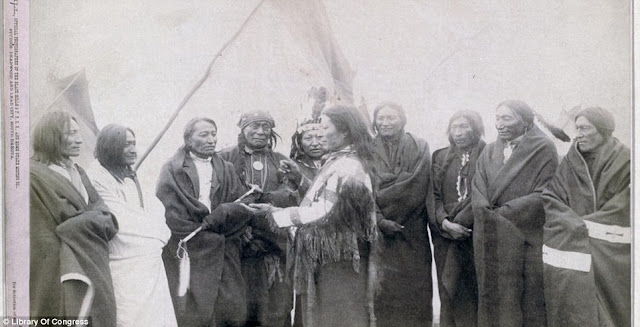
The newspaper, The Daily Mail this week ran several pictures from the US Library of Congress which gave a great look into the way the Old West really was.

In grainy black and white photographs, it's the way the Wild West really was.
From hunting, mining and wagon trains to white settlers mixing with native American Indians, life on the frontier is captured movingly by cameraman John C.H. Grabill.
Between 1887 and 1892 he sent 188 photographs to the Library of Congress for copyright protection. Most of his work centred on the then rowdy town of Deadwood in South Dakota.

The famous and the infamous passed through in search of adventure including the legendary Wild Bill Hickok, Wyatt Earp, George Armstrong Custer, and Calamity Jane.

But long before the arrival of the white man, the land was home to the Cheyenne, Kiowa, Pawnee, Crow and Sioux (or Lakota) Indians. Grabill was best known for his compelling pictures in the aftermath of the Wounded Knee Massacre by the U.S. 7th Cavalry in 1890.




In grainy black and white photographs, it's the way the Wild West really was.
From hunting, mining and wagon trains to white settlers mixing with native American Indians, life on the frontier is captured movingly by cameraman John C.H. Grabill.
Between 1887 and 1892 he sent 188 photographs to the Library of Congress for copyright protection. Most of his work centred on the then rowdy town of Deadwood in South Dakota.

The famous and the infamous passed through in search of adventure including the legendary Wild Bill Hickok, Wyatt Earp, George Armstrong Custer, and Calamity Jane.

But long before the arrival of the white man, the land was home to the Cheyenne, Kiowa, Pawnee, Crow and Sioux (or Lakota) Indians. Grabill was best known for his compelling pictures in the aftermath of the Wounded Knee Massacre by the U.S. 7th Cavalry in 1890.


Saturday, 26 February 2011
A man's gotta' do what E's gotta' do

"The old paperbacks will always be there and thank the Lord for that. I love trawling through the markets and secondhand book shops. But concentrating solely on the older stuff is not going to help the genre to move forward into the new age. Love it or loathe it, we all need to get on pushing the eBooks and encouraging western readers to buy eBooks, by pointing out how much western stuff is out there. In a few short years, I believe, very few westerns will be published physically - depressing maybe, but there you have it."

 |
| Remember him - he's back on the eBook cutting edge! |
 |
| More bang for your buck |
The WIKI definition of western fiction - "Western fiction is a genre of literature set in the American Old West frontier (usually anywhere west of the Mississippi River) and typically set during the late nineteenth century. Well-known writers of Western fiction include Zane Grey from the early 1900s and Louis L'Amour from the mid 20th century. The genre peaked around the early 1960s, largely due to the popularity of televised Westerns such as Bonanza. Readership began to drop off in the mid- to late 1970s and has reached a new low in the 2000s. Most bookstores, outside of a few western states, only carry a small number of Western fiction books."
I can't argue with that but what the WIKI fails to mention is that there has been a small spike in sales of western fiction over the last five years - myself I firmly believe this is due to the amount of passionate western related stuff on the Internet.
For it's survival the western must embrace the world of the eBook. But just sticking them up on Amazon or any of the other retail site, and hoping for the best is not going to do the trick. Which is why I believe the blogosphere is important - western writers are first and foremost, western fans and we need to show this by continuing to produce interesting western based content on the web, we need to continue to discover new angles for bringing new interest into the genre.

And so another Wild West eMonday is on the horizon and this time I hope to have a full weekend of posts by various luminaries of the western genre.So anyone reading this who is involved in any way in the western genre, then contact me and let me know you want to take part. And western fans, and a great many visit The Archive daily, let us know what kind of western features would make for an entertaining weekend and provoke you to buy a new western eBook.
....go on, a man's gotta' do what E's gotta' do.....
Sunday, 20 February 2011
Thoughts on writing a western
The following article is reworked from a piece I wrote for the Archive back in 2009.
"One of the most vapid and infantile forms of art ever conceived by the brain of a Hollywood film producer." ...Dwight Macdonald, The Miscellany 1929

"The western remains, I suppose, America's distinctive contribution to the film."...Arthur Schlesinger Jr, Show April 1963
Geographically and historically the concept of "The West" is very loosely defined, when associated with the literary and film genre of the western. With the possible exception of the Eastern Seaboard almost every part of the USA had been called "The West" at some stage in the country's history.
The federal government defines "The West" as including the following states: Alaska, Arizona, California, Hawaii, Idaho, Montana, Nevada,New Mexico, Oregon, Utah, Washington and Wyoming. But from the movies and books both Kansas and Nebraska can be added. And maybe Hawaii and Washington should be removed. The West of popular imagination usually contains those areas associated with the final frontiers of American settlement - anything West of the Mississippi River. An area associated with cowboys, Indians, outlaws and lone lawmen.
Amongst the earliest western literature with artistic merit were the works of James Fennimore Cooper, his most famous works being 1826's Last of the Mohicans - though by the true definition of the genre none of the author's works are strictly westerns. The books were set in colonial America and featured the British rule and true westerns are set in independent America.
EZC Judson, writing under the pen name Ned Buntline was an early writer of traditional westerns. He earned himself the nickname of, 'Father of the Dime Novel' and turned Buffalo Bill into a figure of mythic proportions. However the first western with the classic ingredients was Owen Wister's The Virginian in 1902, which largely invented the guidelines that western writers still follow today.
The names Louis L'amour and Zane Grey have dominated the genre for many years and still do to some extent. But an early European champion of the genre was Karl May with his popular Shatterhand books. He wrote over 60 books but Shatterhand is his most famous character. Indeed Shatterhand was revived by B.J. Holmes in a series of books for the successful UK western house, Black Horse Westerns.
The cinema has always had a love affair with the western and during the silent era there were many hundreds of westerns made. Most of these have been lost to history but there are still some prime examples of early westerns to be sought out by fans.
Some of the most important silent westerns that still exist and can be found on DVD or in many cases for free download from archive.org include: The Iron Horse (1924) directed by John Ford
The Covered Wagon (1923) directed by James Cruze
Battle of Elderbush Gulch (1914) directed by D W Griffith
In cinematic terms there is little doubt that the Golden Age of the western took place between the years 1940 - 1970. There were many classics before and since but during these years there was never a time when most major studios didn't have at least one western in production.
During the Fifties and Sixties in particular the western also dominated the small screen with many western TV series being aired. Among the most well known are:
Bonanza
Gunsmoke
The Big Country
The Virginian
The Rifleman
Have Gun will Travel
Wyatt Earp
Wanted Dead or Alive
The modern era has also seen many classics of the genre, both on the screen and between the covers - Lonesome Dove, Sons of Texas, Blood Meridian, Tombstone, The Unforgiven to name but a few.
The Western truly is THE GENRE TOO TOUGH TO DIE. Kevin Costner is working on a new western, there are remakes in the works of both Butch and Sundance and The Big Valley. American greats like Dusty Richards and Larry McMurtry continue to write quality western works. And America can also lay claim to Corman McCarthy who may not write western in the tarditional sense, certainly carries the spirit of the western in his work. British western house, Black Horse Westerns are continuing to bring out new western fiction written by writers from all over the world. Among these you will find such loved writers as Lance Howard, B. J. Holmes, Ben Bridges, Jack Giles,Nik Morton, Mathew P. Mayo, Chap O'Keefe and Jim Lawless - And that's not to mention old Jack Martin but I'm too modest to name him; self publicising hack that he is.This is just a small selection of the writers producing all new traditional westerns under The Black Horse banner. To list them all would take up a post in itself. And I may try that one day.

The western provides a form of escapism, a comfort zone that is becoming more and more important in the frantic world we live in today. There is an endearing quality in taking the imaginative leap to a time long gone and finding that the issues facing people were remarkably similar to those we face on a daily basis, it is inspiring to read about people facing up to life's trials and tribulations and standing resolute against anything thrown at them.
 The western as a literary genre had its golden age sometime around the middle of the last century and indeed the writers of that period are still widely read today - L'amour, Zane Grey. But to find the roots of the genre you have to travel further back, much further - in fact to the Old West itself when hack writers were mythologising the West even as it was going on around them.
And we continue to mythologise the West and we will forever more. I like to think that in my own small way I have added to the myth of the West with my own novels, and maybe I've learned something since Tarnished Star was first published back in 2009 and maybe some of my tips listed below will prove useful to anyone wanting to write a western.
SO WHERE DO I START ? Research is very important in the westerns. You must get the details right, particularly with guns and location. I've often been enjoying a book and then I notice some mistake the writer has made and it drags me out of the story. Even minor mistakes can ruin a story. However the aspiring western writer should take heart in the fact that mostly everyone knows what the west would have looked like. This makes the writers' job that much easier and with the advent of the internet any required information is usually only a few key-strokes away.
 THE ACTUAL WRITING. There is no one way to do this. Some writers like to rush through the first draft and then take care of structure, style and plot problems in the re-write. Others are more cautious and will plod along, revising as they go and when that first draft comes out it needs very little tweaking. I hop between both camps but I do like to keep the story moving along, to give it pace and I actually look forward to the revising once the first draft is complete. For me the first draft is a necessary evil and getting it out of the way is all important.
CHARACTERS. It is good characterisation that can turn a good story into a great one. Try and put yourself in your characters mindset and think what you would do in a given situation, however it is important to put modern inhibitions aside. You would have been a very different person had you been alive in the 1880's. Perhaps the single most helpful piece of advice for creating characters is READ, READ AND READ. Only by studying the work of writers you admire can you ever hope to understand the process involved in creating realistic people to populate what is after all an outlandish fictional landscape.
STOP PROCRASTINATING AND GET DOWN TO IT. The biggest thing is to stop talking about it and get on with it, as difficult as it can be to find time in our hectic lives it is important to be stubborn and get down to the actual writing. You must make time - no matter what- or your creation will always be a pipe dream. Remember it is no different writing a western to any other form of genre fiction and the tools used will always be the same. Behind every successful (define successful as professionally published)writer is a person who was pig headed enough to get on with writing no matter what was going on around them.
THE BEST ADVICE . And here it is, the best advice anyone can give someone wanting to write for a living, anyone wanting to hone their craft and create readable prose. It's nothing mythical. no arcane knowledge belonging to a select few. It is this - READ. Read everything you can get your hands on, devour every western that comes your way. Pay attention to the accepted masters of the genre and read classic as well as modern westerns. Look at what contemporary authors are doing with the genre. Just because the lone gunfighter is becoming a cliché doesn't mean you should forsake him or even her as the case may be. There are certain conventions the western fan demands and only by being familiar to the genre can the writer hope to recognise what these are.
So get writing, you've an arduous trail ahead of you but with stamina and a self belief as wide as the prairies you can do it.
 My third western novel, The Ballad of Delta Rose will be published this coming July by Black Horse Westerns is available for pre-order now - CLICK HERE. Pre-ordering is the best way to ensure your copy and no monies will be deducted from accounts until the book is ready to be shipped.
The large print, trade paperback of my first western, The Tarnished Star will be published next month and is also available for pre-order - Click Here
"One of the most vapid and infantile forms of art ever conceived by the brain of a Hollywood film producer." ...Dwight Macdonald, The Miscellany 1929

"The western remains, I suppose, America's distinctive contribution to the film."...Arthur Schlesinger Jr, Show April 1963
Geographically and historically the concept of "The West" is very loosely defined, when associated with the literary and film genre of the western. With the possible exception of the Eastern Seaboard almost every part of the USA had been called "The West" at some stage in the country's history.
The federal government defines "The West" as including the following states: Alaska, Arizona, California, Hawaii, Idaho, Montana, Nevada,New Mexico, Oregon, Utah, Washington and Wyoming. But from the movies and books both Kansas and Nebraska can be added. And maybe Hawaii and Washington should be removed. The West of popular imagination usually contains those areas associated with the final frontiers of American settlement - anything West of the Mississippi River. An area associated with cowboys, Indians, outlaws and lone lawmen.
Amongst the earliest western literature with artistic merit were the works of James Fennimore Cooper, his most famous works being 1826's Last of the Mohicans - though by the true definition of the genre none of the author's works are strictly westerns. The books were set in colonial America and featured the British rule and true westerns are set in independent America.
EZC Judson, writing under the pen name Ned Buntline was an early writer of traditional westerns. He earned himself the nickname of, 'Father of the Dime Novel' and turned Buffalo Bill into a figure of mythic proportions. However the first western with the classic ingredients was Owen Wister's The Virginian in 1902, which largely invented the guidelines that western writers still follow today.

The names Louis L'amour and Zane Grey have dominated the genre for many years and still do to some extent. But an early European champion of the genre was Karl May with his popular Shatterhand books. He wrote over 60 books but Shatterhand is his most famous character. Indeed Shatterhand was revived by B.J. Holmes in a series of books for the successful UK western house, Black Horse Westerns.
The cinema has always had a love affair with the western and during the silent era there were many hundreds of westerns made. Most of these have been lost to history but there are still some prime examples of early westerns to be sought out by fans.
Some of the most important silent westerns that still exist and can be found on DVD or in many cases for free download from archive.org include: The Iron Horse (1924) directed
 by John Ford
The Covered Wagon (1923) directed by James Cruze
Battle of Elderbush Gulch (1914) directed by D W Griffith
In cinematic terms there is little doubt that the Golden Age of the western took place between the years 1940 - 1970. There were many classics before and since but during these years there was never a time when most major studios didn't have at least one western in production.
During the Fifties and Sixties in particular the western also dominated the small screen with many western TV series being aired. Among the most well known are:
Bonanza
Gunsmoke
The Big Country
The Virginian
The Rifleman
Have Gun will Travel
Wyatt Earp
Wanted Dead or Alive
The modern era has also seen many classics of the genre, both on the screen and between the covers - Lonesome Dove, Sons of Texas, Blood Meridian, Tombstone, The Unforgiven to name but a few.
The Western truly is THE GENRE TOO TOUGH TO DIE. Kevin Costner is working on a new western, there are remakes in the works of both Butch and Sundance and The Big Valley. American greats like Dusty Richards and Larry McMurtry continue to write quality western works. And America can also lay claim to Corman McCarthy who may not write western in the tarditional sense, certainly carries the spirit of the western in his work. British western house, Black Horse Westerns are continuing to bring out new western fiction written by writers from all over the world. Among these you will find such loved writers as Lance Howard, B. J. Holmes, Ben Bridges, Jack Giles,Nik Morton, Mathew P. Mayo, Chap O'Keefe and Jim Lawless - And that's not to mention old Jack Martin but I'm too modest to name him; self publicising hack that he is.This is just a small selection of the writers producing all new traditional westerns under The Black Horse banner. To list them all would take up a post in itself. And I may try that one day.

The western provides a form of escapism, a comfort zone that is becoming more and more important in the frantic world we live in today. There is an endearing quality in taking the imaginative leap to a time long gone and finding that the issues facing people were remarkably similar to those we face on a daily basis, it is inspiring to read about people facing up to life's trials and tribulations and standing resolute against anything thrown at them.
 The western as a literary genre had its golden age sometime around the middle of the last century and indeed the writers of that period are still widely read today - L'amour, Zane Grey. But to find the roots of the genre you have to travel further back, much further - in fact to the Old West itself when hack writers were mythologising the West even as it was going on around them.
And we continue to mythologise the West and we will forever more. I like to think that in my own small way I have added to the myth of the West with my own novels, and maybe I've learned something since Tarnished Star was first published back in 2009 and maybe some of my tips listed below will prove useful to anyone wanting to write a western.
SO WHERE DO I START ? Research is very important in the westerns. You must get the details right, particularly with guns and location. I've often been enjoying a book and then I notice some mistake the writer has made and it drags me out of the story. Even minor mistakes can ruin a story. However the aspiring western writer should take heart in the fact that mostly everyone knows what the west would have looked like. This makes the writers' job that much easier and with the advent of the internet any required information is usually only a few key-strokes away.
CHARACTERS. It is good characterisation that can turn a good story into a great one. Try and put yourself in your characters mindset and think what you would do in a given situation, however it is important to put modern inhibitions aside. You would have been a very different person had you been alive in the 1880's. Perhaps the single most helpful piece of advice for creating characters is READ, READ AND READ. Only by studying the work of writers you admire can you ever hope to understand the process involved in creating realistic people to populate what is after all an outlandish fictional landscape.
STOP PROCRASTINATING AND GET DOWN TO IT. The biggest thing is to stop talking about it and get on with it, as difficult as it can be to find time in our hectic lives it is important to be stubborn and get down to the actual writing. You must make time - no matter what- or your creation will always be a pipe dream. Remember it is no different writing a western to any other form of genre fiction and the tools used will always be the same. Behind every successful (define successful as professionally published)writer is a person who was pig headed enough to get on with writing no matter what was going on around them.
THE BEST ADVICE
 . And here it is, the best advice anyone can give someone wanting to write for a living, anyone wanting to hone their craft and create readable prose. It's nothing mythical. no arcane knowledge belonging to a select few. It is this - READ. Read everything you can get your hands on, devour every western that comes your way. Pay attention to the accepted masters of the genre and read classic as well as modern westerns. Look at what contemporary authors are doing with the genre. Just because the lone gunfighter is becoming a cliché doesn't mean you should forsake him or even her as the case may be. There are certain conventions the western fan demands and only by being familiar to the genre can the writer hope to recognise what these are.
So get writing, you've an arduous trail ahead of you but with stamina and a self belief as wide as the prairies you can do it.
My third western novel, The Ballad of Delta Rose will be published this coming July by Black Horse Westerns is available for pre-order now - CLICK HERE. Pre-ordering is the best way to ensure your copy and no monies will be deducted from accounts until the book is ready to be shipped.The large print, trade paperback of my first western, The Tarnished Star will be published next month and is also available for pre-order - Click Here
Wednesday, 16 February 2011
Old West Icons - Those Soiled Doves
Prices for the services of these women varied from town to town but an average cost was 25c for a Mexican woman to $1 for an American lady. Higher prices were charged if a woman was of unusual youth and often a woman with red hair would fetch the highest price of all. It was a popular belief around the mining camps that women with auburn hair were the most amorous women in the world.
Why though would women become involved in this profession?
The answer to that question was no different in the Old West than it is today. Many of them had been abandoned by their families or left alone when a husband died or ran off, others were mentally illiterate and others still were immigrants with no other way to make a living. And although their profession was frowned upon they were often a vital part of early cowtown life.
Below I have posted a 1915 poem by Dana Burnet:
Subscribe to:
Posts (Atom)


-
 UPDATE - Interview with kid expert Fred Nolan on the Archive HERE Billy the Kid keeps riding through the dreamscape of our minds-silhou...
 -
 I've have decided to read the entire Lonesome Dove saga in chronological order which means I kick off with Dead Man's Walk which w...
 -
 Is Deadwood the best TV western ever? To my mind, yes. Each and every episode demands multiple viewing if you are to pick up on all the nuan...