Duffle Coat Manor doesn't have that much of a ring to it and yet that was the locally used name for the manor house that Hammer films turned into Bray Studios.
The house had been used immediately following the war to store duffle coats - but the roof leaked and the coats took in so much water, swelled to blob like proportions, that the weight caused the entire inside of the building to collapse, and when Anthony Hinds visited the building it was little more than a shell. The film company took over residence of the manor house in 1951 - Initially the building was rented for studio space but a year later it was purchased and became world famous as the home of Hammer Films. The colourful nickname of Duffle Coat Manor has now been largely forgotten, a footnote in the history of this remarkable studio.
When I was growing up - I was ten years old in 1975 and during this period the movies were regularly shown on late night television, usually as a double bill - my parents took their parental responsibility seriously and I was never allowed to stay up to watch the movies. Maybe they considered the movies too scary, too graphic for my young mind. Though I think the real reason was that they didn't want me staying up after they had retired and munching all the chocolate biscuits. The reason matters not but it resulted in the movies taking on the status of forbidden fruit. And we all know that forbidden fruit taste sweeter than any other kind.
BBC2 was the channel and usually on a Saturday night they would start a horror movie double bill - the channel regularly ran a double bill horror season from 1975 until 1981. The show would start somewhere around 11pm and go on until 1am - then we would get the test card as the station closed down for the night - I shit you, not. TV used to close down in those days. The days of 24 hour TV were still some years away. Often it would be a double bill of the old black and white Universal horrors, and I loved those too, but on times they would select films from studios such as Hammer and Amicus. These two British studios produced films where the blood dripped impossible red and the heaving breasts were bared. I reckon I saw my first pair of tits in a Hammer movie and believe me that leaves a lasting impression - thank you Ingrid Pitt.
'Critical opinion doesn't really concern us at Hammer. We judge our films at the box office. We're a perfectly commercial company. We turn out films we think are fairy tales.' Michael Carreras, Hammer Films.
Hammer movies were my faves - the company had started out during the Thirties, and produced a spooky thriller, The Mystery of the Mary Celeste in 1935 which starred Bela Lugosi - in a sense this was the studio's first brush with Dracula given that Lugosi was Hollywood's best known Count Dracula.During the war Hammer were largely inactive. The company was reformed in 1947 as the production arm of Exclusive Pictures. There's an interesting story there, of how Hammer transformed from a low budget studio, producing cheap comedies and thrillers to a name that became synonymous around the world with horror movies.
That's a post for another day, though - for now let's go back to those double features.
This LINK will take you to a You Tube video from 1977 of Kenny Rogers talking about the Horror Double Bills.
Now I vividly remember sneaking downstairs one Saturday night after everyone else had gone to bed, and switching on the TV. I kept the volume low and didn't dare turn on the lights and this was my first experience of Christopher Lee as Dracula. Checking back in BBC listings I think this must have been the 14th September 1976, I was two months aways from my 12th birthday, and I think the movie was Dracula: Prince of Darkness. This was the first Hammer movie I'd ever seen and I was transfixed to the screen, which often ran blood red. The reason this sticks so clearly in my mind is because that night I had the most vivid nightmares and my father had to run in when I woke up screaming, pointing, yelling - 'He's behind the door.' True story that, not a word of a lie and I'm sure my father remembers it. After all he went bat shit crazy the following day when he discovered the dent I'd made in the packet of chocolate biscuits.
Of course today the films have dated, but there's a certain something to a Hammer film that makes them so watchable. Horror films today are far more graphic, the special effects more realistic but give me a Hammer movie over the adventures of Jason or Freddy any day of the week.
So suitable for the British horror studio was Conan Doyle’s, The Hound of the Baskervilles that it could have been written with Hammer Films in mind. Indeed following their success with revamping the Dracula and Frankenstein franchises Hammer turned to the most famous fictional detective of them all, Sherlock Holmes for this movie which was intended to be the first in a new series with Peter Cushing in the title role. Alas the movie didn’t perform as well at the box office as expected and plans for the series were scrapped while Hammer concentrated on more gothic material. Pity really – I would have loved to have seen Hammer tackle The Giant Rat of Sumatra.
The film looks like a Hammer movie – the colour is excellent, garish in places with all that over saturated red and the gothic elements that the studio did so well, are brought out in Doyle’s story like never before. Of course they were always there, even in the original story but Hammer emphasise these parts of the storyline without really altering the original. There are some differences to the original story – Stapleton’s webbed hands for one thing, the tarantula attack for another but these work well within the story and indeed the webbed hands carried by one line of the Baskerville clan is inspired and is a nice little macabre touch.
Peter Cushing here gives an excellent performance as Sherlock Holmes – the actor was a Sherlockian himself and he brings his knowledge of the character to the role. Andre Morell is a more than suitable Watson. It is also nice to see Christopher Lee playing a romantic lead role and one wonders what would have happened had he played more such roles. He is certainly convincing here. All in all this is a great Sherlock Holmes movie and under the direction of Terence Fisher the ponderous middle section so obvious in most productions of this story moves along at a great pace.
Why wasn’t it a big box office hit then? Well the blame for this lies with Hammer themselves. They promoted the movie as a big horror flick in the style of their successful Dracula and Frankenstein movies, with hardly any mention that this was in fact a Sherlock Holmes movie. The advertising posters suggested a kind of werewolf but when we see the hound on screen it is nothing more than an over sized Great Dane. Movie fans back in the day may have been disappointed – after all, they were going to see a film starring Hammer’s two biggest horror icons with a large slavering hound in the advertising posters and what they got Sherlock Holmes adventure. A damn thrilling one nonetheless but word of mouth could have harmed the movie after its strong opening weekend.
Still the movie’s stood the test of time and this is a great version of the much filmed story – it’s also nice to see the current DVD version showing such an impressive looking cut of the movie. The colours are vibrant and the sound booming. It is only a pity that it is a full frame 4.3 version on the UK release when I believe the American market get a true widescreen version.
Peter Cushing would of course go onto play Holmes for the BBC, but his performance as the detective here is perhaps his definitive stab at the part. Christopher Lee also got a stab at playing both Watson and Holmes in future Holmes movies but the less said about them the better.
Made in 1965, Hammer Studios made a good choice in deciding to make the movie in old school black and white – there are some effectively blocked shots here, shadows dancing over Bette Davies’s face, caressing and highlighting her bone structure, that just wouldn’t be the same in colour, especially the blood red tones Hammer are known for.
The movie is not the standard horror picee that Hammer became famous for, but rather a clever psychological thriller that will keep new viewers guessing right up to the very last reel. “Is it Master Joey who is actually mad? Or is he right about his seemingly gentle nanny? Is she actually a barmy fruitcake with murder in mind?”
When I placed the disc in the player, I was of the impression that I’d never seen this movie before but a few minutes in and I realised that I had seen the film before, though long ago on a TV viewing and I’d not realised the film was done by Hammer who I associated with Dracula, Frankenstein and other gothic chillers. Mind you I didn’t really remember that much, just had the vague impression that I’d seen it somewhere. sometime. And so I was not sure how things would turn out and then cleverly laid aura of mystery completely enveloped me. When we are first introduced to Master Joey (William Dix) we are shown a troubled, though clever little boy who has a very black sense of humour. He scares one of the teachers at his home for disturbed children, by rigging up a device that makes it look as if he has hung himself, within the first few minutes of the movie. And as soon as he returns home to his family he is shows as cheeky and incredibly naughty, while his nemesis, the titular Nanny, comes across as all sweetness and light. If anything the old woman, played by Bette Davies, comes across as having the patience of a saint in the way she deals with the boisterous Joey.
The movie contains a commentary from Jimmy Sangster, Marcus Hearne (author of The Hammer Vault) and Rene Glynne and for a commentary recorded 41 years since the film was made, the anecdotes come thick and fast – it seems both Sangster and especially Glynne who possesses an incredible memory. Sangster tells us that Greer Garson was Hammer’s first choice for the role of the Nanny but when the actress turned the role down, Bette Davies was approached.
Besides the Hollywood weight of Bet Davies, we have British actress Wendy Craig as Joey’s mother. I found it unusual to find Craig in such a dramatic role since I was brought up watching her playing variations of a dizzy middle aged mum in sitcom after sitcom. And although her part isn’t that substantial, she seems to spend most of the movie lounging about half wasted, she certainly comes across well – through subtle use of her eyes she clearly shows the anguish of the woman who is still mourning the accidental drowning of her daughter. The young actor playing Joey is William Dix and the Internet Database tells us that he made one more film in 1967 and then didn’t make another until 2001. The rest of the cast are made up those familiar British faces that often turn up in old movies or TV shows.
I really enjoyed this movie – Bette Davies and her young co-star William Dix are particularly good, and the plot is paced so the suspense runs right up until the final denouncement.
A creepy movie, excellently directed, written and acted…and you can’t really ask for more than that.
Duffle Coat Manor doesn't have that much of a ring to it and yet that was the locally used name for the manor house that Hammer films turned into Bray Studios.
The house had been used immediately following the war to store duffle coats - but the roof leaked and the coats took in so much water, swelled to blob like propotions, that the weight caused the entire inside of the building to collapse, and when Anthony Hinds visited the building it was little more than a shell. The film company took over residence of the manor house in 1951 - Initially the building was rented for studio space but a year later it was purchased and became world famous as the home of Hammer Films.The colourful nickname of Duffle Coat Manor has now been largely forgotten, a footnote in the history of this remarkable studio.
When I was growing up - I was ten years old in 1975 and during this period the movies were regularly shown on late night television, usually as a double bill - my parents took their parental responsibility seriously and I was never allowed to stay up to watch the movies. Either they considered the movies too scary, too graphic for my young mind or they didn't want me staying up after they had retired and munching on all the chocolate biscuits. I don't know what the reason was but this resulted in the movies taking on the status of forbidden fruit. And we all know that forbidden fruit tastes better than any other kind.
BBC2 was the channel on usually on a Saturday night they would start a horror movie double bill - the channel regularly ran a double bill horror season from 1975 until 1981. The show would start somewhere around 11pm and go on until 1am - then we would get the test card as the station closed down for the night - I shit you, not. TV used to close down in those days. The days of 24 hour TV were still some years away. Often it would be a double bill of the old black and white Universal horrors, and I loved those too, but on times they would select films from studios such as Hammer and Amicus. These two studios produced the films where the blood dripped impossible read and the heaving breasts were bared. I reckon I saw my first pair of tits in a Hammer movie and believe me that leaves a lasting impression - thank you Ingrid Pitt.
Now I vividly remember sneaking downstairs one Saturday night after everyone else had gone to bed, and switching on the TV. I kept the volume low and didn't dare turn on the lights and this was my first experience of Christopher Lee as Dracula. Checking back in BBC listings I think this must have been the 14th September 1976, I was two months aways from my 12th birthday, and I think the movie was Dracula: Prince of Darkness. This was the first Hammer movie I'd ever seen and I was transfixed to the screen, which often ran blood red. The reason this sticks so clearly in my mind is because that night I had the most vivid nightmares and my father had to run in when I woke up screaming, pointing, yelling - 'He's behind the door.' True story that, not a word of a lie and I'm sure my father remembers it. After all he went bat shit crazy the following day when he discovered the dent I'd made in the packet of chocolate biscuits.
Of course today the films have dated, but there's a certain something to a Hammer film that makes them so watchable. Horror films today are far more graphic, the special effects more realistic but give me a Hammer movie over the adventures of Jason or Freddy any day of the week.
At 93 years of age it could be said that he had a good innings, but nevertheless the loss of legendary actor, Christopher Lee is a shock. He seemed immortal, had been around forever and was one of those who would always be around. His work spans the decades, crossing genres, taking in everything from schlock horror to Star Wars, Lord of the Rings and beyond. He's resided both in Baker Street and Baskerville Hall and even recorded both opera and heavy metal music. The actor celebrated his 93rd birthday only a few weeks ago, and the as soon as I heard the news of his passing all I could think was, 'Wow, he's going to look freaky in his coffin!'
'I've seen many men die right in front of me. I've seen the worst that human beings can do to one another. the results of torture, mutilation and seeing someone blown to pieces by a bomb.' Christopher Lee talking about his experiences during the second world war.
Lee appeared in over 200 movies, many of then genuine classics - The Man with the Golden Gun, The Whicker Man, Lord of the Rings, but it is perhaps for his work with the Hammer studios where he became something of a double act with another much missed British horror icon, Peter Cushing that he will be best remembered.
'I was attached to the SAS from time to time but we are forbidden –
former, present, or future – to discuss any specific operations. Let's
just say I was in Special Forces and leave it at that.' Christopher Lee
Following a highly colorful and distinguished war record, Lee's entry into film started in 1946, . He
was initially turned down by several studios, being told he was too tall to be an actor but he was signed as a contract player to The Rank Organization and made his screen debut in future James Bond director, Terence Young's Corridor of Mirrors (1947). Lee had only one line in the movie - a satirical shaft meant to qualify the lead's bravura." - nevertheless he made an impact on the director who would later recommend him to friend, Terence Fisher for Hammer's 1957, The Curse of Frankenstein. The film was a huge success and then a year later Lee portrayed Count Dracula in Hammer's Dracula (AKA, The Horror of Dracula) and was arguably the screen's greatest ever Dracula, in the minds of many, including my own, Lee eclipsed Bela Lugosi's portrayal of the character and remains the definitive screen vampire. During his time with Hammer Lee played many iconic roles, Frankenstein's Monster, Dracula, The Mummy, Rasputin and even Henry Baskerville alongside Peter Cushing as Sherlock Holmes. Lee himself would play Sherlock Holmes in 1962's, Sherlock Holmes and The Deadly Necklace. But Lee's association with Holmes doesn't end there and he also played, Mycroft Holmes (Sherlock's brother) in Billy Wilder's The Private Life of Sherlock Holmes (1970).
Lee's work with Hammer is enough to guarantee him screen immortality but there was so much more to the actor - 1973's The Whicker Man is an all time classic and the actor also worked in Spainish films but left after discovering he had unknowingly narrated a soft porn movie. That film was Jess Franco's Eugenie (1970)
' I had no idea that was what it was when I agreed to the role. I was told
it was about the Marquis de Sade. I flew out to Spain for one day's work
playing the part of a narrator. I had to wear a crimson dinner jacket.
There were lots of people behind me. They all had their clothes on.
There didn't seem to be anything peculiar or strange. A friend said: 'Do
you know you are in a film in Old Compton Street?' In those days that was where the mackintosh brigade watched their films.
'Very funny,' I said. So I crept along there heavily disguised in dark
glasses and scarf, and found the cinema and there was my name. I was
furious! There was a huge row. When I had left Spain that day everyone
behind me had taken their clothes off!' Christopher Lee
In 1973 Lee played alongside Roger Moore in the James Bond movie, The Man with the Golden Gun and perhaps provided his best screen villain since Dracula, The movie may not be one of the best in the Bond franchise but Lee is mesmerizing on screen.
" In Fleming's novel he's just a West Indian thug, but in the film he's
charming, elegant, amusing, lethal.' Christopher Lee
That same year Lee appeared on the cover of Paul McCartney's Band on the Run album cover and then in 1977, tired of only being offered roles in horror movies Lee relocated to America. His first role was in Airport 77 and later Steven Spielberg would cast him in 1941. In more recent years Lee turned up in Peter Jackson's Lord of the Rings as well as The Hobbit. He also put his stamp on another classic movie franchise when he appeared in the Star War prequels. In 2010 Lee took the unlikely move of recording an heavy metal album but nevertheless, Charlemagne: By the Sword and the Cross, was both a critical and commercial success.
Lee's last role was in the video game, Deus Ex Machina 2 in which Lee narrated the piece in the role of the programmer.
Christopher Lee died in hospital after a short illness but people like Christopher Lee are never truly gone, because they will live on forever through their work. He will continue to thrill movie fans for as long as there are movie fans and as I look at my considerable DVD collection of his work I am reminded that, Christopher Lee has truly risen from the grave.
Hammer are to make three new movies a year including a new Dracula
- Don’t get too excited because that information comes from a 1980
press release from the company who had recently bought Hamden House
which they intended to convert into another Bray Studios. None of that
came to fruition, well apart from the new studios and a TV series, and
it was a while longer before Hammer finally got back into feature film
production but the golden days of the studio are now long behind us.
That proposed new Dracula film would have brought Christopher Lee back
to the role and would have been set in contemporary times because Hammer
felt that gothic films had had their day. Alas none of this was to be
and until the recent revival the last Hammer horror film was 1976′s To
the Devil a Daughter which wasn’t really a financial success.
However given the success of Hammer’s The Woman in Black, a new Dracula
movie is once again on the cards but it is extremely doubtful that
Christopher Lee will take the role of everyone’s favorite vampire,
thought he’d make a cool Van Helsing. These days the company is in the
hands of Simon Oakes and are going from success to success under his
guidance. Not only are they producing new genre films, and having great
success with them, but the classic output is being lovingly transferred
to new DVD and Blu-ray editions, and they even have an imprint for
publishing horror novels, with Hammer Books. And only this week it was
announced that Michael Sheen has been offered the leading role in The
Quiet Ones, unveiled to be the next movie from Hammer Films. In
addition, Brit actor Damien Lewis is also said to have been offered a
part.Based on a earlier script by Rampart/The Messenger
writer & director Oren Moverman that has been re-drafted by John
Pogue (Ghost Ship, U.S. Marshals), the horror is described as a
‘poltergeist movie’ by Hammer Films CEO Simon Oakes and which will start
filming in May in South Africa.
“We can’t really tell you much about it but we really are
looking at it. I’ve been saying that we’d never remake the films per se,
but we would do our own versions of it. Certainly in my time with Hammer we will definitely do a Dracula. We will do a Frankenstein if we can find a route in. It’s about finding a route in that makes it your film.” Simon Oakes
Hammer are healthy again which is a good thing for movie lovers – the
studio may have considered its output to be B-movies but they have
become iconic and the very name conjures up images of gothic horror -
This studio may have lost all relevance when it started churning out big
screen versions of popular sitcoms like On The Buses and Love Thy
Neighbor, but no one really doubted that the studio would one day rise
from the dead.
Hammer originally started out in the 1930′s when Will Hammer founded
Hammer Productions. He was soon joined by Enrique Carreras and together
they formed a distribution company called Exclusive Films. They produced
a few comedies during the Thirties as well as a thriller The Mystery of
the Mary Celeste which starred Hollywood’s Count Dracula, Bela Lugosi.
But by the Forties Hammer were no longer producing films and it wasn’t
until the two founder’s sons took control that the Hammer we know and
love started to form. Right from the start James Carreras displayed a
shrewd business mind and he reckoned that by ensuring none of their
films had a budget larger than £20.000 and by making five films a year
they could turn over a profit annually of £25,000. Hammer could not
afford big name stars and so it was decided to concentrate on the
domestic market and produce movie versions of popular radio shows. They
scored some success with versions of PC49 and Dick Barton but it wasn’t
until 1955 and The Quatermass Experiment that Hammer really came into
its own. And from there it was a hop, skip and jump to 1957′s, The Curse
of Frankenstein, which gave Hammer its first real bite out of the
lucrative American market. The film also started a cycle of gothic
horror films for which the studio have become synonymous.
The Hammer Frankenstein and Dracula cycles went on into the Seventies
and ended on a high point for the baron with Frankenstein and the
Monster from Hell and an all time low for Drac with The Satanic Rites
of Dracula. However the Dracula movies led to an interesting series of
films based loosely on the Sheridan Le Fanu’s Carmilla story – The
Vampire Lovers, Lust for a Vampire and Twins of Evil, but by now the
boom years had ended and Hammer dwindled into a shadow of its former
self. They’re fighting fit now, though.
Horror film studio Hammer will collaborate with such distributors as
StudioCanal, Germany’s Anolis Entertainment, Pinewood and illuminate
Hollywood HTV to perform a major restoration of the studio’s iconic
movie studio. The partnership will reformat 30 films into HD for Blu-ray
and new media exploitation.‘Dracula Prince of Darkness’ is the first
movie that is scheduled to be released as part of the global restoration
project. It will be released in the UK in March 2012, in conjunction
with StudioCanal
Other titles to get the HD treatment include ‘The Reptile,’ ‘The
Plague of The Zombies,’ ‘The Devil Rides Out,’ ‘Rasputin the Mad Monk’
‘The Mummy’s Shroud.’ ‘The Curse of Frankenstein,’ ‘Dracula’ and ‘The
Mummy.’
The movies will not only feature fully-restored HD picture and sound,
they will also feature newly-filmed extras, including interviews with
cast members. The extras are being produced by Marcus Hearn, an expert
and historian for Hammer, and the author of ‘The Hammer Vault.’
“Our decision to restore some of Hammer’s most famous titles
not only allows existing fans to experience the films again in high
definition, but also encourages a new global audience to discover Hammer
for the first time-especially as we get read to release our next
exciting new Hammer project, ‘The Woman in Black.’” Simon Oakes, the President and CEO of Hammer
It’s been some years since I’ve seen this movie and I was pleased to
find it on DVD doubled with Quatermass 2 – the DVD transfer is bright
and crisp and the black and white image looks sharp with no artifacts
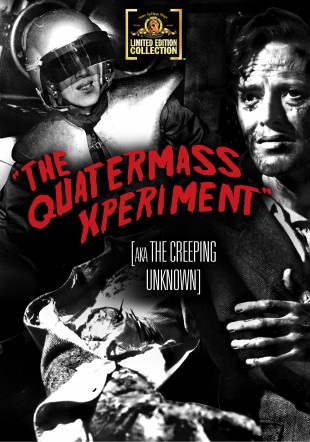
whatsoever. It’s another great DVD package from Hammer, though these films really are begging for more extensive extra features Scene selection and original trailers do not make up for a commentary or documentary.
The DVD bills the movie as the Quatermass Experiment on both the
inlay and the disc itself but the correct title, and the one that pops
up on screen in The Quatermass Xperiment – Hammer Films chose the
spelling to put an emphasis on the X certificate which the movie
originally recieved from the board of film classification. And although
far removed from Hammer’s later horror series the film is regarded as
the first of the Hammer Horrors.
The plot, taken from the BBC TV serial of the same name, well, the
Quatermass Experiment in any case, concerns a spaceship that crashes
back to Earth with only the one member of the crew aboard. That crew
member, Carroon , has mutated into something and is able to absorb the
life force of any living thing he comes into contact with. He first
absorbs a cactus which causes his right arm to begin mutating. Carroon’s
wife, Judith, hires a private investigator to break her husband out of
the hospital. The escape is successful but Carroon kills and absorbs the
private investigator in the process.
The original TV series was an enormous success with critics and
audiences alike, later described by film historian Robert Simpson as
“event television, emptying the streets and pubs, and Hammer wisely
stuck to the same elements but did make the central character of
Quatermass something less of
the square jawed hero. Here he doesn’t come across as particularly
likable and considers his scientific work to be above all else,
including human life. Jack Warner is at hand to provide a sidekick with
his policeman who is not a million miles away from Dixon of Dock Green.
Hammer also changed the ending – in the TV series Quatermass persuaded
Caroon to commit suicide for the good of mankind, but in the movie
version its all cool electrocuting the monster that was once a man.
Overall this is a classic SF/Horror film with excellent
performances from the entire cast, with special honours going to Richard
Wordsworth as the doomed astronaut – he manages with facial expressions
alone to create great sympathy as he stumbles across the countryside
like Karloff’s Frankenstein’s monster. It may be pulpy and old fashioned
but then it’s a damn sight better than many modern SF thrillers.
HAMMER FILMS are back with their first movie production (excluding the online movie, Beyond the Rave) in decades. In fact it's been more than thirty years since a film entered the cinema with the Hammer Films logo.
Patrick and Louise are a young couple who have been through hell - their daughter was killed by a savage dog. Thinking that a move would help them to come to terms with their grief they settle in the small Irish village of Wakewood. Soon afterwards they stumble upon a group of locals, led by a very sinister Timothy Spall performing a bizarre pagan ritual in which the recently deceased are brought back to life. They are told their daughter can be brought back to life but only for three days, during which they will be able to properly say their goodbyes.
As expected things go wrong and become very gory as their daughter, Alice, now a teeny psychopath goes on the rampage. It's a genuinely creepy movie which takes the horror aspects seriously, even the pagan mumbo jumbo is presented in a straight forward style which may make the film seem slow by modern genre standards, but that's not to say it's a bad movie because it isn't - it reminded me of horror classic The Wicker Man and seems to be paced in a similar fashion.
I don't really enjoy modern horror films, preferring the classic monsters over the latest slasher of the week, and I found myself glued to the screen for the admittedly short duration of this movie - 88 mins including titles.It is refreshing to see a horror movie aimed at adults, where suspense is much more important than cheap shocks .
Hammer remain the most successful British film studio in history - they made films that showed in every corner of the world and although they made movies in many genres - comedy, thriller, drama, grand period adventure, fantasy, military thillers - it is with horror movies that they are best remembered.
Hammer though had no grand plan concerning horror and indeed they stumbled into the genre by accident and by doing so took Dracula, Frankenstein and the Wolfman back from Hollywood and reinvented them for an whole new audience. The horror tales had largely been born in Britain and thanks to Hammer Movies we took our gothic heritage back and then mixed them in with gallons of impossibly red blood and a liberal splattering of heaving bosoms and sent them back out around the world, raking in a fortune for the UK film industry.
It was ironic given that it was the SF movie boom of the late Forties/early Fifties that killed off the original horror boom, that it should be the SF genre that would show Hammer that horror was the way forward for the studio. in 1955 Hammer adapted the hit TV series Quatermass Experiment. Hammer knew that they could be more graphic than the BBC had been allowed to and they purposely strove to obtain am X (the equivalent of 18) certificate in order to market the film as, The Quatermass Xperiment. The film was a huge surprise hit and the BBC cashed in on this by making another Quartermass TV series, which Hammer than produced, in colour, as Quatermass and the Pit. Hammer also started producing another Quatermass movie but when the rights were taken from them they altered the movie somewhat and released the very Quatermass-like X, the Unknown.
""Well, no one can say the customers won't have had their money's worth by now. In fact, someone will almost certainly have been sick. We must have a great deal more restraint, and much more done by onlookers' reactions instead of by shots of 'pulsating obscenity', hideous scars, hideous sightless faces, etc, etc" From a BBFC (British Board of Film Classification) report on X-The Unknown.
Both of the Quatermass movies and X-The Unknown followed the typical British boy's own style - they had a very energetic hero and a dynamic storyline. The hero was a no-nonsense scientist who was focused on his work to the point of destruction of both his own life and those around him - this was a very interesting choice of protagonist for the time when heroes were usually cleaner than clean. Hammer's Quatermass was not a million miles away from their version of Baron Frankenstein.
And it was with Frankenstein that Hammer scored their biggest hit to date and ensured that the company would forever be associated with the horror genre. Although the story was in the public domain, Universal Pictures owed the rights to their storyline from their own classic, Frankenstein and more troubling they also had a patent on Boris Karloff's amazing make up design. Hammer knew they could not improve on the classic Karloff look and so they did a clever thing - that altered the focus of the story, turning Baron Frankenstein into the villain of the piece and the monster his helpless victim. And although Karloff will always be associated as the definitive monster, Hammer's version was much more logical. No longer were there comical bolts holding the head on - Hammer's monster looked like the victim of a car crash.
'I tried to play the monster as an ill-coordinated, childish creature.' Christopher Lee.
The Curse of Frankenstein (1957) grossed more than 70 times its costs. The crtics hated the film but cinema fans loved it. It was massive in the UK and even bigger in the US and indeed everywhere the film played it returned healthy profits. And even though Hammer still continued with other genres they became known as, The Hammer House of Horror.
It was only natural that after their success with Frankenstein that Hammer should turn to that other great horror icon, Dracula. And this time the studio turned in the definitive screen version of the story and Christopher Lee's Dracula was far more effective than Bela Lugosi's version.
"The uncouth, uneducated, disgusting and vulgar style of Mr Jimmy Sangster cannot quite obscure the remnants of a good horror story, though they do give one the gravest misgivings about treatment. [...] The curse of this thing is the Technicolor blood: why need vampires be messier eaters than anyone else? Certainly strong cautions will be necessary on shots of blood. And of course, some of the stake-work is prohibitive." From the BBFC report on Dracula.
Dracula was an enormous success, breaking box-office records in the UK, the United States (released as Horror of Dracula), Canada, and across the world. On 20 August 1958 the Daily Cinema reported:
"Because of the fantastic business done world-wide by Hammer's Technicolor version of Dracula, Universal-International, its distributors, have made over to Jimmy Carreras' organisation, the remake rights to their entire library of classic films"
Hammer films now went down the same path as Universal had previously trodden with their original classic monster movies. Subsequent movies would feature more and more monsters in a bid to make each film more terrifying than the last, and then by the time they did the parodies it was all over. It's the same thing that happened with the western movie.
Hammer were in many ways an exploitation studio and in their latter days they lived up to this, cashing on on any genre that was popular and mixing it in with their horror - The Legend of the Seven Golden Vampires brought the then hot kung fu craze into their gothic world. The result is an entertaining movie.
Later Hammer tried one desperate measure after another to shock and titulate. A sequence of lesbian vampire films showed them scraping the bottom of the barrel. Though 1971's Lust for a Vampire, loosely based on the Camilla story is quite good.
Flesh and Blood: The Hammer Heritage of Horror is a splendid 90 minute documentary looking at the entire history of Hammer. It is narrated by Christopher Lee and Peter Cushing (This was the actor's last project before his death) and is still available on DVD.
Vampires are very much in vogue at the moment, particularly with younger readers and film-goers, but the hordes of Twilight fans could do themselves a favour and discover British studio, Hammer's back list of classic horror films.
In the US the film is known by the title, The Horror of Dracula and was directed by the late great Terence Fisher. The title role was played by Christopher Lee and the actor did what was thought impossible - he improved on Bela Lugosi's version of the bloodsucker. Lee is superb in every scene - he doesn't so much walk as glide and his stature makes him look magnificent when brooding about the gothic sets.
Upon original release it had fans lining up around the block to see this new kind of visceral horror movie - the scene where Van Helsing (Peter Cushing) drives a stake with ghoulish zeal into the heart of the undead Lucy is as effective as ever. And Dracula's eventual demise is thrilling. What is remarkable is how good the film looks today - and not a pixel of CGI anywhere to be seen. The gothic sets are excellent. And the performances, theatrical in style, are brilliant. The film is available as a great DVD print, though devoid of extra features. Well worth seeing - this is the best movie version of Bram Stoker;'s Dracula and Christopher Lee is the best celluloid Dracula there has ever been. Indeed is ever likely to be.
Hammer Film Production was originally started up by British Theatre Chain owner, Enrique Carreras and comedian William (Hammer) Hinds. The company was set up to produce a small amount of films for British domestic release by Exclusive. Eventually the company branched out and by obtaining a US partner they were able to get their films into the lucrative American markets.
Hammer were clever in their initial choice of films - carefully selecting popular UK radio shows and theatre hits to film which ensured a ready made audience. These film boasted an almost exclusively British cast but there was always a token American to soften the affect of all those British accents for other markets.
Hammer's first major success was a movie adaptation of the popular BBC series, The Quatermass Experiment . The film was huge in the UK but had an even greater success when it was released in the US in 1956. The film was retitled The Quatermass Xperiment for the US release which referred to its X certificate which was much the same as an 18 certificate today.
It was clear to the film company that horror and SF was going to be a big part of its future - the first films into production were a sequel to Quatermass and a remake of Frankenstein. Originally the Curse of Frankenstein was to be shot in black and white but at director, Terence Fisher's urging they decided to go with a colour version.
When the film was in the can Hammer sold the US distribution to Warner Brothers and it opened in the US to terrible reviews and even worse ones in the UK. The Observer's film critic said, it is one of the most repulsive films I have ever seen. And whilst the film may seem tame by today's standards, it did show a bit more gore, not to mention cleavage than was the norm for the period.
The film, critical flop, was a huge commercial hit, taking £5 million and it made the company a hot property and now American distributors were knocking on their door. It is worth noting that the gore, severed hands, gouged eyeballs and basic mayhem which shocked audiences set the benchmark for horror cinema.
Hammer would now become synonymous with horror as they began a cycle of movies that would see them tackle most of the familiar ghouls and ghosties - Dracula, The Wolfman, The Mummy, Zombies, Graverobbers and even Jack the Ripper. And although the company would continue in other genres, British comedy especially, it was for their horror films that they are best remembered. Indeed the company still exists today and recently released an all new movie,their first for many a year, Beyond the Rave onto the web and this can now be purchased on DVD. Check them out HERE
Frankenstein was followed up in 1958 with The Horror of Dracula which was an even bigger success. And Christopher Lee made an even better Dracula than Bela Lugosi who had so memorably played the character in Universal's version of the story. Again the critics were unkind but these days the film has become to be regarded as an all time classic - some critics have even placed it in the top 5 British movies ever made.
THE ESSENTIAL HAMMER The Quatermass Experiment (1956) - dated but still tingles with tension. The Curse of Frankenstein (1957) - Ushers in a new age of gruesome horror
Horror of Dracula (1958) - Hammer's best film. Christopher Lee makes a great and sinister vampire and the sexual aspect, previously hidden away in the subtext, was brought to the fore.
The Revenge of Frankenstein (1958)-The films starts up a second after the first movie ended and sees Baron Frankenstein escape the guillotine.
The Mummy(1959) - superior in every way to the Boris Karloff version
The Curse of the Werewolf (1960) - Oliver Reed is superb in this Gothic version of the ancient folk tale. He doesn't make such a tragic figure as Lon Chaney Jnr in the Universal Wolf-man, but the film is well acted and the set pieces are brilliantly staged.
The Legend of the Seven Golden Vampires (1974) - This mesh-up of martial arts and vampires is good trashy fun.
As the films went on and the audiences dwindled the company upped the gore and the sexual content with mixed results. Of their later output The Karnstein trilogy which was loosely based on Camilla is well worth seeing - starting off with The Vampire Lovers (1970) and continuing with Lust for a Vampire(1971) and Twins of Evil (1972). The trailer for Vampire Lovers is embedded below.
WORTH A WATCH Dracula AD 1972 - The vampire in Swinging modern day London. Fab as well as scary.
Plague of the Zombie (1965) - although this drags in places it is effective in delivering chills but only if you can stay awake. Though many do rate this film highly.
To the Devil a Daughter (1966) - A flop at the time but this version of the Dennis Wheatley novel has stood the test of time.
Dracula Has Risen from the Grave (1968) - Christopher Lee back as Dracula. Nuff said.
During the 70's Hammer found that their brand of gothic horror was becoming old fashioned next to films like The Excorsist and Rosemary's Baby and George Romero had set a new benchmark for gore with Night of the Living Dead. The studio, although still making the odd horror movie, devoted most of its energies to big screen versions of popular British TV sitcoms such as On The Buses and Man About the House. The last film of the original Hammer was 1979's remake of the Hitchcock classic The Lady Vanishes with Elliot Gould in the starring role. It was hoped this film would rekindle the ailing studio's fortunes but the film flopped and the studio went to the wall. Film production ended and the company produced several successful TV series but these were Hammer productions in name only and the exuberance of past films had vanished forever.
These days I don't much like horror films - the genre has become largely teen and slasher obsessed but from time to time there is an old Hammer movie on TV and I'll watch it. They have the look of a costume drama and the landscape is lensed in a Gothic fashion - the skies are always dark and foreboding, the moon always full, the wind always howls and any blood spilt is impossibly red. And of course there is always that cleavage as buxom wenches once again fall victim of the suave vampire. They sure don't make em like they used to.
Hammer have been revived in recent years and there is talk of a big budget horror movie from the studio. Maybe it will work - maybe the horror genre has gone as far as it can with splatter and effects and maybe now is the time for the return of Gothic horror. Maybe one day we will see the Hammer name up in lights again...it would be nice to think so.