The Archive presents the last of Keith Chapman's (aka western writer, Chap O'Keefe) contributions to our vastly extended Great British Comic Book Weekend. The following all action, sci-fi tales comes from Smash Annual 1969.
Remember clicking on any image will give a larger, more easily readable version.
That's it for comic books for awhile, but there's more to come from Chap O'Keefe - there's some hot western news concerning Chap just around the corner, and the Archive will, as always, be first with this news.
This week expect some exciting Misfit Lil news - Nuff said....for now anyway.
On with the show - we present, unseen for decades, the a complete strip of The Legend Testers.
CLICK HERE TO SEE THE ENTIRE GREAT BRITISH COMIC BOOK WEEKEND
Showing posts with label THE GREAT BRITISH COMIC BOOK WEEKEND. Show all posts
Saturday, 9 April 2011
Thursday, 7 April 2011
THE GREAT COMIC BOOK WEEKEND - REDUX
Last weekend's comic book celebration here on the Archive was a great success but we were unable to bring you several strips written by Keith Chapman AKA western writer, Chap O'Keefe because of technical problems. These have now been ironed out and we present the missing strips for your enjoyment - don't forget clicking on any images will enlarge them.
First up is Rubber Man from Smash Annual 1968 - including a page of the original script
Later on the Archive we will post another Keith Chapman script - The Legend Testers from Smash Annual 1969
First up is Rubber Man from Smash Annual 1968 - including a page of the original script
Later on the Archive we will post another Keith Chapman script - The Legend Testers from Smash Annual 1969
Monday, 4 April 2011
THE GREAT BRITISH COMIC BOOK WEEKEND - AND SO....
WOW IT'S BEEN A FRANTIC WEEKEND AND LEFT ME RATHER BRUISED AND BATTERED!!!
The Archive's Great British Comic Book Weekend is at an end, and although there's been some great posts, and I'd like to thank everyone who contributed, we have only scratched the surface of what is a vast subject. There are some great comic book blogs out there that concentrate mainly on UK comics - Bear Alley and Blimey It's another blog about comics, to name but two. And one of the best resources for info on British Comics is Dez Skinn's own website Here.
This end however, in best comic book tradition, is a false end, a cliffhanger for more goodies. We have several scans of strips by Keith Chapman still to run and these will be presented later this week, when we have gotten over a few technical problems. So I hope you enjoyed all you've had and still have a little room left for that which is to come.
The Archive's Great British Comic Book Weekend is at an end, and although there's been some great posts, and I'd like to thank everyone who contributed, we have only scratched the surface of what is a vast subject. There are some great comic book blogs out there that concentrate mainly on UK comics - Bear Alley and Blimey It's another blog about comics, to name but two. And one of the best resources for info on British Comics is Dez Skinn's own website Here.
This end however, in best comic book tradition, is a false end, a cliffhanger for more goodies. We have several scans of strips by Keith Chapman still to run and these will be presented later this week, when we have gotten over a few technical problems. So I hope you enjoyed all you've had and still have a little room left for that which is to come.
THE GREAT BRITISH COMIC BOOK WEEKEND - FLICK OFF CLINT
Dez Skinn is a legend in British comic books - Comicsbullitin called him, "the best known man in British comics with a reputation that proceeds him worldwide. Born in 1951, Dez has spent many years editing and writing comics and not for nothing is he often called, The British Stan Lee.
Although a busy man Dez was only too gracious with his time when the Archive requested a question/answer session. Read on as the Archive proudly presents an interview with a true comic book giant.
TA: You started off with IPC during what could be called the golden era of British comics. Tell us about working on such iconic titles as Whizzer and Chips, Cor and Buster. Were the humour titles of particular interest to you?
DS: I actually started as a research chemist, but I was rubbish at that! Then following a stint with Yorkshire Newspapers, yes, I moved to London at IPC Magazines, at the time the world's biggest publisher! It was a chap named Mick Anglo who I'd come down to see, but he didn't need any staff so I eventually ended up on Whizzer and Chips!
NOT where I'd wanted to be as I was a fan of everything American at the time, especially those lovely Jim Warren magazines, Creep, Eerie, Vampirella and Famous Monsters. Something about their format made them seem more grown-up than regular US comicbooks which you looked kinda foolish reading beyond being about 12!
But working at IPC was a great 5-year apprencticeship, an amazing learning curve and prepared me for what was to follow (and gave me a great address book of writer, artist, editorial and design contacts)
TA: What comics did you read when you were a kid and what got you into comics in the first place?
DS:Like many of my generation, I learned to read (age 4!) from comics. Jack and Jill, Playhour, Swift, Beano, Dandy, Beezer and Topper. Then I moved up to adventure titles, Swift, Eagle, Victor, Hotspur, Lion, Tiger, Valiant, Hornet. Amazing the range that existed back then. My first exposure to Americana was seeing a Flash comic, (#111, if I remember correctly) while at the seaside in Scarborough. Full colour throughout and two complete beautifully-drawn stories? I was blown away!
ON WORKING AT IPC "The most important rule of all was to avoid two words, flick and Clint. So no references to flick-knives or Clint Eastwood in British comics, no siree bob. The reason was simple, most comics were printed letterpress, where fine lines would either blob out or disappear entirely and the space between letters often fill in. That’s why you invariably saw exclamation marks instead of full stops, punctuation was paramount and you’d no guarantee a lettered full stop would survive the presses.
But “flick”? Like “Clint” with lettering always created in upper case, the gap between the “L” and the “I” had a tendency to fill in, creating the appearance of a “U”. It became a regularly used expression among trainees if somebody was getting on your nerves, “Flick off, clint!” Tut-tut!" Dez Skinn
TA:When you went to Warners you had to expand their comic range - did you have much freedom with titles like Korak, Tarzan and so forth? Did you have to get your stories OKAYED by the people responsible for the TV shows?
DS: The board interfered on covers initially, always wanting hard-sell colours "Red and yellow, red and yellow..." so I stopped showing them any! But other than that, the amount of freedom was positively scary. When I was about to launch Starburst independently I realised I could write a House of Hammer editorial saying it was rubbish and people should drop it in favour of my new SF magazine! Not that that was true, but that's how much freedom I had. Of course I was way too responsible to say such a thing. (And I'd have been fired when they'd read such in print.). It was no different with the licenced titles, but all the ERB material (Tarzan and Korak) was from the international pool that all licensees took material from.
TA: What was MAD like to work on?
DS: Brilliant! I'd adored it as a kid and it was great to bring my gang of writers and artists aboard. Also the respect the film industry had for the title was amazing (except for Stanley Kubrick who hated Borey Lyndon!). I got to meet quite a few stars and directors through it, so I was very pleased. It was also great to be able to put my "stamp" on the title, making it more film-related, especially with covers.
You set up your own company to create Starburst. Why do you think that title was such a success? Its influence can be felt in modern Sci-Fi titles like SFX.
ME: Ah, if only Starburst had kept up, there wouldn't have been room for SFX! I knew Star Wars was a hit in America and had wanted an SF companion to my House of Hammer. So the timing seemed obvious, as Star Wars launched in the UK six months after its US summer debut. Wonderful for me. But my publisher felt that with Cinema X, MAD and House of Hammer they had enough film coverage in print, so I produced it in my spare times, in the evenings. But when I got the trade orders in, for 72,000 copies (almost three times what House of Hammer sold), I knew I'd got it right!
TA:Is it true that Stan Lee asked you personally to take over at Marvel UK?
DS: I knew Stan from his earlier UK visits, being in the industry. So by 1978 when their reprints novelty had worn off and were sliding badly in sales, Marvel asked me to write a report on how to turn their fortunes around. They chose me to ask as I'd beaten them to the shops with Star Wars coverage (despite them being the official licencee) and even ran a Spider-Man film story before them! Stan liked my report - even though I had to rewrite it lots of times so it wasn't too critical (it was a paid gig, you can't bite the hand that feeds you). He visited the UK and invited me to join him for a weekend to discuss my ideas. But he also asked me to implement them as the UK publisher!
TA: You launched Doctor Who Weekly magazine. Tom Baker was the then current Doctor - did he have any involvement?
DS:Not half! Tom and I toured the country launching the title. To the wholesale and retail trade and to the fans. A wonderful time I had of it. Tom was a real character!
TA- When you left Marvel you seemed to vanish from comics for some time. What happened?
I wanted to try something different. I'd done what I'd set out to at Marvel, made the company profitable again through revamps and new launches, so I didn't want to just be a paper pusher, a production editor, so I left it in the hands of my assistants, who all got promotions and hopefully pay rises, so everybody was happy! Because I'd acquired lots of film contacts, through working in Columbia-Warner House in Wardour Street and through producing Starburst, Monster Mag and House of Hammer, so I thought I'd put them and my artist contacts together. I set up a design studio, offering storyboards and post-production work to film companies. My artist partner's wife had been a fashion editor so we also did a lot of work for the fashion industry. The company was called Studio System and made a refreshing change from constant weekly and monthly comics and magazine deadlines.
TA- Your comeback was with Quality Communications. You published a lot of the 2000AD stuff then and of course you co-created V for Vendetta. Any stories of this period?
DS: Hundreds of stories, that's why I started my website (90,000 words to date and I'm not even out of the 1970s yet!). But Judge Dredd came much later. Studio System was great but we were a service company, only busy when needed. I wanted to be master of my own destiny again so I got back into publishing. As Quality Communications (so named to remind me to put quality above quantity) I first revived House of Hammer (as Halls of Horror because Hammer weren't making films any more!) and launched Warrior as a creator-owned anthology. It was unheard of at the time, letting writers and artists own the material you commissioned from them. But it resulted in them producing their best work, so we got Marvelman, Axel Pressbutton, V for Vendetta (for which I still get my share of the royalty cheques from Warner Bros!), Big Ben, Shandor - continuing from House of Hammer, and more. It put a lot of world class writers and artists on the map and won stacks of awards. It may have done a Jimmy Dean and died young, but better than than ending up like Elvis Presley!
Then came the Judge Dredd US editions. That as meant to be like a Marvel UK in reverse, first making money from reprints and then using the profits to create new material (as I'd done with Captain britain, Night-Raven, The Black Knight, Doctor Who, etc for Marvel). But this time it was for America. Shame we didn't last long enough to achieve my aim, I dropped out over cost-cutting greed after a year or so and left my printer to do horrible cheap stretched versions.
TA-What did you think of the V Vendetta movie?
DS: Brilliant. Film can never be 100% faithful to any other medium, whether radio, TV series, book or comic, it has to play to its own strengths. So considering it was Hollywood, who usually retain little more than the title, I was very pleased.
TA-What do you think the British comic industry needs at the moment?
DS: A young Dez Skinn! Somebody foolish, altrusitic and with a passion. And with the balls to walk the walk as well as talk the talk! For myself I'm busy playing in a new sandpit, the United Arab Emirates.
TA:Why has the UK comic market shrunk? Do you think the reason is that kid's now have so many other mediums to explore - MOVIES, 24HR TV, computer games? Will then comics ever demand their attention in the way they once did?
DS: It happened in the US in the 1970s. There the newsstands stopped wanting comics, because they took up as much space as more expensive titles, but without the same profit incentive. Also there were so many different titles, and the sellers didn't know which would prove popular and which would not sell (a problem with everybody having their own title – wisely avoided in the UK by us generally sticking with long-lasting anthology titles).
But over here, the trade (WH Smith, Tesco, etc) are equally incapable of judging a good from a bad title, so nowadays they look at the quality of the cover-mounted free gift to assess the entire comic (utter nonsense, I know!). This has resulted in almost as much being spent on the "giveaway" as on the actual contents of the title.
End product: higher cover price for a lesser item. Hence sales shrinkage, hence retail cutbacks leading to even lower sales. It's not fair to blame alternatives to comics, there have always been alternatives.
When I used to be in the thick of it, launching titles based on content rather than attachments, the publishers made the decisions and the trade (wholesale and retail) was thankful that anybody would produce things they could sell and make a profit from. Now they seem to be calling the shots, with publishers brow-beaten by people whose expertise is in selling confectionery. Madness!
TA - I have always thought the nostalgia market has not been tapped to its fill potential. I'd love to see a glossy monthly featuring reprints from old IPC titles like Battle, Action, 2000AD etc. If you could produce a dream title of reprints what stories would be included and why?
TA:Sorry, but for me "a dream title of reprints" is somewhat oxymoronic. While I've dealt with more than my fair share of reprinted material -- from MAD to Marvel to Fleetway/IPC material -- it has always been as a means to an end. The end being that cheap reprints, if they sell well, provide a budget for new ideas.
In MAD, I always had as much new material as possible. http://dezskinn.com/warner-williams/#MAD
At Marvel I used the profits from reprints to revive Captain Britain and the Black Knight, plus creating Nigh-Raven http://dezskinn.com/Marvel-UK-3/
...and launching Doctor Who Weekly! http://dezskinn.com/Marvel-UK-5/
At IPC with my first stint on annuals, I always kept some money back for new material. http://dezskinn.com/ipc-fleetway/#spooky
On my second stint, with Judge Dredd, Steel Claw, Cursitor Doom and the like for America, I had plans to go way beyond their inventory. I'd much rather originate than reprint and let others take the easy path of high cover prices for the limited market of nostalgia. http://dezskinn.com/quality-periodicals/#beyond
With new ideas you can merchandise and license, for foreign editions and films, with reprints your hands are tied. They're low-risk, but preaching to the converted. I'm more the missionary sort, ever wanting to bring new people into the fold.
RELATED LINKS: http://dezskinn.com
...a lifetime's work, both in progress and still under construction.
http://tiny.cc/Holmesmovie
John Watkiss's stunning concept portfolio: The Art of Sherlock Holmes:
http://tiny.cc/Mr_B
... try it for a truly unique performer. Highly recommended!
Although a busy man Dez was only too gracious with his time when the Archive requested a question/answer session. Read on as the Archive proudly presents an interview with a true comic book giant.
TA: You started off with IPC during what could be called the golden era of British comics. Tell us about working on such iconic titles as Whizzer and Chips, Cor and Buster. Were the humour titles of particular interest to you?
DS: I actually started as a research chemist, but I was rubbish at that! Then following a stint with Yorkshire Newspapers, yes, I moved to London at IPC Magazines, at the time the world's biggest publisher! It was a chap named Mick Anglo who I'd come down to see, but he didn't need any staff so I eventually ended up on Whizzer and Chips!
NOT where I'd wanted to be as I was a fan of everything American at the time, especially those lovely Jim Warren magazines, Creep, Eerie, Vampirella and Famous Monsters. Something about their format made them seem more grown-up than regular US comicbooks which you looked kinda foolish reading beyond being about 12!
But working at IPC was a great 5-year apprencticeship, an amazing learning curve and prepared me for what was to follow (and gave me a great address book of writer, artist, editorial and design contacts)
TA: What comics did you read when you were a kid and what got you into comics in the first place?
DS:Like many of my generation, I learned to read (age 4!) from comics. Jack and Jill, Playhour, Swift, Beano, Dandy, Beezer and Topper. Then I moved up to adventure titles, Swift, Eagle, Victor, Hotspur, Lion, Tiger, Valiant, Hornet. Amazing the range that existed back then. My first exposure to Americana was seeing a Flash comic, (#111, if I remember correctly) while at the seaside in Scarborough. Full colour throughout and two complete beautifully-drawn stories? I was blown away!
ON WORKING AT IPC "The most important rule of all was to avoid two words, flick and Clint. So no references to flick-knives or Clint Eastwood in British comics, no siree bob. The reason was simple, most comics were printed letterpress, where fine lines would either blob out or disappear entirely and the space between letters often fill in. That’s why you invariably saw exclamation marks instead of full stops, punctuation was paramount and you’d no guarantee a lettered full stop would survive the presses.
But “flick”? Like “Clint” with lettering always created in upper case, the gap between the “L” and the “I” had a tendency to fill in, creating the appearance of a “U”. It became a regularly used expression among trainees if somebody was getting on your nerves, “Flick off, clint!” Tut-tut!" Dez Skinn
TA:When you went to Warners you had to expand their comic range - did you have much freedom with titles like Korak, Tarzan and so forth? Did you have to get your stories OKAYED by the people responsible for the TV shows?
DS: The board interfered on covers initially, always wanting hard-sell colours "Red and yellow, red and yellow..." so I stopped showing them any! But other than that, the amount of freedom was positively scary. When I was about to launch Starburst independently I realised I could write a House of Hammer editorial saying it was rubbish and people should drop it in favour of my new SF magazine! Not that that was true, but that's how much freedom I had. Of course I was way too responsible to say such a thing. (And I'd have been fired when they'd read such in print.). It was no different with the licenced titles, but all the ERB material (Tarzan and Korak) was from the international pool that all licensees took material from.
TA: What was MAD like to work on?
DS: Brilliant! I'd adored it as a kid and it was great to bring my gang of writers and artists aboard. Also the respect the film industry had for the title was amazing (except for Stanley Kubrick who hated Borey Lyndon!). I got to meet quite a few stars and directors through it, so I was very pleased. It was also great to be able to put my "stamp" on the title, making it more film-related, especially with covers.
You set up your own company to create Starburst. Why do you think that title was such a success? Its influence can be felt in modern Sci-Fi titles like SFX.
ME: Ah, if only Starburst had kept up, there wouldn't have been room for SFX! I knew Star Wars was a hit in America and had wanted an SF companion to my House of Hammer. So the timing seemed obvious, as Star Wars launched in the UK six months after its US summer debut. Wonderful for me. But my publisher felt that with Cinema X, MAD and House of Hammer they had enough film coverage in print, so I produced it in my spare times, in the evenings. But when I got the trade orders in, for 72,000 copies (almost three times what House of Hammer sold), I knew I'd got it right!
TA:Is it true that Stan Lee asked you personally to take over at Marvel UK?
DS: I knew Stan from his earlier UK visits, being in the industry. So by 1978 when their reprints novelty had worn off and were sliding badly in sales, Marvel asked me to write a report on how to turn their fortunes around. They chose me to ask as I'd beaten them to the shops with Star Wars coverage (despite them being the official licencee) and even ran a Spider-Man film story before them! Stan liked my report - even though I had to rewrite it lots of times so it wasn't too critical (it was a paid gig, you can't bite the hand that feeds you). He visited the UK and invited me to join him for a weekend to discuss my ideas. But he also asked me to implement them as the UK publisher!
TA: You launched Doctor Who Weekly magazine. Tom Baker was the then current Doctor - did he have any involvement?
DS:Not half! Tom and I toured the country launching the title. To the wholesale and retail trade and to the fans. A wonderful time I had of it. Tom was a real character!
TA- When you left Marvel you seemed to vanish from comics for some time. What happened?
I wanted to try something different. I'd done what I'd set out to at Marvel, made the company profitable again through revamps and new launches, so I didn't want to just be a paper pusher, a production editor, so I left it in the hands of my assistants, who all got promotions and hopefully pay rises, so everybody was happy! Because I'd acquired lots of film contacts, through working in Columbia-Warner House in Wardour Street and through producing Starburst, Monster Mag and House of Hammer, so I thought I'd put them and my artist contacts together. I set up a design studio, offering storyboards and post-production work to film companies. My artist partner's wife had been a fashion editor so we also did a lot of work for the fashion industry. The company was called Studio System and made a refreshing change from constant weekly and monthly comics and magazine deadlines.
TA- Your comeback was with Quality Communications. You published a lot of the 2000AD stuff then and of course you co-created V for Vendetta. Any stories of this period?
DS: Hundreds of stories, that's why I started my website (90,000 words to date and I'm not even out of the 1970s yet!). But Judge Dredd came much later. Studio System was great but we were a service company, only busy when needed. I wanted to be master of my own destiny again so I got back into publishing. As Quality Communications (so named to remind me to put quality above quantity) I first revived House of Hammer (as Halls of Horror because Hammer weren't making films any more!) and launched Warrior as a creator-owned anthology. It was unheard of at the time, letting writers and artists own the material you commissioned from them. But it resulted in them producing their best work, so we got Marvelman, Axel Pressbutton, V for Vendetta (for which I still get my share of the royalty cheques from Warner Bros!), Big Ben, Shandor - continuing from House of Hammer, and more. It put a lot of world class writers and artists on the map and won stacks of awards. It may have done a Jimmy Dean and died young, but better than than ending up like Elvis Presley!
Then came the Judge Dredd US editions. That as meant to be like a Marvel UK in reverse, first making money from reprints and then using the profits to create new material (as I'd done with Captain britain, Night-Raven, The Black Knight, Doctor Who, etc for Marvel). But this time it was for America. Shame we didn't last long enough to achieve my aim, I dropped out over cost-cutting greed after a year or so and left my printer to do horrible cheap stretched versions.
TA-What did you think of the V Vendetta movie?
DS: Brilliant. Film can never be 100% faithful to any other medium, whether radio, TV series, book or comic, it has to play to its own strengths. So considering it was Hollywood, who usually retain little more than the title, I was very pleased.
TA-What do you think the British comic industry needs at the moment?
DS: A young Dez Skinn! Somebody foolish, altrusitic and with a passion. And with the balls to walk the walk as well as talk the talk! For myself I'm busy playing in a new sandpit, the United Arab Emirates.
TA:Why has the UK comic market shrunk? Do you think the reason is that kid's now have so many other mediums to explore - MOVIES, 24HR TV, computer games? Will then comics ever demand their attention in the way they once did?
DS: It happened in the US in the 1970s. There the newsstands stopped wanting comics, because they took up as much space as more expensive titles, but without the same profit incentive. Also there were so many different titles, and the sellers didn't know which would prove popular and which would not sell (a problem with everybody having their own title – wisely avoided in the UK by us generally sticking with long-lasting anthology titles).
But over here, the trade (WH Smith, Tesco, etc) are equally incapable of judging a good from a bad title, so nowadays they look at the quality of the cover-mounted free gift to assess the entire comic (utter nonsense, I know!). This has resulted in almost as much being spent on the "giveaway" as on the actual contents of the title.
End product: higher cover price for a lesser item. Hence sales shrinkage, hence retail cutbacks leading to even lower sales. It's not fair to blame alternatives to comics, there have always been alternatives.
When I used to be in the thick of it, launching titles based on content rather than attachments, the publishers made the decisions and the trade (wholesale and retail) was thankful that anybody would produce things they could sell and make a profit from. Now they seem to be calling the shots, with publishers brow-beaten by people whose expertise is in selling confectionery. Madness!
TA - I have always thought the nostalgia market has not been tapped to its fill potential. I'd love to see a glossy monthly featuring reprints from old IPC titles like Battle, Action, 2000AD etc. If you could produce a dream title of reprints what stories would be included and why?
TA:Sorry, but for me "a dream title of reprints" is somewhat oxymoronic. While I've dealt with more than my fair share of reprinted material -- from MAD to Marvel to Fleetway/IPC material -- it has always been as a means to an end. The end being that cheap reprints, if they sell well, provide a budget for new ideas.
In MAD, I always had as much new material as possible. http://dezskinn.com/warner-williams/#MAD
At Marvel I used the profits from reprints to revive Captain Britain and the Black Knight, plus creating Nigh-Raven http://dezskinn.com/Marvel-UK-3/
...and launching Doctor Who Weekly! http://dezskinn.com/Marvel-UK-5/
At IPC with my first stint on annuals, I always kept some money back for new material. http://dezskinn.com/ipc-fleetway/#spooky
On my second stint, with Judge Dredd, Steel Claw, Cursitor Doom and the like for America, I had plans to go way beyond their inventory. I'd much rather originate than reprint and let others take the easy path of high cover prices for the limited market of nostalgia. http://dezskinn.com/quality-periodicals/#beyond
With new ideas you can merchandise and license, for foreign editions and films, with reprints your hands are tied. They're low-risk, but preaching to the converted. I'm more the missionary sort, ever wanting to bring new people into the fold.
RELATED LINKS: http://dezskinn.com
...a lifetime's work, both in progress and still under construction.
http://tiny.cc/Holmesmovie
John Watkiss's stunning concept portfolio: The Art of Sherlock Holmes:
http://tiny.cc/Mr_B
... try it for a truly unique performer. Highly recommended!
THE GREAT BRITISH COMIC BOOK WEEKEND - MEMORABLE CHARACTERS
As mentioned in his two earlier posts HERE and HERE, Keith Chapman is known to Archive readers as Chap O'Keefe, author of a string of popular westerns. However as we have learned Keith has also worked in the comic books field. I wondered how the two disciplines of writing differed?
And so over to Keith:
You were less of a free agent when writing a comic strip. For a start, with a novel, even for a publisher's line like Black Horse Westerns where the printed book will have a set number of pages, you have some latitude on length, sometimes of several thousand words. The comic strip story, or instalment of it, runs to so many frames, and apart from variation of just a few, that's it.
I've seen novels, even BHWs, where characters -- or rather their often well-regarded authors -- indulge in pages of thought and reflection. In a comic strip, that isn't possible. Can you imagine picture after picture of a single character dominated by his thinking in speech bubbles? Even lengthy flashbacks present problems for comic books, confusing the reader and requiring ugly visual devices like wriggly frames for the pictures.
The other day I read a fascinating Comics Journal interview with the late Tom Sutton, an American artist who drew for Marvel, DC, Warren, and Charlton. He is perhaps best remembered for his long run on the Star Trek comic, but he drew a couple of the scripts I wrote for the Charlton ghost titles in the 1970s. One of his biggest grouses was about scriptwriters who used text panels merely to repeat what he was expected to show in the pictures. Scriptwriters have to rein themselves in. A panel is not a place to show off descriptive skills, but to give continuity and explication that can't be shown.
Comic writing assignments are also very likely to involve characters and concepts that have already been decided in advance by the publishers and an editorial team. Much but not all of my work for the British annuals fell into this category. Most editors, too, used to require a synopsis before submission of the finished script.
All this discipline would make for slow work, you might think. But I never found it so. You never get to the "where do I go next?" stage while writing a script. Working quickly is never a problem. "Next" is the next picture you have to describe for the artist to draw. And it has to be something fresh and interesting. The script format provides its own momentum. The process is excellent training for writing action-packed adventure fiction.
For illustration, I'll send you scans of advice from Dundee comics publisher D. C. Thomson and from US publisher Charlton's Comic Book Guide for the Artist/Writer/Letterer, written in 1973 by Nic Cuti.
The two Thomson pages come from an eight-page leaflet issued in 1966. Perhaps readers can click on the images to read them full size. They don't mention that many of the strips in Thomson's comics were adapted by staff from text stories that had appeared previously in the company's text story papers that had run from the 1920s to the 1960s. For example, the Victor's war flyer, Braddock VC, and its athlete, the Tough of the Track, had earlier been favourites in the Rover. Twenty years later the new comics home was good as gone, too.
An earlier Thomson leaflet, giving info to prospective writers for the text papers, had said, "Note that these stories can be indicated in terms of the main character, and in that lies an important tip -- tell about the doings of an interesting character to make a story!"
I know I don't need to emphasize that for Archive readers. Whether your fiction is a novel or a comic script, you need a memorable hero or heroine. It's something I've tried to keep in mind, especially when creating leading characters for my series western novels about Misfit Lil and Joshua Dillard. Differences for sure, but much that is just the same!
And so over to Keith:
You were less of a free agent when writing a comic strip. For a start, with a novel, even for a publisher's line like Black Horse Westerns where the printed book will have a set number of pages, you have some latitude on length, sometimes of several thousand words. The comic strip story, or instalment of it, runs to so many frames, and apart from variation of just a few, that's it.
I've seen novels, even BHWs, where characters -- or rather their often well-regarded authors -- indulge in pages of thought and reflection. In a comic strip, that isn't possible. Can you imagine picture after picture of a single character dominated by his thinking in speech bubbles? Even lengthy flashbacks present problems for comic books, confusing the reader and requiring ugly visual devices like wriggly frames for the pictures.
The other day I read a fascinating Comics Journal interview with the late Tom Sutton, an American artist who drew for Marvel, DC, Warren, and Charlton. He is perhaps best remembered for his long run on the Star Trek comic, but he drew a couple of the scripts I wrote for the Charlton ghost titles in the 1970s. One of his biggest grouses was about scriptwriters who used text panels merely to repeat what he was expected to show in the pictures. Scriptwriters have to rein themselves in. A panel is not a place to show off descriptive skills, but to give continuity and explication that can't be shown.
Comic writing assignments are also very likely to involve characters and concepts that have already been decided in advance by the publishers and an editorial team. Much but not all of my work for the British annuals fell into this category. Most editors, too, used to require a synopsis before submission of the finished script.
All this discipline would make for slow work, you might think. But I never found it so. You never get to the "where do I go next?" stage while writing a script. Working quickly is never a problem. "Next" is the next picture you have to describe for the artist to draw. And it has to be something fresh and interesting. The script format provides its own momentum. The process is excellent training for writing action-packed adventure fiction.
For illustration, I'll send you scans of advice from Dundee comics publisher D. C. Thomson and from US publisher Charlton's Comic Book Guide for the Artist/Writer/Letterer, written in 1973 by Nic Cuti.
The two Thomson pages come from an eight-page leaflet issued in 1966. Perhaps readers can click on the images to read them full size. They don't mention that many of the strips in Thomson's comics were adapted by staff from text stories that had appeared previously in the company's text story papers that had run from the 1920s to the 1960s. For example, the Victor's war flyer, Braddock VC, and its athlete, the Tough of the Track, had earlier been favourites in the Rover. Twenty years later the new comics home was good as gone, too.
An earlier Thomson leaflet, giving info to prospective writers for the text papers, had said, "Note that these stories can be indicated in terms of the main character, and in that lies an important tip -- tell about the doings of an interesting character to make a story!"
I know I don't need to emphasize that for Archive readers. Whether your fiction is a novel or a comic script, you need a memorable hero or heroine. It's something I've tried to keep in mind, especially when creating leading characters for my series western novels about Misfit Lil and Joshua Dillard. Differences for sure, but much that is just the same!
THE GREAT BRITISH COMIC BOOK WEEKEND - NEL PAPERBACKS
The New English Library published four paperbacks with the common theme of British (actually Fleetway) comic characters in 1977. These were a strange blend of text story and panels from the original comics.
Man, how I wish I could get hold of these!
THE GREAT BRITISH COMIC BOOK WEEKEND - TOP COMIC BOOK CHARACTERS PART 2
This is a personal list and is not intended to be an indication of the best characters ever created in British comics, although many of those in my selection undoubtedly are.
I started reading comics in the 1970’s and stopped sometime during the mid 80’s.
Of course I would return to comic book reading and these days regularly read several titles.
However the top ten (in no particular order) that follows is heavily influenced by that first burst of
comic book reading and as such reflects the style of comics
that were my personal preference.
PART ONE CAN BE FOUND HERE
4 - D Day Dawson - this character as his strip which appeared in Battle Picture Weekly was one of my all time favourites - indeed the central premise of the story influenced my forthcoming Black Horse release, The Ballad of Delta Rose. The story told of Sgt. Steve Dawson who was shot on the Beaches of Normandy during the D-Day landings. However he survived but has a bullet lodged close to his heart, that will eventually kill him. With nothing to lose Dawson vows to fight on.
3-Dredger- I loved the Dredger strip which first appeared in the controversial, Action until the comic's demise and then made it's way over to Battle. The later creation of Judge Dredd owes a lot to Dredger - even their names were similar.
2 - Judge Dredd - You've got to love Judge Dredd, even if he is the biggest fascist in a fascist state. The character is perhaps the UK's only comic book character able to challenge the dominance of the American's hold on comic book action heroes. He's something of a mystery - we've never seen what he looks like beneath that helmet - well as long as you ignore the dreadful Stallone movie version. Created in the mid 1970's, during a period of great unrest between the British populace and the government, a time when there was the very real feeling of revolution in the air, a time when Britain was sliding towards total anarchy, the strip was a clever satire on state control. Set initially in a future New York which eventually morphed into Mega City One- a sprawling metropolis that covered most of the Eastern United States, Dredd has gone on to become a true institution - So great is the character's name recognition that his name is sometimes invoked over similar issues to those explored by the comic series, such as the police state, authoritarianism and the rule of law.
1-Charley Bourne - created by Pat Mills and drawn by Joe Calquhoun, Charley's War is far more than a comic strip. It can hold its place amongst all of the great literature and films dealing with the first world war. Charley's War tells the story of an underage British soldier called Charley Bourne. Charley joins the British Army during World War I at the age of 16 (having lied about his age and told the recruiting officers that he was 18, and is quickly thrust into the Battle of the Somme.Everything about this strip was different to the usual war strips - it didn't rely on square jawed heroics, but rather presented the conflict in a realistic way and tackled subjects that were never previously covered in comic strips. So important is the strip in the evolution of comics that is has often been called, the greatest comic strip of all time.
The strip is currently available in a series of deluxe hardback graphic novels from Titan Books.
THE GREAT BRITISH COMIC BOOK WEEKEND - PEST OF THE WEST
The always helpful Keith Chapman has here provided us with a two page scan of Pest of the West as an example of some of his comic book scripting, together with a fascinating little bonus - a page of his original script. The story originally appeared in the Wham! Annual for 1967 and given Keith's current-day status as western writer Chap O'Keefe and his long association with the Archive it is a honour to reproduce the strip here.
Readers cans click on any of the images for a larger, easily read version which will open in their browser.
Sunday, 3 April 2011
THE GREAT BRITISH COMIC BOOK WEEKEND - Tainted Stats
Later today the Archive's Comic Book Weekend will continue and there's still much more to come, but for now here are the latest stats.
Weekly Stats Report: 28 Mar - 3 Apr 2011
Project: THE TAINTED ARCHIVE
URL: http://tainted-archive.blogspot.com/
Weekly Stats Report: 28 Mar - 3 Apr 2011
Project: THE TAINTED ARCHIVE
URL: http://tainted-archive.blogspot.com/
| Mon | Tues | Wed | Thur | Fri | Sat | Sun | Total | Avg | |
| Pageloads | 992 | 957 | 946 | 834 | 838 | 731 | 885 | 6,183 | 883 |
| Unique Visitors | 736 | 669 | 707 | 612 | 642 | 535 | 626 | 4,527 | 647 |
| First Time Visitors | 697 | 632 | 677 | 592 | 617 | 508 | 589 | 4,312 | 616 |
| Returning Visitors | 39 | 37 | 30 | 20 | 25 | 27 | 37 | 215 | 31 |
THE GREAT BRITISH COMIC BOOK WEEKEND - A SENSE OF ANARCHY
Keith Chapman is better known to Archive readers as Chap O'Keefe, author of a series of hugely popular western novels - his character Misfit Lil is a particular favourite around these parts, but as well as being an accomplished novelist Keith has an interesting background in comic books.
In his previous post HERE Keith said he prefered the text type stories to comic strips and yet one of the unique strengths of the comic book would seem to be its visual nature? When did it become obvious that strips were going to see the end of the text story? When I was reading comics in the seventies the only time we ever saw a text story was in an annual, and even that was rare. Was there opposition to strips dominating? Did the old school in the industry think the comic book was dumbing down?
The first part is easy to answer. If your customer wants a story told in comic-strip form, he or she is by definition seeking entertainment of a visual nature, so that's going to be the product's strength. I'm not sure about the strength being "unique" to the comic book. Some would argue the swing to comics was driven by the increasing accessibility of movies and television after the Second World War.
From the writer's point of view, writing scripts was possibly a slightly faster procedure than writing text stories. Payment was therefore better if you had a good flow of ideas. In the same time it took to write a text yarn of 3,000 to 6,000 words for a weekly story paper, a writer could produce script for the instalments of several serials appearing in weekly comics. I'm sure people like Ted Cowan, who originally wrote the likes of the Ginger Nutt school stories for The Champion, were happy enough to switch to scriptwriting for Lion and its companions. One of Cowan's best remembered creations today is Lion's Robot Archie while Ginger Nutt was in all but name revived in strip form as Dodger Caine for Tiger.
I can't recall anyone stopping to say the switch was simply a dumbing down. Opposition to domination by strips might have come from readers who saw story papers close one by one to be replaced by frequently short-lived comics. But broadly speaking that didn't arise. Young buyers didn't have a public place to voice concerns, and their years for enjoying either form of literature were probably no more than a half-dozen at best. They lost interest and a next generation of readers never knew what they were missing.
I'm far from the only one who'd like to know for sure what really caused the end of the weekly story papers. Likewise, many would like to know what had, by the end of the 1980s, reduced the British comics industry to a shadow of what it was just a couple of decades earlier. I've heard of once prolific and talented contributors who today are so disillusioned about what happened they can't bring themselves to talk about it to the one-time fans of their work. I suspect the meltdown had more to do with changes of business ownership and the inflation of costs -- ever-rising cover prices getting out of sync with income. Perhaps more avenues had arrived to compete for pocket money, too.
In the 1960s, financial pressures were already shaping what could and could not be done in the comics field. My employers at Micron were under-capitalised. Debts to their printers and others mounted. One quick answer was an increase in the cover price of Micron pocket libraries from one shilling to one shilling and threepence. It wasn't much more than ten years since a rival 64-page Amalgamated Press (Fleetway) library had cost just sevenpence a copy. But when Micron raised its prices, Fleetway didn't follow suit. Possibly it needed to by this date, but it stuck to the handy and attractive "1/-" tag. The big corporation that controlled Fleetway also owned the biggest glossy magazines, including the top three women's weeklies packed with lucrative colour advertising and commanding profitable circulations. This gave it muscle with the big chains and distributors like WH Smith, all important when it came to launching new titles and maintaining the stocking and display of old favourites.
When Micron had to hand over its business to an associate company of its main printer, I was lucky enough to find alternative employment with Odhams Books, first in Henrietta Street, then in offices above the Covent Garden tube (subway) station behind those odd, semi-circular windows you can see in the picture. Here, slips on banana skins were not just a possibility in comic-book art but on the footpaths, too. Covent Garden was still London's main market for fruit and vegetables; a fragrant and colourful setting.
And so I was back in the central city with what was essentially another division of the corporation I'd left when I'd quit Fleetway. But the two years I'd spent as an editor at Micron had put me in a different league. This time, comprehensive experience and the sheer volume of work I'd handled in Mitcham at Micron allowed Managing Editor George Beal to justify taking me on to the Odhams staff as a senior.
The convenience of having a willing writer on hand in the office was also valued, I think. I was invited to contribute scripts and stories galore to all of the annual, book editions of the weekly Odhams comics: Eagle, Boys' World, Girls' World, Wham!, Smash! Working under another name in my evenings and at weekends writing for these more expensively produced, durable hardcover books, I couldn't have been kept busier, and on a range of material, including non-fiction features. One of the articles I wrote, for a Wham! Annual, was about actor William Terriss whose ghost was said to haunt the Covent Garden tube station!
For all the dominance of strips, I don't think anyone could accuse the Eagle of this era of any dumbing down. Nor the similar Boys' World and Girls' World.
But the group of Odhams comics that became known as the Power Comics included Wham! and Smash!, which were launched as humour titles based initially around the talents of artist Leo Baxendale, a defector from the D. C. Thomson comics, like the Beano and the Dandy, which were based in Dundee, Scotland. The Power Comics were supervised by Alf Wallace, whom I've already mentioned in his previous, similar role at Fleetway. Early on, Smash! also introduced reprints of the Marvel superheroes, like the Incredible Hulk, to the wider British public.
I'm in no way ashamed of my minor association with the groundbreaking Power Comics, both scriptwriting and editing for the Wham! and Smash! Annuals. But looking back, I would have to agree with others that the Smash! comic's appeal was centred around a sense of rebellion and irreverence. Eventually, Smash! was revamped and absorbed into the larger IPC Magazines stable where comics were produced along traditional Fleetway lines.
Cartoonist Lew Stringer has commented at his Blimey! blog that Smash!, with "its swingin' sixties demeanour, its sense of anarchy, and its unique identity", lost a great deal when it was finally revamped to "conform to the template of a traditional boys' weekly". And a reader commenting at the same blog has said of the revamp, "I was, as they say today, gutted when this happened! .... Somehow, it really felt like the sixties were over when this happened!"
To quote Lew more fully: "Smash! had pretty much ignored the traditional UK adventure fare of war and sport serials. The adventure series it had contained had been fantastic in nature, from the British superhero Rubberman to the time-traveling series The Legend Testers. Smash! had been an escapist comic, non-establishment in many ways, and readers loved that aspect of it. IPC's takeover heralded a move to neuter Smash's maverick nature and turn it into a standard boy's adventure weekly."
The British-originated adventure strips that appeared in Smash! were influenced by the American reprints. To see what I mean, take a look at the scans of the Rubberman and Legend Testers sets I hope you'll be able to put up at the Archive.
Rubberman featured in the weekly comic in serials, but the story here is one of two, complete in four pages, that I wrote for Smash! Annual 1968. It went on sale in the last quarter of 1967 for the Christmas-gift market. Note that this Rubberman is not the character who appeared in US comics, but the one created for Smash! comic by Ken Mennell and Alfredo Marculeta. For curiosity's sake, you might also like to see an image of the first page of the carbon copy of my typewritten script.
Then there's the Legend Testers, a complete five-pager that featured in the 1969 annual. Like Rubberman, Rollo and Danny, the Legend Testers, appeared in serials in the weekly. I think I wrote three scripts featuring the characters for the Smash! annuals.
Dumb? It's question of how you want to look at it, I guess. But the blood-and-thunder element is not so very different from some of what I've written much later in the Chap O'Keefe western novels.
.
In his previous post HERE Keith said he prefered the text type stories to comic strips and yet one of the unique strengths of the comic book would seem to be its visual nature? When did it become obvious that strips were going to see the end of the text story? When I was reading comics in the seventies the only time we ever saw a text story was in an annual, and even that was rare. Was there opposition to strips dominating? Did the old school in the industry think the comic book was dumbing down?
The first part is easy to answer. If your customer wants a story told in comic-strip form, he or she is by definition seeking entertainment of a visual nature, so that's going to be the product's strength. I'm not sure about the strength being "unique" to the comic book. Some would argue the swing to comics was driven by the increasing accessibility of movies and television after the Second World War.From the writer's point of view, writing scripts was possibly a slightly faster procedure than writing text stories. Payment was therefore better if you had a good flow of ideas. In the same time it took to write a text yarn of 3,000 to 6,000 words for a weekly story paper, a writer could produce script for the instalments of several serials appearing in weekly comics. I'm sure people like Ted Cowan, who originally wrote the likes of the Ginger Nutt school stories for The Champion, were happy enough to switch to scriptwriting for Lion and its companions. One of Cowan's best remembered creations today is Lion's Robot Archie while Ginger Nutt was in all but name revived in strip form as Dodger Caine for Tiger.
I can't recall anyone stopping to say the switch was simply a dumbing down. Opposition to domination by strips might have come from readers who saw story papers close one by one to be replaced by frequently short-lived comics. But broadly speaking that didn't arise. Young buyers didn't have a public place to voice concerns, and their years for enjoying either form of literature were probably no more than a half-dozen at best. They lost interest and a next generation of readers never knew what they were missing.
I'm far from the only one who'd like to know for sure what really caused the end of the weekly story papers. Likewise, many would like to know what had, by the end of the 1980s, reduced the British comics industry to a shadow of what it was just a couple of decades earlier. I've heard of once prolific and talented contributors who today are so disillusioned about what happened they can't bring themselves to talk about it to the one-time fans of their work. I suspect the meltdown had more to do with changes of business ownership and the inflation of costs -- ever-rising cover prices getting out of sync with income. Perhaps more avenues had arrived to compete for pocket money, too.
In the 1960s, financial pressures were already shaping what could and could not be done in the comics field. My employers at Micron were under-capitalised. Debts to their printers and others mounted. One quick answer was an increase in the cover price of Micron pocket libraries from one shilling to one shilling and threepence. It wasn't much more than ten years since a rival 64-page Amalgamated Press (Fleetway) library had cost just sevenpence a copy. But when Micron raised its prices, Fleetway didn't follow suit. Possibly it needed to by this date, but it stuck to the handy and attractive "1/-" tag. The big corporation that controlled Fleetway also owned the biggest glossy magazines, including the top three women's weeklies packed with lucrative colour advertising and commanding profitable circulations. This gave it muscle with the big chains and distributors like WH Smith, all important when it came to launching new titles and maintaining the stocking and display of old favourites.
When Micron had to hand over its business to an associate company of its main printer, I was lucky enough to find alternative employment with Odhams Books, first in Henrietta Street, then in offices above the Covent Garden tube (subway) station behind those odd, semi-circular windows you can see in the picture. Here, slips on banana skins were not just a possibility in comic-book art but on the footpaths, too. Covent Garden was still London's main market for fruit and vegetables; a fragrant and colourful setting.
And so I was back in the central city with what was essentially another division of the corporation I'd left when I'd quit Fleetway. But the two years I'd spent as an editor at Micron had put me in a different league. This time, comprehensive experience and the sheer volume of work I'd handled in Mitcham at Micron allowed Managing Editor George Beal to justify taking me on to the Odhams staff as a senior.
The convenience of having a willing writer on hand in the office was also valued, I think. I was invited to contribute scripts and stories galore to all of the annual, book editions of the weekly Odhams comics: Eagle, Boys' World, Girls' World, Wham!, Smash! Working under another name in my evenings and at weekends writing for these more expensively produced, durable hardcover books, I couldn't have been kept busier, and on a range of material, including non-fiction features. One of the articles I wrote, for a Wham! Annual, was about actor William Terriss whose ghost was said to haunt the Covent Garden tube station!
For all the dominance of strips, I don't think anyone could accuse the Eagle of this era of any dumbing down. Nor the similar Boys' World and Girls' World.
But the group of Odhams comics that became known as the Power Comics included Wham! and Smash!, which were launched as humour titles based initially around the talents of artist Leo Baxendale, a defector from the D. C. Thomson comics, like the Beano and the Dandy, which were based in Dundee, Scotland. The Power Comics were supervised by Alf Wallace, whom I've already mentioned in his previous, similar role at Fleetway. Early on, Smash! also introduced reprints of the Marvel superheroes, like the Incredible Hulk, to the wider British public.
I'm in no way ashamed of my minor association with the groundbreaking Power Comics, both scriptwriting and editing for the Wham! and Smash! Annuals. But looking back, I would have to agree with others that the Smash! comic's appeal was centred around a sense of rebellion and irreverence. Eventually, Smash! was revamped and absorbed into the larger IPC Magazines stable where comics were produced along traditional Fleetway lines.
Cartoonist Lew Stringer has commented at his Blimey! blog that Smash!, with "its swingin' sixties demeanour, its sense of anarchy, and its unique identity", lost a great deal when it was finally revamped to "conform to the template of a traditional boys' weekly". And a reader commenting at the same blog has said of the revamp, "I was, as they say today, gutted when this happened! .... Somehow, it really felt like the sixties were over when this happened!"
To quote Lew more fully: "Smash! had pretty much ignored the traditional UK adventure fare of war and sport serials. The adventure series it had contained had been fantastic in nature, from the British superhero Rubberman to the time-traveling series The Legend Testers. Smash! had been an escapist comic, non-establishment in many ways, and readers loved that aspect of it. IPC's takeover heralded a move to neuter Smash's maverick nature and turn it into a standard boy's adventure weekly."
The British-originated adventure strips that appeared in Smash! were influenced by the American reprints. To see what I mean, take a look at the scans of the Rubberman and Legend Testers sets I hope you'll be able to put up at the Archive.
Rubberman featured in the weekly comic in serials, but the story here is one of two, complete in four pages, that I wrote for Smash! Annual 1968. It went on sale in the last quarter of 1967 for the Christmas-gift market. Note that this Rubberman is not the character who appeared in US comics, but the one created for Smash! comic by Ken Mennell and Alfredo Marculeta. For curiosity's sake, you might also like to see an image of the first page of the carbon copy of my typewritten script.
Then there's the Legend Testers, a complete five-pager that featured in the 1969 annual. Like Rubberman, Rollo and Danny, the Legend Testers, appeared in serials in the weekly. I think I wrote three scripts featuring the characters for the Smash! annuals.
Dumb? It's question of how you want to look at it, I guess. But the blood-and-thunder element is not so very different from some of what I've written much later in the Chap O'Keefe western novels.
.
THE GREAT BRITISH COMIC BOOK WEEKEND -STILL TO COME
Still to come in The Great British Comic Book Weekend, which will run to late Monday evening (since I'm on a night shoot tonight - 11pm - 7am) we have:more from Keith Chapman
a major interview with comic book legend, Dez Skinn
Many more scans
A look at comic book free gifts
Vintage Adverts
The funnies
and so much more
THE GREAT BRITISH COMIC BOOK WEEKEND - BATTLE STATIONS
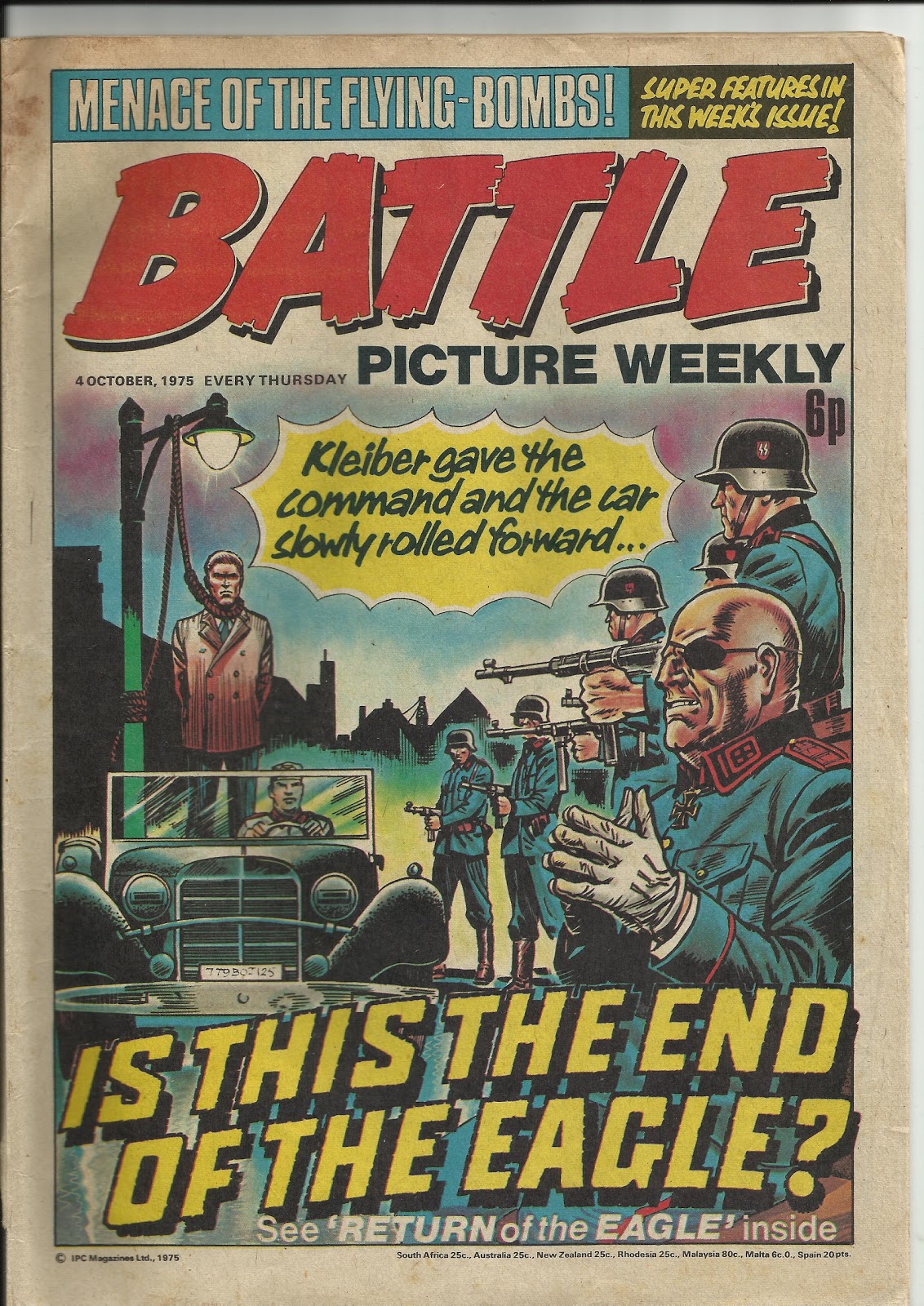
In 1975 a new comic was launched by IPC that would forever change the face of British comics - created by Pat Mills and John Wagner, Battle Picture Weekly was launched in order to compete with rival publisher D C Thomson's successful Warlord which was racking up impressive weekly sales. Warlord, although tame by today's standards, was also far more gritty than was the norm for comic books, and IPC knew that they had to compete by bringing out an equally gritty comic.
Both Mills and Wagner were freelancers and both had been contracted by IPC to work in their girl's comic department. However Wagner soon quit comics after editing two failed titles, Sandie and Princess Tina - Sandie was cancelled after selling only 199,000 copies which may seem impressive figures all these years later but at the time most comics sold a quarter of a million copies a week.
When Mills was put in charge of developing a new comic to rival Warlord, he requested John Wagner be brought back into the fold and so in late 1974 the two men started work on what would become Battle Picture Weekly.
"The old school felt our stories were too violent," John Wagner said in an article for Judge Dredd Megenzine in 2003. "We certainly were in comparison to them but you can't be too violent. Part of it was a reaction to way comics had been up until then - too safe, sanitised. Characters never died, nothing ever changed, nothing progressed. It was so unreal and with Battle we wanted to kick some butt."
And Battle certainly was a breath of fresh air - where in the past stories had always been about upper class officer types, the comic broke with the norm and most of its lead characters were working class soldiers. It also produced in time two of the best ever British comic strips in Charley's War and Darkie's Mob.
The very first issue featured eight stories - D Day Dawson, Loft's One Man Luftwaffe, The Flight of The Golden Hind, Battle Honours (true life tales), Day of the Eagle (Battle's answer to Warlord's, Lord Peter Flint), The Bootneck Boy, Rat Pack (shameless rip off of The Dirty Dozen but great fun) and Terror Behind the Bamboo Curtain.
Battle was a huge success, though not in quite the way it had been expected. Day of the Eagle was intended to be the lead strip but being so heavily influenced by Warlord's Peter Flint, it seemed out of place in the comic. Where the rest of the strips were at least based in a gritty reality, Eagle was all James Bond style shenanigans. By far the most popular strips were D Day Dawson, Rat Pack and The Bootneck Boy.
Mills left Battle to concentrate on a new title which became the controversial Action and Wagner became script editor on the girl's comic line. Dave Hunt was now in charge of Battle.
Issue 37 introduced three new serials - Merril's Marauders featured an American troop fighting in Asia, Y fOR Yellow Squadron told of a misfit band of RAF pilots as they were licked into a tight fighting unit and Destroyer which was a Navy strip. None of these would last the course though. And it wasn't until issue 45 that a character came along who was as popular as Battle's big three - Dawson, Bootneck Boy and Rat Pack.
This character was Major Easy - a James Coburn lookalike who kept ice cool in battle and drove a battered Bentley around the battlefield. And so popular was the new character that he soon booted D Day Dawson into second place in the readers polls. In British comics there was also a box for readers to list their top three stories and then send these into the editor. All of IPC's comics did this which allowed for an almost instant guide to what the readers liked.
In October of 1976 IPC found its title Valiant losing popularity and so it was merged into Battle and the comic now became known as, Battle Picture Weekly and Valiant. The comic continued until 1977 when Action was merged into the title and the word Valiant dropped.
During the time if a title failed then it was common practise for the dying title to be merged into a more successful title, with only the most popular strips being carried over. And so Battle now became Battle Action and the title truly entered a golden period.
In my opinion Battle Action was the best British comic ever produced - I think it topped 2000AD on quality and that the only reason 2000AD outlasted it is that 2000AD concentrates on the sci-fi genre which is more in favour with the core audience. However in terms of storytelling Battle Action could beat 2000AD hands down. Take Charley's War for instance which
Take Charley's War for instance which must hold valid claims for the title of best ever comic strip story. Set during World War 1 and with a dirt poor, not very smart, working class boy as its central character, the story was an anti war parable as epic as any great novel. And there were also other strips which represented the best storytelling ever produced for the comic book format - Johnny Red, The Sarge and Hellman of Hammer Force to name but three.
The name Battle Action would remain until 1982 when the title reverted to plain old, Battle.
However in 1983 the title became Battle Action Force and started to include stories using the Action Force toy range as characters. It was here that the slid began and the gritty Battle of old was all but gone.
The title did survive until 1987 when it became Battle Storm Force and then in 1988 Battle itself was merged into the revamped Eagle becoming Eagle with Battle.
It was the end of an era.
comic's history - click on any for a large readable version.
Both Mills and Wagner were freelancers and both had been contracted by IPC to work in their girl's comic department. However Wagner soon quit comics after editing two failed titles, Sandie and Princess Tina - Sandie was cancelled after selling only 199,000 copies which may seem impressive figures all these years later but at the time most comics sold a quarter of a million copies a week.
When Mills was put in charge of developing a new comic to rival Warlord, he requested John Wagner be brought back into the fold and so in late 1974 the two men started work on what would become Battle Picture Weekly.
"The old school felt our stories were too violent," John Wagner said in an article for Judge Dredd Megenzine in 2003. "We certainly were in comparison to them but you can't be too violent. Part of it was a reaction to way comics had been up until then - too safe, sanitised. Characters never died, nothing ever changed, nothing progressed. It was so unreal and with Battle we wanted to kick some butt."
And Battle certainly was a breath of fresh air - where in the past stories had always been about upper class officer types, the comic broke with the norm and most of its lead characters were working class soldiers. It also produced in time two of the best ever British comic strips in Charley's War and Darkie's Mob.
The very first issue featured eight stories - D Day Dawson, Loft's One Man Luftwaffe, The Flight of The Golden Hind, Battle Honours (true life tales), Day of the Eagle (Battle's answer to Warlord's, Lord Peter Flint), The Bootneck Boy, Rat Pack (shameless rip off of The Dirty Dozen but great fun) and Terror Behind the Bamboo Curtain.
Battle was a huge success, though not in quite the way it had been expected. Day of the Eagle was intended to be the lead strip but being so heavily influenced by Warlord's Peter Flint, it seemed out of place in the comic. Where the rest of the strips were at least based in a gritty reality, Eagle was all James Bond style shenanigans. By far the most popular strips were D Day Dawson, Rat Pack and The Bootneck Boy.
Mills left Battle to concentrate on a new title which became the controversial Action and Wagner became script editor on the girl's comic line. Dave Hunt was now in charge of Battle.
Issue 37 introduced three new serials - Merril's Marauders featured an American troop fighting in Asia, Y fOR Yellow Squadron told of a misfit band of RAF pilots as they were licked into a tight fighting unit and Destroyer which was a Navy strip. None of these would last the course though. And it wasn't until issue 45 that a character came along who was as popular as Battle's big three - Dawson, Bootneck Boy and Rat Pack.
This character was Major Easy - a James Coburn lookalike who kept ice cool in battle and drove a battered Bentley around the battlefield. And so popular was the new character that he soon booted D Day Dawson into second place in the readers polls. In British comics there was also a box for readers to list their top three stories and then send these into the editor. All of IPC's comics did this which allowed for an almost instant guide to what the readers liked.
In October of 1976 IPC found its title Valiant losing popularity and so it was merged into Battle and the comic now became known as, Battle Picture Weekly and Valiant. The comic continued until 1977 when Action was merged into the title and the word Valiant dropped.
During the time if a title failed then it was common practise for the dying title to be merged into a more successful title, with only the most popular strips being carried over. And so Battle now became Battle Action and the title truly entered a golden period.
In my opinion Battle Action was the best British comic ever produced - I think it topped 2000AD on quality and that the only reason 2000AD outlasted it is that 2000AD concentrates on the sci-fi genre which is more in favour with the core audience. However in terms of storytelling Battle Action could beat 2000AD hands down. Take Charley's War for instance which
Take Charley's War for instance which must hold valid claims for the title of best ever comic strip story. Set during World War 1 and with a dirt poor, not very smart, working class boy as its central character, the story was an anti war parable as epic as any great novel. And there were also other strips which represented the best storytelling ever produced for the comic book format - Johnny Red, The Sarge and Hellman of Hammer Force to name but three.
The name Battle Action would remain until 1982 when the title reverted to plain old, Battle.
However in 1983 the title became Battle Action Force and started to include stories using the Action Force toy range as characters. It was here that the slid began and the gritty Battle of old was all but gone.
The title did survive until 1987 when it became Battle Storm Force and then in 1988 Battle itself was merged into the revamped Eagle becoming Eagle with Battle.
It was the end of an era.
comic's history - click on any for a large readable version.
Subscribe to:
Posts (Atom)
Let's be careful out there......
The recipient of 26 Emmy awards, actually nominated 29 times and between 1981 and 1984 it had four consecutive wins of Best TV Series. It...
-
Fame is indeed a fickle thing, and I've been reminded of that by the death of Gerald Harper on the 2nd July this year...I didn't e...
-
The western can be many things - any kind of story can be told within a western setting and the genre can be relevant to this tarnished mode...
-
The Tainted Archive is a place of highbrow reading, and so when paparazzi photographers recently caught a snap of Catwoman herself, Ann...