Showing posts with label keep em laughing. Show all posts

Friday, 26 August 2011

Keep Em' Laughing - Splatstick time

What is a goremody? Well certain horror films – Abbot and Costello meet Frankenstein, Evil Dead 2, Scream, Braindead and scores of others use humour as much as gore in their movies – thus they are goremodies, splatstick movies.
But there is some debate with horror fans over the place for comedy in horror. The screenwriter of the Fright Night remake recently listed her favourite horror comedies with Shaun of the Dead taking the top spot and Quentin Tarantino went on record to state that the mixture of humour and horror in John Landis’ American Werewolf in London inspired him to mix genres in his own movies.
Horror fans seem to like a few laughs with their chills, but there are those that insist humour has no place in a true horror movie. That’s what makes the Exorcist such a relentless experience – there is absolutely no light relief in the entire movie. And today the original Evil Dead, the most serious of the franchise,  outsells its sequels year on year and has done for the best part of a decade. So is humour an important part of the genre or does it detract from the effect of the horror?

“I think the really hardcore horror fans only want Evil Dead 1. As I’ve come across more and more horror fans, that seems to be a consensus. They want the horror, the want the unrelenting grueling horror, and they don’t want the filmmaker to tell them when to laugh. If something’s too gruesome, they want to decide to laugh on their own. They don’t need a joke there.” Rob Tabert, producer of the Evil Dead films.

Personally I like my horror films to be peppered with humour – nothing too silly, mind. I mean I’m no fan of out and out horror comedies, but a little black humour often helps. Take the Exorcist for instance – the film, although acknowledged as a classic, is too brutal and uncompromising for my tastes. It’s not something I would choose for repeat viewing. The horror movies I watch more than most are the Universal classics and these films for the most part were strictly serious, with the odd dash of gallows humour. But I do agree that the best horror movies use humour sparingly and are all the more effective for it – take the original Nightmare on Elm Street which does contain some light relief but for the most part is nail-biting tension. None of the sequels or remakes have ever touched upon the brilliance of the first. It’s the same with the Halloween franchise. And many more I could mention – in fact if I tried to list them all, this post would go on and on and on and….

Horror and comedy are certainly linked – this is why the image of a circus clown, the ultimate comedian, can appear terrifying. Stephen King realised this and the creation of Pennywise from IT represents pure distilled terror. Killer Klowns from Outer Space, tough may have diluted this somewhat.
However it remains an interesting question – do horror movies need humour? I suppose it depends on the film and when done well, the humour does not detract from the horror but instead enhances it. Think American Werewolf in London, or From Dusk to Dawn – both movies benefit greatly from the black humour. And then there’s that scene in The Shining (The Kubrick original, of course) in which Mad Jack is busting through the door with an axe, his terrified family cowering on the other side of the door – “Heeerrrreee’s Johhhhnnny!”, he yells manically in what is a terrific scene, made all the more chilling by the manic humour. Then again there are countless horror movies, sequels mostly, where the film’s  been ruined by outright comedy.
You pays your money, you take your choice.

Wednesday, 24 August 2011

Keep Em' Laughing - Dad's Army

The complete Dad's Army box set.

Well it's very nearly the entire collection - most of the second series are missing from the archives and only three episodes are included here, though the missing episodes do exist as audio and these recordings are included as special features. The show ran from 1968 - 1977, for 9 seasons with 80 episodes including a couple of Christmas specials And excluding the missing episodes I've watched them all since Christmas. It really does stand up as one of the best sit-coms ever made, perhaps the perfect sitcom.

Season 7 is a the only weak season - perhaps because of the death of James Beck (Walker) towards the end of season six. A new character is brought in, the dippy welsh photographer Private Cheeseman. The problem is that the character's lines sound like Walker lines and sometimes the character is just too silly. Even in the slapstick world of Walmington-on-Sea the Taffy stands out like a sore thumb. Interestingly the episode in season six that they were working on when James Beck died, should have been canned as the episode makes no sense. Beck had shot the location footage but not the studio work, which results in him suddenly popping up mid episode when he wasn't seen earlier.

Season eight was a return to form, the Welsh character having vanished, and once again the group dynamic is correct - though James Beck's absence is noticed. Still season eight contains some classic episodes as did the following season, the last, when the actors really were showing their ages. John Le Mesurier especially seems to have aged by season 9. Ironically Godfrey, both the oldest actor and character, doesn't seemed to have aged a day since the first episode.


And speaking of classic episodes - Keep Young and Beautiful always reduces me to tears of laughter. In this episode the older members of the troop use Fraiser's embalming fluid in order to hide their wrinkles. Menace from the Deep is another classic that showcases the Jones character, played wonderfully by Clive Dunn who, despite playing the aged butcher, was actually the third youngest member of the cast. The actor recently celebrated his 90th birthday which means he would have been in his forties when the show started. All in all there are too many classic episodes to bring attention to them all, but with the exception of the one poor season the show never missed.

The show was set during World War II and concentrated on the Home Guard (Originally called the local defence volunteers before the name was changed because the press claimed LDV stood for look, duck and vanish.) and although many real life men who had been members of the home guard initially objected to the show, it went onto become a national institution. The show was responsible for several catchphrases that entered the British lexicon - 'they don't like it up em', 'stupid boy', 'you're entering the realms of fantasy now', or the wonderfull , 'we're doomed.'


Originally intended to be called The Fighting Tigers, Dad’s Army was based partly on co-writer and creator Jimmy Perry’s real-life experiences in the Local Defence Volunteers (later known as the Home Guard). Perry had been 17 years old when he joined the 10th Hertfordshire Battalion and with a mother who did not like him being out at night and fearing he might catch cold, he bore more than a passing resemblance to the character of Frank Pike. An elderly lance corporal in the outfit often referred to fighting under Kitchener against the "Fuzzy Wuzzies" and proved to be a perfect model for Jones.

The success of the show is in the characters and the fact that the viewer loves them all - Mainwaring, always the most pompous, shows his human side in several episodes and comes across as a decent man living in strange times, Sgt Wilson, brilliantly laid back but with hidden depths, Jones, the bloodthirsty veteran with a love of the cold steel, Godfrey so polite that he'd apologise after shooting a Nazi, Walker, the wide boy with a heart of gold, Fraiser the wild eyed undertaker with a penchant for idle gossip and Pike, the stupid boy. All in all its an ensemble made in comedy heaven.
.

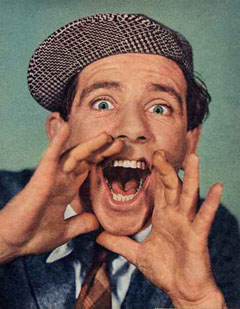
Keep Em' Laughing - Norman Wisdom


 It is for the series of British film comedies  made between 1953 and 1966 that Norman Wisdom is best remembered - so successful were these films that for a period in the Sixties, Wisdom's films made even more money than the James Bond movies. Unlike many British comedians Wisdom's enjoyed massive popularity in many Eastern Bloc countries - in Albania the actor was and remains huge.


Charlie Chaplin called Wisdom his favourite clown.

The character of Norman Pitkin who Wisdom played in most of his better films was the classic everyman character and his small stature and the way he faced off against big business and bureaucracy endeared him to the cinema going public. Wisdom was superb at physical slapstick and these skills were brought to the fore in his movies. Prat-falls abounded with Wisdom being hurled through windows or over walls. His films usually contained a romantic subplot, a lesson Wisdom learned from another British comedy great, George Formby.


The top five Wisdom movies.
Trouble in Store
The Early Bird
The Bulldog Breed
A Stitch in Time
On the Beat


The Wisdom films still hold the abitity to make the viewer scream with laughter - thay may often be silly and derivative of each other, but it doesn't matter. The routines are so well worked out and executed, the character so well observed that it's impossible not to be seduced by the little man in the flat cap.


When I was a kid, Wisdom's films would regularly show up on TV as afternoon matinees - that they were usually shown during school holidays was testament to how the character Wisdom created had crossed generations in his appeal. Now you can't ask for more than that.

Most of Wisdom's better films are available in a great box set collection from ITV Home Entertainment - the box set contains twelve movies and retails at a decent price of £20, even less at online store like Amazon.

Keep Em' Laughing - What about health and safety?


Harold Lloyd's glasses character was the proto-type lovable geek, the boy next door, an everyman with romance in his heart but not too much in his head. Though that's not strictly accurate - the glasses man was far from stupid but he sure enough found himself involved in some dumb situations.

Safety Last is a silent movie that still thrills to this day and it is difficult to think of a big budget modern movie that manages to thrill, scare and delight quite so effectively as Safety Last. The final 20 minutes will literally have the viewer's heart in their mouth as our hero, forced to scale a skyscraper, performs one of the most memorable series of stunts and gags in motion picture history. The climb up the building is pure cinema - with an inventive series of obstacles getting in the way of the intrepid glasses man.

With a climax so intense, so powerful the rest of the film is somewhat overshadowed but there's much to enjoy in the first part of the film where there are many fine quiet moments and scenes of inspired comedy. The problem is that store clerk, Lloyd has told his beloved that he is the managing director of an impressive department store. There are some great visual gag scenes such as Harold using the reflection in a bald man's head to comb his hair and a fair few frantic chases. One of the best is when Harold fearing he will be late for work hijacks a number of vehicles in a frantic dash across town. At one point he even feigns a heart attack to get a ride in an ambulance that is going his way. When he reaches the store he has to sneak in and by disguising himself as a mannequin he manages to get carried in. Though he sneezes and sparks off another hilarious scene as the guy carrying him is terrified out of his mind.

Don't think of this as a silent movie but think of it as pure cinema. It really is sheer brilliance and the current DVD release, the Optimum box set, contains a print of the film which has been remastered to a very high standard - the black and white picture is without blemish and the new musical store is very sympathetic to the images on screen. The romantic ending even managed to get to an old cynic like me.

Excellent.

TRIVIA: Harold Lloyd out-grossed both Charlie Chaplin and Buster Keaton during the 1920's.

Lloyd actually filmed the daredevil climb first with no clear idea of how they would get to that point. Like Chaplin he was working without a script and hoping inspiration would come. Thankfully it did.

Keep Em' Laughing - Comedy Gold

Charlie Chaplin was a genius - there can be no doubting that. He created the little tramp character and whilst on the surface it may seem nothing more than an oversized pair of trousers, Hitler's facial hair and a funny walk, but there was a certain undefinable magic in the character and movie fans took him so deeply into their hearts, that Chaplin became the most famous movie star in the world, and even today he has hordes of fans - in 1999 the American Film Institute placed him at number 10 in a list of the greatest screen legends of all time - in front of Gary Cooper and just behind Spencer Tracy.

The Little  Tramp debuted during the silent film era in the Keystone comedy Kid Auto Races at Venice (released on 7 February 1914 and embedded below). However, Chaplin had devised the tramp costume for a film produced a few days earlier but released later (9 February 1914), Mabel's Strange Predicament. Mack Sennett had requested that Chaplin "get into a comedy make-up".


"I had no idea what makeup to put on. I did not like my get-up as the press reporter [in Making a Living]. However on the way to the wardrobe I thought I would dress in baggy pants, big shoes, a cane and a derby hat. I wanted everything to be a contradiction: the pants baggy, the coat tight, the hat small and the shoes large. I was undecided whether to look old or young, but remembering Sennett had expected me to be a much older man, I added a small moustache, which I reasoned, would add age without hiding my expression. I had no idea of the character. But the moment I was dressed, the clothes and the makeup made me feel the person he was. I began to know him, and by the time I walked on stage he was fully born."    Charlie Chaplin on the creation of the Little Tramp


There is something special about Chaplin's comedy that still resonates today - in terms of physical comedy he was superb thanks to skills learned in the Music Halls of London where he would often be planted in the audience, as a drunk theatre goer, and proceed to throw himself around, falling over chairs, or from the balcony before taking his place on the stage. Though there was much more than slapstick and Chaplin often used pathos in his comedy and several of his longer works contain social commentary. Politically he leaned to the Left and this was often obvious in his movies, and  his beliefs got him into trouble with the American Government during the McCarthy era.

Although Chaplin had his major successes in the United States and was a resident from 1914 to 1953, he always maintained a neutral nationalistic stance. During the era of McCarthyism, Chaplin was accused of "un-American activities" as a suspected communist and J. Edgar Hoover, who had instructed the FBI to keep extensive secret files on him, tried to end his United States residency. In 1952, Chaplin left the US for what was intended as a brief trip home to the United Kingdom for the London premiere of Limelight. Hoover learned of the trip and negotiated with the Immigration and Naturalization Service to revoke Chaplin's re-entry permit, exiling Chaplin so he could not return.


Me playing at Charlie
"Since the end of the last world war, I have been the object of lies and propaganda by powerful reactionary groups who, by their influence and by the aid of America's yellow press, have created an unhealthy atmosphere in which liberal-minded individuals can be singled out and persecuted. Under these conditions I find it virtually impossible to continue my motion-picture work, and I have therefore given up my residence in the United States." Charlie Chaplin.


It was not until 1972 that Chaplin did return to the US in order to collect an honorary Oscar.


Chaplin died in his sleep in  Switzerland on Christmas Day 1977.


BELOW IS THE COMPLETE SHORT IN WHICH THE LITTLE TRAMP FIRST APPEARED:


Monday, 22 August 2011

Keep Em' Laughing - Laurel and Hardy

Laurel and Hardy's made 106 films as a double act and out of their entire output it is the work they did for the Hal Roach studios that is their best remembered and most highly regarded. In their crumpled suits, bowler hats they are without a doubt the most recognisable comedy team in the history of screen comedy. They appeal across generations and are still popular today. Their particular blend of slapstick is truly timeless and hilariously funny.

The films they made for Hal Roach are available on DVD, both as separately and as a 21 disc box set. All of the classics are here - Sons of the Desert, Way out West, The Music Box, A Chump at Oxford, Brats to name but a few - most are available on the discs in two versions, one being the original and the other having undergone the colourisation process. The discs also contain a large amount of lesser known silents and shorts.

There is a full list of the entire contents of the DVD series HERE

 "Mr. Hardy told Mr. Laurel to meet him at the Southern Pacific Station Wednesday morning - So Mr. Laurel went to the Santa Fe on Thursday afternoon - "

Stan Laurel was the creative powerhouse behind the successful duo, but to dismiss Ollie as a mere stooge is to do the team a great disservice. Stan may have slaved away pefecting their routines, while Ollie prefered to spend time between takes on the golf course, but when they came together a magic happened and neither of them were as good seperately.

.


Sunday, 21 August 2011

Keep em' Laughing - Dai Bando

THE LATE DAI BANDO
Seems to me that a blog is a place to write about one's passions and the Archive has always been eclectic in the subjects covered and so the coming week will see Comedy being a major theme, as I'm finding myself in the mood to write about the comedy that has touched me over the years.

I've done a bit of stand up comedy myself and until a few years ago I was regularly gigging, but the type of venues I played have been disappearing for some time now and comedy has suffered more than most from the bland march of political correctness - or at least the type of comedy I performed has. I used to perform under the name Dai Bando and my routine was a mixture of gags, many of them blue as well as observationial stuff. The latter I used to love writing and feel that I developed skills that have since served me well as a novelist.

I used to use a lot of material that relied on racial stereotypes, but there was nothing hateful in the routine, instead humour was used to explore race and, I hope, demonstrate that we're all the same beneath the skin. Nothing was intended to hurt and I'm of the opinion that racial jokes are fine as long as it's good natured. British Comedy has a long tradition of humour defined by race as well as gender with the kitchen sink thrown in for good measure. I suppose Dai Bando was a mixture of Bill Hicks, Tony Hancock, Woody Allen and Tommy Trinder.

"There was a Welshman, and Englishman and a Irishman..."

"My mother-in-law's so fat then when you take her knickers down her arse is still in them."

Stand up comedy is a difficult art to learn and often dangerous to perform, as I know only too well. I still remember performing several years ago in Tonypandy. when a heckler didn't like my come backs to his insults - he promptly jumped up on stage and with one well aimed fist, knocked me out cold. To add insult to injury the biggest laugh I got that night was when the bruiser knocked me out - the audience apparently thought it was part of the show and found it the funniest thing ever. Comedians getting their noses broken always goes down well in the Rhondda Valleys.


And so it wasn't too long after that event that Dai Bando left the rat race of live comedy  - my props (an inflatable sheep, a funny hat and a microphone shaped like a penis) were packed away and Dai Bando walked off into the comedy sunset.

Will he ever return?

Well, every now and then I feel an itch that need to be scratched as the urge to take to the stage  makes itself felt. Thus far I've not given into it and Dai Bando remains in retirementnever say never.

Next: Laurel and Hardy


Let's be careful out there......

  The recipient of 26 Emmy awards, actually nominated 29 times and between 1981 and 1984 it had four consecutive wins of Best TV Series. It...