Thursday, 30 January 2014

The Long Saturday NIght by Charles Williams

I only picked up this paperback because of the publisher's logo - Gold Medal are famed for publishing hard boiled crime originals and most of the old paperbacks are highly sought after. I knew little about the author - Charles Williams seems to be one of those writers forgotten by all but a select few, and I was surprised to find when I Googled him that I had experienced his work before, or at least seen a film based on a book of his. 1989's  Dead Calm was actually based on a novel the author published in 1963. There have been other films based on the author's work but I'm not at all familiar with them.

Onto the Long Saturday Night - it's a fast moving crime novel in which a man. John Warren, is one the run because he is the prime suspect in the murder of both his wife and her lover. The novel is told in the first person with Warren being the narrator and it just zings along with each chapter serving up another clue among a catch of red herrings. In the end Warren teams up with his secretary and together they figure out who the real killer is but there is no way of proving it. That is until they come up with a plan that will involve Warren giving himself up to the police.


It all comes good in the end and there's even a happy ending - ah bless! The best thing about the book is the sheer readability - it grabs the reader from the first few pages and doesn't relax its hold until the very end.

I understand it Hard Case Crime brought one of the authors books back into print - Hard Case published A Touch of Death in 2006 - let's hope more come back into print since if the others are anywhere as good as The Long Saturday Night then these books are ripe for rediscovery.


UPDATE - Several people commented on this post and one comment in particular led me down a dark alley. And anyone wanting to learn more about Williams and other pulp writers may want to follow me. You see at the end of this dark alley shines an oasis of light known as the Amazon homepage (Yes I know big bad Amazon who are putting everyone else out of business. But love them or loathe them they seem to have everything and anything.) and from here you can check out a book titled - Paperback Confidential which was written by Brian Ritt.

I've not seen this book yet but it certainly looks interesting and I'm going to head up the Amazon and order immediately.


These are the authors who turned out the dark noirs and hardboiled thrillers, private detective puzzles and psychological suspense, police procedurals and backwood melodramas, stories of passion... and cold-blooded murder. 132 profiles of the men and women who wrote the books that became the backbone of the Pulp and Paperback Era from the 1930s through the 1960s. Here you will find information on the acknowledged masters like Dashiell Hammett, Raymond Chandler, James M. Cain and Cornell Woolrich... the rack mainstays like Gil Brewer, Brett Halliday, Day Keene, and Charles Williams... and the unjustly forgotten like Malcolm Braly, Elisabeth Sanxay Holding, Ennis Willie and Douglas Sanderson. Each profile contains details about the author's life and explores key works, with special attention paid to series characters. Also covered are screenplay and teleplay work, as well as movies based on the authors' stories. Paperback Confidential also includes a handy PseudoDex with all the various names these authors wrote under, and a section for each author with further recommendations for the reader s consideration.

Sherlockathon - A Study in Pink

The BBC's Sherlock was originally commissioned as a series of six sixty minute episodes, and indeed this opening story was actually filmed as a sixty minute pilot but when the powers that be saw the pilot they were delighted and suggested a series of three ninety minute TV movies. This was to be a prestige series and the BBC were throwing their weight behind it.

Writers and creators Steven Moffat and Mark Gatiss were delighted with the change in format. They knew the relationship between Holmes and Watson was as important as the mystery itself, and this larger canvas would allow them to explore both without having to neglect either aspect.

The original sixty minute pilot is included on the season one box set and watching it alongside the broadcast TV movie is becomes apparent that this was the right decision to make the series as a collection of ninty minute TV movies. It gave the writers more space to concentrate on characters and this version is as concerned with character as it is with the mystery aspect. Indeed in later episodes the mystery would often be pushed into the background, while the story concentrated on the character relationships.

This was to be an undated Sherlock Holmes for the 21st century, but the writers were concerned to keep the feel of the original Doyle stories. When I first heard of this series I wasn't expecting much, I don't think anyone was, and the one thing that troubled me more than anything else was the lack of a pipe - the modern
day setting didn't bother me at all (after all most of the Rathbone movies, which I love, were actually set in the modern day), nor did the fact that this Holmes would use computers and smart phones, but the one thing that I felt was sacrilege was that Holmes would no longer smoke a pipe.

How the hell can you do Holmes without his beloved pipe? After all the silhouette (Holmes and pipe) is one of the most recognizable images in all pop culture. That pipe is iconic! Holmes without a pipe - why that's like Superman without his cape, Starskey without Hutch or Batman with Ben Affleck.

I don't even think doing away with the pipe was an artistic decision but rather came from the wave of political correctness which is still blighting our lives. Smoking was very much frowned upon by the time Sherlock was filmed, and this seemed like yet another attempt to sanitize classic literature.

I guess you could say that I was determined to hate this new Sherlock series - however as soon as the episode started and I saw the chemistry between Watson and Holmes I was won over. Out first scene of this new manic Holmes saw him beating a corpse with a riding whip in order to determine the extent of bruising after death (a scene that was actually referenced in the original canon) and Cumberbatch is immediately Sherlock Holmes. The writers explained away the lack of a pipe in a great scene in which Holmes is wearing three nicotine patches.

'It's a three patch problem,' he tells Watson which again comes from the original canon because when Holmes was involved in a particularly baffling case he would often chain smoke pipes, calling the case a, 'three pipe problem.' That scene brought a smile to my face.

After that the pipe didn't seem to bother me that much...mind you I would still love to see Holmes puffing on the briar.

Much is made of the bromance between Holmes and Watson, but this is handled with great humour and skill.  A Study in Pink uses the fact that people confuse Holmes and Watson for a couple to great effect. This aspect of the story is pitched just right and provides several great comedic scenes.


Overall A Study in Pink was an excellent first episode - quite brilliant in fact and I've no doubt that for many people the pairing of Martin Freemen and Benedict Cumberbatch as Holmes and Watson will become definitive. It's odd but these modern day Holmes feel more like Doyle than the Guy Ritchie/Downey Jnr Holmes movies which were set in the correct Victorian timeline. And whilst the series is not as authentic as say the excellent Jeremy Brett series, it is very much a Holmes for our time.

The final scene in which our demented genius killer of the week tells Holmes that the man behind it all was
The bloke next door - Lestrade
Moriarty is incredibly effective if you know the Holmes canon - it's strange but Moriarty was only used in two of the original Holmes stories but due to subsequent works the character's become a much bigger presence in the Holmes universe than he originally was.  I would also like to give a shout out to Rupert Graves who gives us a wonderfully downbeat portrayal of Inspector Lestrade. This blokey version of the policeman really sparks alongside our modern Sherlock Holmes.

It's no wonder the series has become such a huge hit for the BBC - right from the first story the characters are immediately recognizable and the relationships whilst modernized are pure Conan Doyle.


Monday, 27 January 2014

The Long Walk - Richard Bachman AKA Stephen King

This is an older Stephen King story, actually written before Carrie (1974) but unpublished until 1979 when King had become a hot property. Though the novel was not originally published under the King name and instead became one of the books the author published as by Richard Bachman.

And at the time of publication it was a secret that King was Bachman - In fact King went to great pains to hide the fact that he was the author and a false bio was invented for Bachman. King's agent, Kirby
Bachman author photograph - actually Richard Manuel,
McCualey even hired a friend of his to be photographed, posing as Richard Bachman,  for the book jacket. There were several reasons for the invention of Bachman but the main one was that King's publisher's were reluctant to publish more than one book a year by their current hot property and risk flooding the market. And King himself wanted to see if the books could sell without the Stephen King name, especially as it seemed that the market would buy anything with Stephen King's name attached. As it turned out the Bachman novels sold reasonably well but hardly troubled the bestseller lists. However when it was revealed that Bachman was actually King all of the Bachman novels became huge bestsellers.

I'd read a lot about The Long Walk but had never read it until now. King claims it was the first novel he ever wrote and there are many people who claim that it is actually King's best ever work, and whilst I'm not so sure about this, it is a damn fine book. I was led to believe that the book was set in the near future but that is not the case, and it is actually set in an alternative 1970's America - there are several clues that point to this being an alternative version of the USA, most obvious is the fact that in this America the East Coast was air bombed by the Germans during the Second World War. In fact even the blurb on the original paperback cover claimed the story took place in a future America, but the book is set in present day (the 1970's) only with a twist.

The plot is quite simple - in a dystopian society there is very little hope if you are born on the wrong side of the tracks, very little chance of you improving your lot. The only way seems to be The Long Walk, an annual event in which 100 people line up for a walk - each walker must maintain a minimum speed of four miles per hour. If a walker drops below that speed he gets a warning and another follows after thirty seconds. Three warnings and the walker is shot, usually through the head, - this is called buying a ticket. The walk goes on and on and on until only one walker is left standing. The Walk begins at the Main/Canada border and continues across America's East Coast, mile after blistering mile, until only one person is left alive. The prize for the winner is anything they desire for the rest of their lives.


A slim premise and I can't think of many writers who could spin off an entire novel from such a premise but King does it and he does it incredibly well - as soon as I started reading I became so involved in the story that I didn't want to to close the covers for it's three hundred odd pages. I just had to get to the end and find out what happens.

It's a brutal story - imagine walking and having to keep on walking while your feet blister and then bleed. You are unable to stop because behind you there are several nameless soldiers riding on a slow moving vehicle ready to give you your ticket as soon as you falter.

The hero is a character called Ray Garraty and during the walk he strikes up friendships with several other walkers, only to lose his new friends one by one as they give in to blisters, torn muscles or insanity. Some walkers become so tired, so exhausted that they even welcome the bullet that will put them out of their misery.

The narrative zings along and although it does start to drag somewhat as it nears the climax it never fails to hold the reader's attention. It's no wonder that Stephen King is such a big name when he writes as brilliantly as he does here. 

An absolutely brilliant book. If you've not read this book then you really need to take the Long Walk.

Excellent.


Tainted Stats

Weekly Stats Report: 20 Jan - 26 Jan 2014 
Project: THE TAINTED ARCHIVE
URLhttp://tainted-archive.blogspot.com/

Summary

 MonTuesWedThurFriSatSunTotalAvg
Pageloads1841612071801701561711,229176
Unique Visits1661341691541441231471,037148
First Time Visits154120135142136118142947135
Returning Visits121434128559013

Tuesday, 21 January 2014

Keeping the Edge

Now available as eBook
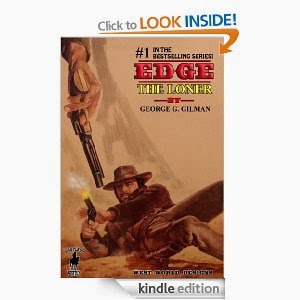
No one could reasonably deny that Leone’s best work was not as defining and important to the western genre, as the best of John Ford or Anthony Mann. Leone’s westerns were spawned from imitation and yet became vastly imitated themselves.Inhabiting the West of the American movies Leone gave the genre a much needed kick, created a heightened reality, both surreal and stylized. He gave the stock gunslingers and cliched bounty hunters a coolness that appealed to the counter culture. Much the same argument can be used with the Edge novels of George G. Gilman – they too were born out of imitation, influenced by the films of Leone and other European directors who were themselves indebted to the Americans. And they too were widely imitated and like Leone they too redefined the western. For where Leone started out as an imitator he ended up creating a sub-genre of his own, as did George G. Gilman. It was the tremendous success of the Edge series that kicked off the boom in Adult western novels.

They are without doubt the most important of the British westerns – true J T Edson was more prolific but, although highly readable, he took his influences first hand from the great American westerns, while Edge drew from a well polluted by the excesses of Leone, Corbucci and others. This resulted in Edge proving popular with a younger, more hip readership than was usual for the western genre.

A man without fear
A man without remorse
A man who survives because he has … the Edge
Edge comes to eBook


#1: The Loner
#2: Ten Grand
aka Ten Thousand Dollar American
#3: Apache Death
#4: Killer’s Breed
#5: Blood on Silver
#6: The Blue, the Grey and the Red
aka Red River
#7: California Killing
#8: Hell’s 7
aka Seven Out of Hell
#9: Bloody Summer
#10: Vengeance Is Black
#11: Sioux Uprising
#12: Death’s Bounty
aka Biggest Bounty
#13: A Town Called Hate
aka The Hated
#14: Big Gold
aka Tiger’s Gold
#15: Blood Run
aka Paradise Loses
#16: The Final Shot
#17: Vengeance Valley
#18: Ten Tombstones to Texas
#19: Ashes and Dust
#20: Sullivan’s Law
#21: Rhapsody in Red
#22: Slaughter Road
#23: Echoes of War
#24: The Day Democracy Died
aka Slaughterday
#25: Violence Trail
#26: Savage Dawn
#27: Death Drive
#28: Eve of Evil
#29: The Living, the Dying and the Dead
#30: Waiting for a Train
aka Towering Nightmare
#31: The Guilty Ones
#32: The Frightened Gun
#33: Red Fury
#34: A Ride in the Sun
#35: Death Deal
#36: Town on Trial
#37: Vengeance at Ventura
#38: Massacre Mission
#39: The Prisoners
#40: Montana Melodrama
#41: The Killing Claim
#42: Bloody Sunrise
#43: Arapaho Revenge
#44: The Blind Side
#45: House On the Ranged
#46. The Godforsaken
#47: The Moving Cage
#48: School for Slaughter
#49: Revenge Ride
#50: Shadow of the Gallows
#51: A Time for Killing
#52: Brutal Border
#53: Hitting Paydirt
#54: Backshot
#55: Uneasy Riders
#56: Doomtown
#57: Dying is for Ever
#58: The Desperadoes
#59: Terror Town
#60: The Breed Woman
#61: The Rifle
For more than twenty years the Edge books dominated the western scene, equally successful in the UK and US and in fact translated into ten different languages. Many of the Edge titles are available in eBook

Herne the Hunter book 1 - John J. McLaglen

Original Corgi Paperback (1976)
Back in the day I  read several of the titles in the Herne series but I don't think I'd read this, the series opener before. Back then I read a lot of westerns, though most of the series I followed were published by NEL ((New English Library) and I tended to pick up westerns from this publisher, namely because they published the excellent Edge series by George G. Gilman and I figured, as a young western reader, that I would get more of the same if I stuck to the same publishing house. It was very rare that I picked up anything by a different publisher since in those bygone days NEL were publishing enough westerns to keep me occupied - hey, when this came out I was only eleven years old and at eleven there is a limited amount of time you can spare for reading, not when there are so many other activities that require your time - marbles, conkers and imagining what Lynda Carter would look like in the nude.

Herne was only one of a number of violent adult western series on the market and many of these books are coming back in eBook thanks to publishing houses like Piccadilly Publishing. I've long championed eBooks here on this blog, and have long said that there is a new market for this type of fiction, and I'm pleased that publishers like Piccadilly are proving this - find them HERE.


New eBook edition
Herne The Hunter: White Death is quite simply a revenge western that sets out the origin of the character that will take us through a series of books. At the start of this book he is happily settled down, having long given up the wild times when he was known as Herne the Hunter. However his contented life is not to last when one night his wife is brutally raped and beaten by a bunch of drunken men. The men have also raped the wife of his neighbour Bill Yates and left her dead.

Herne counts his blessings, at least his wife wasn't killed but she is unable to live with the fact that she was raped by several men, and one morning after putting on the new green dress Herne bought for her she hangs herself. This results in Herne and Yates going off on the vengeance trail.

The scene in which Herne's wife hangs herself is an important one and much is made of the green dress she wears - the scene is depicted on both the original cover and the stunning new eBook artwork, though for some strange reason the dress is the wrong colour on the eBook cover. Nitpicking I know but it's an oddity given that it is such a key scene.

The story though is excellent and moves at a fast pace - it's very violent but that's to be expected since the books are in the style of the Italian Westerns which were so popular back in the day. There are some great western in-jokes - Nathan Brittles (John Wayne's character from She Wore a Yellow Ribbon) is referenced as is Terry Harknett (the author of the Edge westerns). And at one point Herne books himself on the next train to Yuma - it is leaving at 2:10 in the afternoon, but the train is delayed for an hour so Herne ends up on the 3:10 to Yuma.

Overall then an excellent read - yeah there are some scenes that stretch credibility to breaking point, but then this is a part of the genre. Highly recommended.

Let's be careful out there......

  The recipient of 26 Emmy awards, actually nominated 29 times and between 1981 and 1984 it had four consecutive wins of Best TV Series. It...